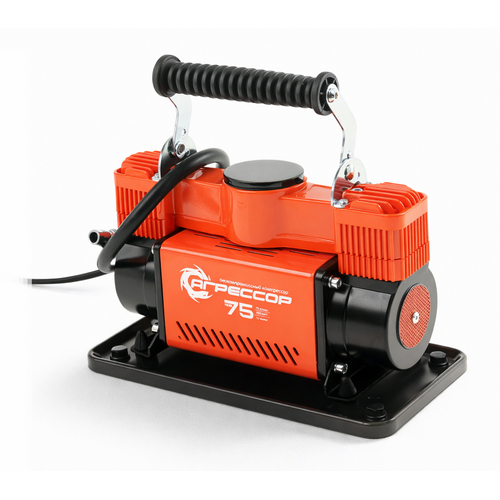
Autoprofi Agressor AGR-75L - Automotive Compressor Review
Some items remain silent in the boot for months, then become more important than much of the vehicle's other equipment on an unfortunate evening. An automotive compressor is one of them. While a tyre holds pressure, it is rarely considered. If pressure falls on a motorway, outside a garage in winter, or after driving unpaved roads, a dependable appliance is preferable to an underpowered pump struggling to work.
The Autoprofi Agressor AGR-75L aims to fill that role. This twin-piston 12-volt compressor specifies 75 L/min and addresses more than small city-car tyres: crossovers, off-road vehicles, minivans, light commercial transport, boats, and other inflatable items used at country properties. It is versatile in concept but has distinct operating characteristics. It is clearly designed for the boot and more demanding tasks rather than a glove compartment.
Design and the Reason for Its Inflation Performance
The compressor class follows a simple trade-off. Smaller, weaker models are easier to store but struggle with large tyres. They suffice for occasional small-car top-ups. Crossovers, off-road vehicles, or vehicles requiring deliberate deflation and reinflation benefit from additional capacity. Twin-piston models provide it: larger and more current-hungry, but substantially more capable.
The AGR-75L follows this arrangement. It has two cylinders, 12 V supply, battery-terminal-only connection, 300 W consumption, and current up to 30 A. A cigarette lighter connection is clearly inappropriate. Air delivery is strong, but current demand is substantial. Features include an all-metal pump assembly, Teflon piston seal, analogue gauge, built-in fuse, and overheat protection. The air hose is 8 metres long, while the power cable is shorter at 2.4 metres.
The accessory package is generous. Besides the hose and gauge, adapters serve balls, bicycles, other inflatables, and boats. A small top compartment stores valve caps, needles, and a spare fuse instead of leaving them loose in the boot. Everything fits in the bag, although packing the hose afterwards can be frustrating: sufficient space exists, but neat arrangement is not always easy.
.Principal Strength
The model's purpose becomes clear quickly: speed matters more than elegance. When pressure must be restored within a reasonable time, the AGR-75L feels considerably more capable than most simple single-piston compressors. It generally suits sixteen-, seventeen-, and eighteen-inch tyres, particularly for ordinary vehicle tasks rather than restoring heavy commercial tyres: topping up a low tyre, reinflating after off-road use, or preparing crossover tyres for travel.
The long hose is a major advantage. The compressor can remain near the bonnet or beside the car while the operator moves around it without relocating the housing between wheels. Its supports provide secure positioning with little vibration-driven movement across asphalt. It does not tend to migrate beneath a bumper and feels like a tool rather than a toy. This practical competence is valuable.
Versatility is another benefit. It is not limited to tyres: boats, mattresses, and balls are also possible. For country properties, fishing trips, or travel with children, an item purchased for one task can become useful everywhere. Tyres today, a boat tomorrow, and an inflatable snow tube afterwards gradually broaden its role.
Real-World Performance
The AGR-75L is particularly useful when the vehicle is larger than a typical saloon with narrow tyres. It suits crossovers and off-road vehicles. Passenger car owners receive a substantial margin; larger vehicle owners obtain an appropriate working format. Pressure rises quickly at low and medium levels, avoiding prolonged top-ups after seasonal pressure loss or poor-road travel.
The gauge has a useful pressure release button. A tyre can be slightly overinflated and excess air carefully released at the wheel without repeatedly disconnecting the hose. The principle is convenient, but readings are more accurate after stopping the compressor. During inflation, the needle may read high, requiring familiarity.
Another frequently mentioned detail is switch location. It is on the compressor, not beside the gauge or hose end. The compressor may stand by the bonnet while the operator is at a wheel, requiring movement back and forth as pressure approaches the target. Once is minor; four consecutive tyres make it noticeable. An otherwise powerful, considered device gains unnecessary handling inconvenience. It is not a major disaster, but quickly makes a remote button desirable.
The valve connector is another questionable detail. It is not particularly convenient and can be stiff to screw on. Occasional use is tolerable; regular tyre work encourages a more convenient quick connector. Some owners therefore modify the connector, switch, or remote activation arrangement.
The model is not quiet, nor should it be expected to be. A twin-piston compressor with this output is clearly audible. However, its sound is generally a steady working hum rather than a strained high-pitched whine. This is acceptable in a garage, courtyard, or roadside setting.
.Winter makes operation less convenient. The hose and cable lose flexibility in freezing conditions. They remain usable but require more care. Starting immediately after storage in a cold boot during severe frost is less pleasant. Handle this equipment carefully and without haste in winter.
Heating is substantial too. After intensive inflation, the powerful compressor's hose and housing can become noticeably hot. The specified 15-minute continuous limit should be taken seriously. This covers four ordinary vehicle tyres, but the AGR-75L should not become a small tyre workshop for an entire evening. It is a useful boot-stored assistant rather than industrial equipment.
Frustrations and Questions
Durability is the least favourable issue. The model has an uneven reputation. One owner obtains years of reliable work; another experiences gauge problems; another encounters fuse, valve, or motor assembly failure. It is not uniformly poor, but reliability variation is noticeable. This is the main obstacle to an unconditional recommendation of the AGR-75L for everyone.
A second criticism is that practical performance feels more modest than packaging figures imply. It inflates strongly and is noticeably faster than simple household models. However, large off-road tyres, high pressures, and prolonged continuous operation reveal finite power and cooling margins. Performance is straightforward up to a point, after which limitations become apparent.
Storage ergonomics are another minor issue. A bag, numerous attachments, and a small top compartment are provided, yet packing everything quickly after use sometimes requires extra effort. This is not serious, but such details shape the overall experience: the concept is correct while execution lacks smoothness.
The gauge itself also merits attention. Its hose-mounted position is convenient for readings at the wheel, but inflation-time accuracy and assembly durability raise more questions than desirable. The idea is good, while implementation warrants closer inspection.
Assessment
The Autoprofi Agressor AGR-75L suits users who have outgrown small boot compressors. It is appropriate for passenger cars with large tyres, crossovers, off-road vehicles, minivans, outdoor trips, boats, and anyone wanting quicker inflation. Its role is straightforward: connect to the battery, complete the work promptly, and continue.
It is less necessary for compact-car owners topping up tyres twice annually and prioritising simplicity, quietness, and compactness. The AGR-75L may be excessive in size and operating character. Buyers particularly concerned about immediate reliability and unwilling to consider modifications should be more cautious.
Nevertheless, the model has practical working qualities that justify accepting some shortcomings. It inflates quickly, stands securely, provides a long hose, and feels useful rather than incidental equipment. Qualifications and everyday imperfections remain, but for substantial compressor capacity at a reasonable price, this Agressor can earn its place in the boot. It is imperfect, yet after successful inflation the practical result is clear: normal pressure has been restored.
Related articles:
Autoprofi Agressor AGR-75L FAQ
Autoprofi Agressor AGR-35 Automotive Compressor Review
BERKUT R15 Automotive Compressor Review
Agressor AGR-35, Tornado AC-580, and BERKUT R15 Automotive Compressors for Tyres, Trips, and Everyday Use