AVS Turbo KA 580 - Automotive Compressor Review
A Practical Working Item for the Boot
An automotive compressor belongs with the spare wheel, tow rope, and torch. While conditions are normal, it remains unnoticed in the boot. When a tyre begins losing pressure on a motorway, at a country property, or in a windy November car park, its value quickly becomes clear: a useful, unobtrusive companion that substantially reduces stress.
The AVS Turbo KA 580 suits this situation. It is neither a speed record holder nor intended for heavy off-road tyres. Its purpose is clear: take it out, connect the cigarette lighter, restore working pressure, and continue driving. For an ordinary passenger car, this often matters more than impressive specifications. On the road, dependable performance counts more than appearance.
The overall impression is simple, understandable equipment: compact, inexpensive, with a bag and attachments, without professional-class claims. This is an appropriate description. It is a useful roadside compressor for seasonal adjustment, a slow puncture, or a deflating tyre rather than tyre workshop machinery.
This Equipment Class and the KA 580 Design
Compressors of this format generally have a simple arrangement: a 12 V motor, piston assembly, air hose, analogue gauge, and power through a cigarette lighter or direct battery connection. Cabin-connected models are convenient but impose a substantial circuit load. Easier connection therefore requires greater attention to current consumption and wiring condition.
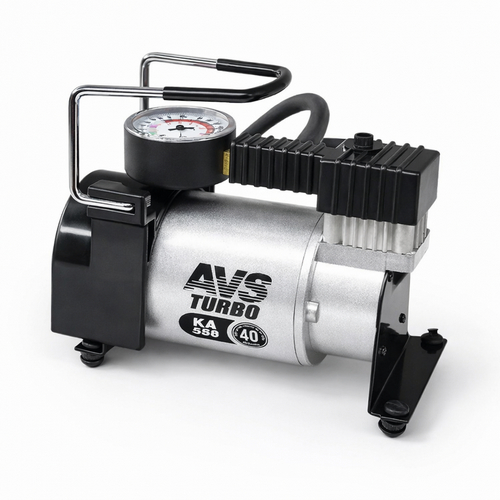
The AVS Turbo KA 580 is this type of roadside piston compressor. It uses 12 V, consumes 150 W, delivers 40 L/min, draws up to 14 A, and specifies 10 atm maximum pressure. Its cable is 3 m long and weight approximately 1.9 kg. A storage bag and adapters for balls and other inflatables are supplied. The housing has a power button, top handle, and rubber feet reducing slipping and some vibration.
The built-in mechanical gauge has two scales. The threaded hose connector is not the fastest arrangement but generally seals more tightly than some inexpensive clip types. In practice, this reduces air loss at the cost of additional screwing movements. Such small details become memorable in everyday use.
.Principal Strength: A Convenient Format for an Ordinary Car
The AVS Turbo KA 580 impresses more through ordinary convenience than numerical margins. It is compact, relatively light, occupies little boot space, and starts without opening the bonnet. Insert the plug, screw the hose onto the valve, and press the button. This simplicity is a substantial everyday advantage.
It performs best in a "top up and continue" role: correcting pressure after cold weather, raising a tyre from 1.5-1.8 atm to normal 2.2-2.4, reaching a tyre shop after a puncture, or inflating a bicycle tyre, ball, or mattress. These are its appropriate tasks without overstating its capabilities.
Another welcome characteristic is basic durability. Even where assembly occasionally needs attention, many units' underlying mechanics last for years. This is practical workshop-style equipment with rough edges that can serve longer than its price suggests when handled properly. Its small size does not negate its value.
.Everyday Performance
Passenger car wheels in the 13-15 size range are generally handled without difficulty. Topping up one tyre is routine, and a partly deflated tyre is restored reasonably quickly. Inflation from empty is possible, but the appliance is not intended for prolonged sessions. Short periods suit it better than continuous intensive work.
Vibration is noticeable. Rubber feet help but do not eliminate buzzing and movement from the small piston mechanism. A level, firm surface is preferable, with occasional hand support. This is an operating characteristic rather than a major failure.
The gauge generally suits roadside pressure adjustment, but laboratory accuracy should not be expected. Some units read close to actual pressure; others show noticeable error, particularly while running and immediately after stopping. Precise adjustment benefits from a separate reliable gauge. For ordinary pressure restoration before continuing, the built-in scale is generally sufficient.
Cable length presents a familiar issue. Three metres generally covers a compact saloon or hatchback. On a long vehicle, reach may be tight and require repositioning through the cabin or choosing another side. For a large crossover, minivan, or commercial vehicle, the length margin is modest.
Cold weather is another consideration. The cable and hose stiffen and become less pleasant to handle. They are more flexible in a warm cabin, while freezing outdoor conditions harden plastic and insulation. Allow the appliance to warm slightly in the vehicle before use. Careful handling is particularly beneficial to wiring.
.Questionable Aspects
The model's weak point is peripheral equipment rather than the compressor concept. Common issues involve cigarette lighter plug heating and high circuit load. It draws up to 14 A, near the standard socket limit in some vehicles. Weak fuses, worn contacts, or an ageing socket can cause heat, interruptions, blown fuses, and other problems.
Heating during prolonged operation is the second criticism. Quickly restoring one tyre is generally satisfactory. Inflating several tyres from empty, a large mattress, or another extended task heats the housing and plug noticeably. A pause is beneficial. Its appropriate rhythm is work, rest, then continuation.
Individual component durability also raises questions. Some units develop wear in the switch, plug, cable insulation, or hose base; bag fittings can break. Output sometimes declines after years. This clarifies the purchase: a useful budget compressor rather than indefinitely durable equipment.
Stated specifications should be viewed realistically. The formal figures are 10 atm and 40 L/min, but actual tyre inflation to ordinary 2.2-2.5 atm and tolerance of repeated operating cycles matter more. By this measure, the model is more convincing as a household assistant than as a numerical champion.
Assessment
The AVS Turbo KA 580 is a good option for passenger car drivers needing their own boot-stored compressor: compact, straightforward, inexpensive, and sufficiently durable for regular tyre top-ups. It suits quick roadside problem solving rather than output competitions. Seasonal pressure correction, country trips, motorway reassurance, and household inflatables are appropriate applications.
It is less suitable for users frequently inflating several large tyres, driving a heavy crossover with large tyres, expecting reference-grade gauge accuracy, or disliking budget details. A higher class with more reliable power connection and greater service life margin is preferable.
The AVS Turbo KA 580 concept is straightforward: practical roadside equipment rather than a polished display product. Given an appropriate task, it performs honestly. In small automotive accessories, this dependability is often the most valued quality.
Related articles:
AVS Turbo KA 580 FAQ
Autoprofi Agressor AGR-35 Automotive Compressor Review
BERKUT R15 Automotive Compressor Review
Agressor AGR-35, Tornado AC-580, and BERKUT R15 Automotive Compressors for Tyres, Trips, and Everyday Use