BAXI ECO Nova 24 F - Combination Gas Boiler Review
A gas boiler has a particular characteristic: its advantages are generally noticed in winter, while its shortcomings can appear on any day of the year. Heating is needed for several months, but hot water is needed continuously. When selecting a combination model, I would therefore first assess how it performs both tasks and how demanding maintenance will be.
The BAXI ECO Nova 24 F is a relatively affordable wall-mounted boiler, yet its internal design is substantial. A copper primary heat exchanger, separate domestic hot water plate exchanger, and brass hydraulic assembly with a three-way valve form a combination deserving attention. Brass is particularly welcome where the manufacturer could readily have economised on materials.
The model produces 24 kW, uses a sealed combustion chamber, and supports radiator heating, low-temperature systems, and instantaneous domestic water heating. However, it has a significant qualification: a fairly high minimum output. In some homes, this matters more than the impressive maximum kilowatt figure.
Compact Housing and a Sensible Layout
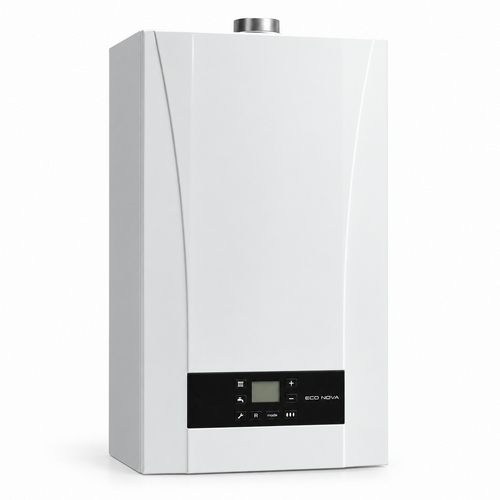
The ECO Nova appearance is straightforward: a white metal housing, a few raised lines on the front panel, and a black display insert. The designers clearly did not intend the boiler as an interior ornament. Appropriately so: after installation, heat, hot water, and predictable operation are what matter.
Dimensions are 704x400x300 mm, and weight is 29 kg. The appliance is relatively easy to position on a kitchen or utility room wall, provided gas equipment placement requirements are met. A depth of 30 cm is reasonable, although lower pipe connections and the upper flue increase the actual installation space required.
.The burner, heat exchangers, pump, gas valve, and controls are behind the front panel, with front maintenance access. The cover is secured by screws below, so the boiler must be positioned to provide proper access for a technician. Installation in a tight furniture enclosure is permissible only with the required fitting and service clearances.
Heating circuit, cold and hot water, and gas connections are beneath the housing. Filling and pressure monitoring components are located there too. The conventional arrangement avoids learning an entirely new installation scheme when replacing an older wall-mounted boiler. Connection dimensions must naturally be checked beforehand.
Two Heat Exchangers: A Design I Appreciate
The ECO Nova 24 F uses two separate heat exchangers. The primary is copper and transfers heat from the gas burner to the heating circuit fluid. The secondary is a stainless steel plate exchanger for domestic hot water.
During heating, water circulates through the primary exchanger and radiators. Opening a hot tap causes the turbine flow sensor to report demand, and the three-way valve redirects circulation to the secondary exchanger. Heat transfers through metal plates to the domestic water. Heating temporarily gives priority to hot water production.
This arrangement is well proven. Heating circuit water and domestic water remain separate, and the plate exchanger can be serviced independently. I prefer it to a bithermic exchanger combining both water passages in one assembly. Separate exchangers complicate hydraulics but provide greater maintenance flexibility.
The primary exchanger has flow turbulators to improve heat transfer and a protective coating. The updated ECO Nova 2025 uses a copper exchanger 225 mm long. The 24 kW version's secondary exchanger has ten plates.
However, a separate domestic hot water exchanger is not immune to limescale. With hard water, deposits gradually obstruct its narrow passages. Output falls, heat transfer deteriorates, and overheating becomes more likely. Water treatment and timely cleaning provide tangible economic benefits.
Brass Hydraulic Assembly and Circulation Pump
The brass hydraulic assembly deserves particular approval. Entry-level boilers frequently use composite hydraulic blocks. Good engineering plastic can operate for years, but brass offers high mechanical strength, withstands substantial loads, and supports reliable threaded connections.
The three-way valve is also brass and electrically actuated. This is a familiar, repairable design with a clear operating principle. However, additional moving components require attention: deposits, dirt, and seal wear can eventually impair switching between heating and hot water.
The circulation pump moves heating fluid through the system. Updated ECO Nova 2025 boilers up to 24 kW use a BDR Thermea (Shinhoo) pump with 5 m head. This is sufficient for an ordinary radiator network with correctly calculated hydraulic resistance. Extensive systems with multiple circuits, long underfloor loops, and additional pumps require a separate hydraulic calculation.
.The built-in automatic air vent reduces airlock risk. An automatic bypass maintains circulation when heating circuit resistance rises, useful as radiator thermostatic valves begin restricting flow.
The expansion vessel holds 7 L, often sufficient for a small heating system. If a house has several dozen radiator sections, extensive pipework, and a large fluid volume, vessel capacity must be calculated. An additional expansion vessel is a sensible purchase in such cases.
24 kW: Useful Reserve or a Cause of Excessive Cycling?
Maximum useful heat output of the ECO Nova 24 F is 24 kW, and minimum output is 9.6 kW. The burner provides continuous electronic flame modulation between these limits. The controls vary combustion intensity according to heat demand.
The upper limit raises few questions. An output of 24 kW covers a substantial heating load and acceptable hot water production. However, I would not calculate heated area simply by dividing kilowatts by an assumed 100 W/m?. Heat loss depends on insulation, windows, climate, ventilation, and many other factors.
The lower limit of 9.6 kW is more interesting. For a modern, well-insulated house of 80-120 m?, this may be excessive on many heating-season days. The boiler quickly heats the fluid to the set temperature, stops the burner, waits for cooling, and starts again. This repeated operation is commonly called cycling.
Frequent starts impair control uniformity and increase stress on ignition components. The situation depends on system thermal capacity, control settings, and actual heat loss. Nevertheless, the minimum output warrants attention before purchasing.
The ECO Nova 24 F is more convincing for a house with substantial heating demand, where modulation range is less critical. For a small, well-insulated home, I would seriously consider a boiler with lower minimum output while retaining the required hot water capacity.
Hot Water: Suitable for One Shower, More Difficult for Two
The domestic hot water circuit delivers 13.7 L/min at a 25 °C temperature rise. At a 35 °C rise, delivery falls to 9.8 L/min. This follows ordinary physics: a greater temperature increase means less water can be heated at unchanged burner output.
This flow is generally sufficient for one shower. A shower and kitchen tap can also operate together, but available delivery margin becomes considerably smaller. Two showers, particularly with cold winter inlet water, can demand more than the boiler can provide.
Hot water temperature is adjustable from 35-60 °C. Minimum flow activating heating is 2.5 L/min. Owners of water-saving taps and flow-restricted fittings should consider this figure. If the stream is too small, the controls may cease recognising a heating demand.
Instantaneous heating has another characteristic. After a tap opens, the controls must detect flow, switch the three-way valve, and ignite the burner. Heated water must then travel through the pipes to the tap. The farther the bathroom is from the boiler, the longer the wait. There is no built-in hot water reserve.
For the same reason, sudden changes in flow and inlet temperature may be felt in the shower. The electronics attempt to maintain the set temperature but cannot instantly compensate for every flow change. Stable mains water pressure and correctly selected taps noticeably affect comfort.
.Straightforward Controls
The front panel has a small blue-backlit liquid crystal display. Heating and hot water temperature buttons sit on either side. The lower row contains mode selection, information, and fault reset keys.
I appreciate direct panel access to essential settings. Changing water temperature requires no lengthy menu navigation. Separate button pairs for heating and hot water reduce confusion. The backlight extinguishes after a few seconds, avoiding an additional nighttime light source.
"Summer" and "Winter" modes are provided. The former supplies hot water only; the latter also serves the heating circuit. The display shows temperature, active mode symbols, and diagnostic messages.
Heating temperature adjustment covers 30-80 °C, with a 30-45 °C range for low-temperature systems. This is convenient for underfloor heating, although floor temperature limits and hydraulics must match the heating system design.
An interesting starting characteristic is a possible two-minute air removal cycle after power is applied. AP appears on the display, the pump alternately starts and stops, and the three-way valve changes position. This procedure explains unfamiliar behaviour at first switch-on.
Room Thermostat and Weather Compensation
The ECO Nova 24 F supports a room thermostat, programmable controller, and outdoor temperature sensor. The latter enables weather compensation: heating fluid temperature follows a set curve according to outdoor conditions.
This is a good principle. When outdoor conditions are relatively mild, continuously supplying high-temperature radiator water is unnecessary. Reducing heat delivery lowers indoor temperature fluctuations and smooths regulation.
A compatible OpenTherm device expands control options. The updated 2025 version uses a Bertelli board with the corresponding connector. BAXI Connect+ compatibility provides remote monitoring. External sensors and control units are selected separately.
I would include a good room controller in the initial system budget. A heating fluid sensor alone cannot know how warm the bedroom or living room has become. Room controls make regulation more meaningful, particularly when sunshine, appliances, and occupancy affect temperature.
Flue System, Gas Consumption, and Electrical Supply
The ECO Nova 24 F has a sealed combustion chamber. A fan provides air supply and combustion product removal through the appropriate pipe system. A 60/100 mm concentric flue is commonly used: the inner passage removes flue gases, while the outer passage supplies combustion air.
Maximum length for this flue is 5 m, with bends reducing permissible length. Separate 80 mm pipes have different installation limits. Design must consider route configuration, bend resistance, and external terminal location requirements.
Flue components are purchased according to the installation arrangement. The basic package includes the boiler, documentation, mounting template, wall fixings, and specified installation components. Actual installation cost must therefore include the flue, isolation valves, filters, and labour.
.Maximum natural gas consumption is 2.72 m?/h, while LPG consumption is approximately 2 kg/h. These are high-load figures, not constant consumption throughout the heating season. Actual use depends on house heat loss, control settings, and hot water consumption.
Specified efficiency is 93%, respectable for a conventional boiler but below modern condensing appliances, particularly in low-temperature heating. The ECO Nova uses conventional gas combustion without recovering additional heat through water vapour condensation.
Rated electrical power is 135 W. The pump, fan, control board, and actuators require electricity. During a power outage, the boiler stops even if gas remains available. A correctly selected UPS is useful for homes with unstable electricity supply.
The controls support operation at reduced gas pressure, although nominal supply conditions remain necessary for rated output. Conversion to LPG is also possible, involving replacement of the relevant components and gas valve adjustment by a qualified specialist.
Noise: A Minor but Significant Household Detail
ECO Nova operation produces fan, circulation pump, water movement, and actuator sounds, natural for a gas boiler. With correct installation, these can remain moderate, but continuous humming may be irritating in a small room.
Rigid pipe connections and mountings that transmit sound to walls are particularly sensitive to vibration. Correct circulation, an air-free system, a functioning pump, and proper burner adjustment matter. Pronounced humming or rattling requires diagnosis.
After the burner stops, the pump may continue circulating water for a time. This post-circulation removes residual exchanger heat. The technically useful function sometimes confuses owners: the flame has stopped, yet the boiler still makes noise.
I would prefer to install this model in a separate utility room or a kitchen away from bedrooms. Acoustic comfort depends on installation quality as well as the appliance itself.
Protection and Maintenance: Economise Elsewhere
Safety systems include ionisation flame monitoring, overheat protection, a flue pressure switch, a water pressure switch, and a 3 bar heating circuit safety valve. Electronic diagnostics display faults.
For a cold heating system, recommended pressure is 0.7-1.5 bar, monitored using the built-in gauge. A constant need to add water indicates a problem whose cause must be identified.
Pump and three-way valve anti-seizure protection is provided for prolonged inactivity. Frost protection activates the necessary mechanisms when heating fluid temperature falls. Naturally, this requires electricity, functioning equipment, and gas supply.
Regular maintenance includes checking the burner, electrodes, gas valve assembly, pump, expansion vessel, heat exchangers, filters, and flue system. Annual service by a qualified specialist is recommended.
I would separately provide a heating return filter and suitable domestic hot water treatment. Radiator dirt can impair circulation and valves, while hard mains water gradually reduces plate exchanger passage area. Maintenance is considerably less expensive than the consequences of neglect.
.Updated Version Features
The ECO Nova has been produced for several years, with design changes over time. The 2025 version updates several components: a serviceable SIT fan, SIT Sigma 845 gas valve, improved copper exchanger, BDR Thermea pump, and Bertelli board.
These changes primarily matter for maintenance and spare parts compatibility. Externally similar boilers from different years may have different internal assemblies. Product code, serial number, and specific version therefore matter when ordering parts.
I regard accessible service documentation and separately replaceable components as design strengths. A gas boiler is purchased for years of use, and servicing an individual assembly matters more than impressive extra functions used only occasionally.
Who Is the BAXI ECO Nova 24 F Suitable For?
In my view, the model's most suitable application is a house or flat with independent heating, requiring substantial heat output and hot water primarily for one bathroom and a kitchen. Its capabilities are sufficient in this role, and the dual exchanger arrangement is justified.
For a small, well-insulated house, pay particular attention to the 9.6 kW minimum output. Good controls improve regulation but cannot change the burner's physical lower operating limit. Compare building heat loss with the boiler's adjustment range.
The ECO Nova 24 F strengths are a copper primary exchanger, separate hot water exchanger, brass hydraulic components, clear button controls, and external control support. Limitations include a relatively narrow modulation range, typical instantaneous hot water characteristics, and the need for careful water quality management.
Overall, the BAXI ECO Nova 24 F appears a sensibly engineered boiler with a conventional design. I appreciate retention of brass hydraulics and separate heat exchangers in an affordable model. This reflects sound engineering. The essential task is matching its output correctly to household needs. It can then perform its intended work: reliably heating water and maintaining warmth without excessive owner attention.
Related articles:
BAXI ECO Nova 24 F FAQ