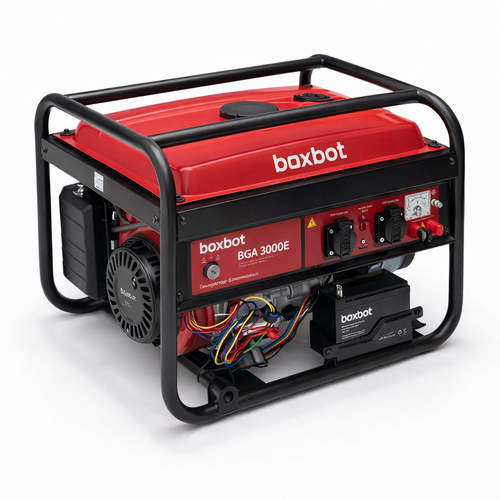
Boxbot BGA 3000E - Electric-Start Petrol Generator Review
The Boxbot BGA 3000E has a useful feature that becomes particularly appreciated during a power outage: the engine can be started by turning a key. There is no need to pull a starter cord and exert physical effort. For a backup generator sometimes used in darkness and cold, this convenience is substantial.
The appliance is also relatively inexpensive, with two sockets, load connection terminals, and a 15-litre petrol tank. At first glance, it has everything required for a country property or small detached house.
However, the attractive price conceals several characteristics. The principal one is an alternator winding made from copper-clad aluminium. The advertised 3 kW also refers to maximum output, while the manual imposes fairly strict operating duration limits. Before purchasing, it is useful to understand exactly what this generator is intended to do.
I would consider the Boxbot BGA 3000E primarily as a budget backup electricity source. It is appropriate for infrequent mains outages, particularly if substantially cheaper than competitors with copper windings. For daily operation over many hours, a device with a longer service life is preferable.
Three Kilowatts Requiring Appropriate Use
The generator has a four-stroke OHV petrol engine with a displacement of 212 cm3. Output is 7 hp, with air cooling. The arrangement is conventional for this class: one cylinder, a carburettor, forced-air cooling, and a mechanical speed governor.
The Boxbot BGA 3000E is rated at 2.8 kW, with a maximum output of 3 kW. The difference is small but important. Three kilowatts is the upper limit, while for prolonged operation the manufacturer recommends no more than 75% of rated output, approximately 2.1 kW.
This is a more useful figure for planning household backup power. A refrigerator, several lights, circulation pump, and television are appropriate loads with sensible allocation. A 2 kW electric kettle can also be operated, but leaves almost no margin for other appliances simultaneously.
.Compressors, pumps, and power tools with powerful electric motors require particular attention. During starting, they may consume considerably more than their rated power. A generator able to power a motor once running will not necessarily start it under load.
A small compressor or 2 kW angle grinder already warrants checking the equipment's starting characteristics. For regular use of demanding power tools, I would prefer a higher generator class so the engine does not operate continuously near its limit.
Electric Starting: This Version's Main Convenience
The E in the name indicates electric starting. The starter is powered by a 12 V, 7 Ah battery. The battery is included with this model, although the contents of the specific offer should be checked before purchasing.
The starting sequence is conventional: open the fuel tap, set the choke appropriately, switch on the ignition, and turn the key. A cold engine requires the choke, which is opened after warming up.
Retention of the manual starter is welcome. If the battery discharges during prolonged storage, a functioning engine can be started with the cord. This alternative starting method is useful.
However, electric starting must not be confused with automatic starting during mains failure. The Boxbot BGA 3000E does not independently detect loss of household voltage or start without human involvement. Standard automatic transfer switch support in this family is provided for the larger BGA 8000E.
For a country property where the owner can go outside and start the generator manually, this is a minor limitation. For a heating boiler that must continue operating in an unoccupied winter house, it is substantial. A different approach to backup electricity supply is required.
Two Sockets, Terminals, and Power Quality
The Boxbot BGA 3000E panel has two 230 V AC sockets rated at 16 A and separate full-output terminals. The latter connect a load directly by wires without an ordinary plug.
This is useful for permanent generator use, but the terminals require careful handling. A qualified specialist must make the connection with appropriate protection, insulation, and cable strain relief.
Two sockets do not double the output. Combined consumption of connected appliances remains limited by the generator's capabilities. A circuit breaker protects against overload and short circuits.
Voltage is controlled by an AVR system. It adjusts alternator excitation as the load changes, helping maintain output voltage within operating limits. This is sufficient for lamps, heaters, and many ordinary electrical appliances.
However, the BGA 3000E is a conventional synchronous generator rather than an inverter type. Output voltage waveform and frequency depend on engine operation and load. The documentation specifies application class G1, and the manufacturer separately warns about limitations when supplying equipment containing electronics.
For expensive computing equipment, sensitive controls, and complex electronics, I would choose a high-quality inverter generator or design a supply system with an appropriate UPS beforehand. AVR regulation alone does not resolve every power quality issue.
.There is another consideration when connecting gas boilers. The generator output uses an isolated neutral arrangement. Some polarity-sensitive boilers require a particular neutral and protective earth connection; otherwise their controls do not detect the flame.
When supplying a boiler and connecting the generator to the household distribution board, an electrician must determine the correct earthing, neutral switching, and mains changeover arrangement. This is a serious matter: the generator must connect through a purpose-designed source changeover assembly.
Copper-Clad Aluminium: Where the Manufacturer Economised
The most controversial aspect of the Boxbot BGA 3000E is the generator winding material. Some commercial descriptions state copper, but a brand representative confirmed the use of copper-clad aluminium.
There is a difference. Aluminium has lower electrical conductivity than copper. Achieving comparable electrical characteristics requires consideration of conductor cross-section, heating, and connection properties. A thin copper layer on an aluminium wire does not make it a fully copper winding.
This solution alone does not mean the generator will fail quickly. Winding quality, cooling, insulation, and connections are also important. However, copper windings are preferable under sustained high load and heat, particularly for equipment purchased for years of intensive use.
I do not particularly favour this economy. Electric starting is convenient, but generator section reliability matters more than turning a key instead of pulling a cord.
If the BGA 3000E is substantially cheaper than a comparable unit with confirmed copper windings, the compromise is understandable. With a small price difference, I would pay extra for copper. I would also confirm the winding material for the selected version with the seller, since catalogue specifications are inconsistent.
A 15-Litre Tank and Ten Advertised Hours
A 15 L fuel tank is fitted above the frame. The generator uses RON-92 petrol, with oil added separately to the engine crankcase. Oil system capacity is 0.6 L.
The BGA 3000E is specified to operate for up to 10 hours per fill at approximately 75% load. Commercial specifications also state consumption of 1.5 L/h.
However, the manual contains an important recommendation: for prolonged reliable service, continuous operation should not exceed four hours, followed by a half-hour break. A separate maximum continuous interval of 10 hours is also stated.
This creates an unusual situation. The fuel reserve theoretically covers a long shift, while careful operation requires cooling stops. For periodic backup power, this is acceptable. For continuous electricity supply at a site, it is inconvenient.
Petrol consumption depends on load. Keeping the generator running for only a few lamps is not particularly economical either: the engine maintains operating speed and consumes fuel even at low electrical output.
.A Compact Frame, but Substantial Carrying Weight
The Boxbot BGA 3000E measures 590x430x435 mm, conventional dimensions for a 3 kW petrol generator. Its frame is tubular, with the engine and alternator exposed for easier inspection and maintenance.
Weight without operating fluids is 46 kg, with petrol in the tank adding further weight. Moving the unit around a property alone is inconvenient, particularly over soil or steps.
Wheels and transport handles are not supplied as standard. Mountings for an optional transport kit are provided, but the kit must be purchased separately. If the generator remains in one prepared location, this is a minor shortcoming. For frequent off-site work, wheels should be included in the initial plan.
The open layout facilitates cooling, but the engine is clearly audible. Specifications give a noise level of 85 dB. Without measurement conditions, comparison with other generators is difficult, but silent operation should certainly not be expected.
Positioning near a dwelling requires adequate distance from windows and doors, protection from precipitation, and free air circulation. A petrol generator must operate outdoors with exhaust prevented from entering buildings. Operation in a garage with the door open is also dangerous because of carbon monoxide.
First Start and Maintenance: Important Details
The generator requires preparation before its first start. Pay particular attention to the rubber transport support beneath the alternator. Remove it before operation. Leaving it fitted can cause damage through incorrect vibration transmission.
Oil requires equally careful attention. Even if liquid is present in the crankcase, it should not be assumed to be suitable operating oil. Transport oil should be replaced with fresh engine oil meeting the manual's requirements. SAE 10W-30 is recommended for this model.
The engine has a low-oil sensor. When the level falls, the system disables ignition. This can prevent starting or stop the generator even though the engine and fuel system appear functional.
Uneven positioning can complicate this situation. A horizontal site and an oil check before starting are therefore essential.
An oil change is prescribed after the first five hours of running-in. During this period, load should be limited to half rated output. Subsequent oil changes follow the schedule based on 50 operating hours or three months of use.
The air filter requires regular cleaning, particularly in dusty conditions. It is accessible through the filter housing cover, and its element can be washed and dried. Periodic spark plug inspection, fuel sediment bowl cleaning, and fastener checks are also necessary.
The design is conventional and serviceable. It is helpful that there is no tightly enclosed housing requiring half the generator to be dismantled for every engine access. However, inexpensive generators need maintenance just as frequently as expensive ones.
.Reliability: Good Starting and Questions about Factory Preparation
A functioning Boxbot BGA 3000E generally starts without particular difficulty. Examples include satisfactory operation with household loads of approximately 2-2.5 kW, refrigerators, lighting, and power tools. This is encouraging for a backup power source.
However, individual units have been reported with unadjusted carburettors, incorrect valve clearances, and faulty fuel taps. The electric-start version has also shown problems cranking the engine and engaging the starter. These do not justify declaring the entire series unreliable, but a functional inspection upon delivery is clearly advisable.
The nature of the available reliability information must also be considered. Many impressions concern initial starts and few operating hours. Information on years of intensive use is considerably less abundant.
The manual itself gives a specific figure: calculated generator life is 500 hours with proper operating conditions and timely maintenance. This does not imply inevitable failure immediately afterwards, but clearly indicates the model's intended purpose.
Five hundred hours is a substantial duration for emergency backup power. If outages last a few hours monthly, the generator can serve for a long time. At six to eight hours of daily operation, this calculated life will be consumed relatively quickly.
I would not purchase the BGA 3000E for year-round supply to a construction site or a house without mains electricity. Initial savings may result in frequent maintenance and premature equipment replacement.
Price and Alternatives
The Boxbot BGA 3000E has an obvious competitor: the simpler manually started Boxbot BGA 3000. If the generator is needed for only a few emergency uses annually, consider whether the additional starter, battery, and associated costs are necessary. Manual starting is mechanically simpler and avoids battery care.
For frequent starts, the E version is more convenient, particularly when users find pulling a petrol engine starter cord difficult.
The Huter DY4000LX is another alternative. It also has an electric starter, with specified rated output of 3 kW. When comparing individual offers, verify winding material, battery inclusion, and warranty terms. Selecting a good generator from its name and peak output alone is difficult.
If supplying electronics is the main task, inverter generators are more interesting. At comparable prices, they often provide less output but are better suited to sensitive equipment. For regular work with powerful pumps or tools, moving to the 4-5 kW class with sufficient starting current margin is more appropriate.
Is the Boxbot BGA 3000E Worth Purchasing?
It is a reasonable purchase if an inexpensive electric-start generator is required for periodic backup supply to a house, country property, or garage. At a working load of approximately 1.5-2 kW, with timely maintenance and appropriate installation conditions, its capabilities should cover essential household tasks.
The main advantages are convenient electric starting with a backup manual starter, two sockets, full-output terminals, and a reasonably spacious fuel tank. The layout is simple, and most maintenance tasks are accessible without complicated dismantling.
The shortcomings are also substantial: copper-clad aluminium in the alternator, 46 kg weight without standard wheels, typical open-generator noise, and limited calculated life. There is also no automatic starting when mains voltage fails.
Purchasing is particularly reasonable when the Boxbot is considerably cheaper than comparable electric-start generators with confirmed copper windings, for example by approximately a quarter or more. At similar prices, I would choose a generator with copper windings and a more substantial specified life.
Overall, the Boxbot BGA 3000E suits users who need electricity occasionally and are prepared to monitor engine condition themselves. It is suitable as backup during an emergency mains outage. As a permanent generating set, its service life is limited, and the design economies cease to justify themselves.
Related articles:
Boxbot BGA 3000E - Operating Instructions in Questions and Answers
Boxbot BGA 5500E - Operating Instructions in Questions and Answers
Huter DY4000LX - Operating Instructions in Questions and Answers