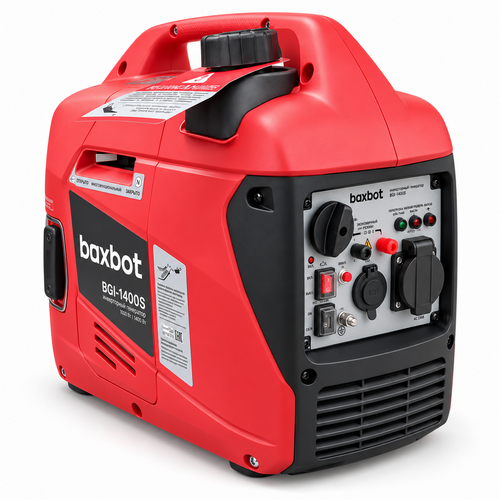
BOXBOT BGI-1400S: A Small Generator with Sensible Capabilities
Small petrol generators have one important advantage: they can actually be taken along. The BOXBOT BGI-1400S weighs 14 kg, has an enclosed plastic housing with a handle, and occupies relatively little space. Place it in the boot, transport it to a country house or worksite, and take it out to obtain an independent electricity source. However, this compactness comes at the cost of output and fuel tank capacity.
The model is interesting primarily because it offers an inverter design, sound-reducing enclosure, and economy mode at a moderate price. This is an appropriate combination for lighting, battery charging, a laptop, television, or small household appliances. Backup power for a gas boiler with a circulation pump can also be arranged after checking compatibility and starting currents.
However, I would not purchase the BGI-1400S with the expectation of supplying an entire country house. It serves a different purpose, and a useful one, provided its limitations are understood beforehand.
1200 W for Continuous Operation, 1400 W Briefly
Start with the figure in the name. The BOXBOT BGI-1400S produces a maximum electrical output of 1.4 kW, but sustained operating load is limited to 1.2 kW. The additional 200 W accommodates brief increases in consumption. Some product listings give both outputs as 1400 W, potentially confusing buyers. The specified 1200 W rating should be used as the reference.
Inside is a four-stroke SH60B petrol engine with a displacement of 60 cm3 and output of 2.1 hp. Electricity passes through an inverter unit that produces 230 V at 50 Hz. This arrangement suits electronic equipment, chargers, computers, and other devices that benefit from a stable supply.
However, an inverter does not override electrical engineering principles. If a pump motor consumes three times its normal power during starting, the generator must withstand that brief surge. Consequently, a refrigerator consuming 150 W in normal operation may present a more demanding load than a 400 W lighting system.
For prolonged operation, I would aim for approximately 800-1000 W of total consumption, leaving a margin for load changes. A small power tool rated at approximately 700-900 W can be connected, but starting currents and operating conditions require separate consideration. A welding machine, 2 kW electric kettle, or powerful heater is beyond this generator's capabilities.
.Housing and Controls: A Sensible Arrangement
The BGI-1400S has an enclosed housing with ventilation grilles. This arrangement is generally quieter than an open frame and more convenient for transport: there are fewer protruding parts, and the engine is protected from accidental external contact. A carrying handle is at the top, with the fuel tank cap nearby.
The main controls and connectors are grouped on the front panel. These include a covered 230 V socket, USB-A and USB Type-C ports, engine switch, economy mode selector, indicator lights, RESET button, and parallel connection terminals. A separate side lever controls the choke. Starting uses a manual recoil starter.
There is no separate display, which I would regard as a real shortcoming. Three indicator lights report generator status and faults, but cannot show current load power, voltage, or accumulated operating hours.
While the device is new, this seems minor. After several months of irregular use, remembering approximately how many hours the engine has operated and when the oil was changed becomes more difficult. A notebook, external hour meter, or memory can be used according to preference. I prefer the necessary information to be available directly on the panel.
On the positive side, the controls are mechanical, without complex menus. Economy mode has a dedicated control, and after overload protection trips, output power can be restored with the RESET button once the cause has been removed. The engine generally does not need to be stopped. This is a practical arrangement.
Economy Mode and Petrol Consumption
The fuel tank holds only 2 L. This is very little for large petrol generators, but the engine here is small, so the fuel reserve is consumed relatively slowly.
At 75% load, specified consumption is 0.7 L/h. A full tank therefore provides approximately 2.8 hours of operation in this mode. At half load, consumption may be approximately 0.4-0.5 L/h, giving around four to five hours per fill. These are guidelines: actual results depend on load, temperature, fuel, and engine condition.
Economy mode varies engine speed according to electrical consumption. If several LED lamps and a charger are connected, the engine does not need to run at high speed continuously. Petrol consumption and noise decrease.
At a connected load of approximately 400-500 W, the ECO effect remains clearly noticeable. As consumption increases, engine speed rises and the difference between normal and economy modes diminishes. When starting equipment with a high inrush current, normal mode is more appropriate so the engine can respond faster to the sudden load increase.
This arrangement is effective for a campsite where lighting and battery charging account for most operation. For many hours of household backup power, the tank is too small. Refuelling is permitted only after stopping the generator and allowing the engine to cool sufficiently. If power is off all day, these interruptions soon become inconvenient.
.How Quiet Is the BOXBOT BGI-1400S?
The manufacturer specifies a noise level of 60 dB. The figure looks attractive, but without the measurement distance and load, it reveals little about actual loudness. At low speed, an enclosed generator can indeed operate relatively quietly. As engine output increases, noise inevitably rises.
The sound-reducing enclosure is useful: its walls shield the engine, and the silencer reduces exhaust noise. At low consumption, the generator sounds noticeably less intrusive than many comparable open-frame models.
However, "quiet" should not be interpreted literally. This is a petrol engine with a moving piston, cooling fan, and exhaust system. Not everyone will appreciate sleeping beside a tent with it running nearby.
The BGI-1400S must be positioned outdoors only, on a stable surface, at a safe distance from windows, doors, and ventilation openings. Exhaust contains carbon monoxide. A sound-reducing enclosure does not make a petrol generator suitable for indoor use, even in a garage with the door open.
Connecting Two Generators and Other Capabilities
An interesting BGI-1400S feature is parallel connection of two compatible inverter generators through dedicated terminals. This arrangement increases available combined output without purchasing one large generating set.
However, a second compatible generator and suitable connection kit are required. The manual determines the connection procedure, as simply connecting two sockets together is prohibited. Two small units will not necessarily cost less than one powerful generator either.
The BGI-1400S has no separate 12 V DC output. A vehicle battery can be charged through an appropriate charger connected to the 230 V socket. USB-A and USB Type-C serve low-power electronics, but should not be regarded as full fast-charging sources for a powerful laptop.
The generator does not provide automatic starting when the central electricity supply fails. There is no automatic transfer switch connection either. Backup supply to household wiring requires a properly arranged source changeover installed with the involvement of a qualified electrician. An ordinary plug inserted into a household socket is unsuitable for this purpose.
Oil, Air Filter, and Maintenance
A small engine also requires care. The BGI-1400S uses SAE 10W-30 engine oil, with a fill capacity of 0.35 L. Fuel is RON-92 petrol and must not be mixed with oil. Before the first start, check the oil level and fill the crankcase if necessary.
Change the oil after the first five hours of running-in. During this period, moderate loads of approximately one-quarter to one-third of rated output are preferable, without sudden overloads. Subsequent maintenance follows the schedule according to operating hours and conditions.
This reveals the disadvantage of an enclosed housing. Access to the air filter and certain serviceable components requires undoing fasteners and removing the side panel. The exterior is tidy, but a routine inspection becomes a minor dismantling task. A quick-release service cover would be more convenient.
The air filter requires cleaning every 50 hours or three months of operation, and replacement after 200 hours. Wash and dry the filter element, then lightly impregnate it with engine oil, removing the excess. Dusty operating conditions require shorter service intervals.
The spark plug presents a similar situation: access is beneath a housing panel. Electrode gap should be 0.7-0.8 mm. A spark plug spanner is included.
The accessory list also specifies two 16 A electrical plugs, a filling funnel, and a manual. However, some deliveries are incomplete, particularly missing the funnel. Checking the box before the first start is advisable. A funnel is inexpensive, but having to find one just as oil filling is about to begin is inconvenient.
.Potential Disappointments after Purchase
The main criticism of the BOXBOT BGI-1400S is not its output itself. A small generator is necessarily limited. More significant is the combination of a small tank, no hour meter, and relatively slow access to serviceable components.
Spare parts present a less obvious concern. Simple tasks such as spark plug replacement or filter maintenance are generally straightforward. Repairing the inverter board, specialised housing parts, or electronic system components may be considerably more difficult. Before purchasing, establish who provides warranty service and whether parts are available for the specific version.
The warranty period is one year. This is typical for an inexpensive generator, but actual engine life should not be inferred from warranty duration alone. There are currently too few verified long-term observations with substantial accumulated operating hours to assess this particular model's durability confidently.
Initial impressions of the BGI-1400S are predominantly favourable: easy starting, moderate noise, economical operation, and the ability to power a refrigerator with a small additional load are noted. There are also isolated reports of uneven engine operation, oil marks on the housing after transport, and incomplete accessories. There is no current basis for treating these as widespread faults, but upon delivery I would inspect the housing, fuel system, oil level, and operation under a moderate load.
The power margin also requires attention. Reports of successful operation above the specified 1400 W should not be interpreted as a revised generator specification. A brief overload may pass without consequences, but regularly relying on it is questionable, particularly given the cost of inverter electronics.
BOXBOT or a More Powerful Generator?
A closely matched competitor to the BOXBOT BGI-1400S is the VNIISSOK A1400I. It has the same rated 1.2 kW and maximum 1.4 kW output, comparable weight, inverter power supply, and economy mode. It also provides an operating information display, a separate 12 V output, and a 2.2 L fuel tank.
For me, an hour meter and additional outputs provide a substantial argument for the VNIISSOK at a similar price. The BOXBOT may be more interesting if substantially cheaper or if the buyer particularly prefers its control layout.
Another option is an inverter generator rated at approximately 2 kW, such as the Brait BR2500i. It provides a greater margin for tools and household equipment, while a larger fuel tank is more convenient during prolonged operation. However, such devices can be heavier and louder, particularly in an open-frame configuration. The decision is between mobility and capability.
Price comparisons must consider specific offers. The BOXBOT BGI-1400S is available at approximately 16-25 thousand roubles, with substantial differences between platforms. At 16-18 thousand, purchasing looks attractive. Around 20 thousand, it should be compared carefully with the VNIISSOK A1400I and other models in the same class. At 23-25 thousand, I would prefer a more functional alternative or pay extra for a generator with a greater power margin.
Is the BOXBOT BGI-1400S Worth Purchasing?
I would recommend the BOXBOT BGI-1400S for specific tasks: outdoor trips, battery charging, lighting, small electronic devices, and short-term backup electricity supply. At loads up to 800-1000 W, it retains a reasonable margin, weighs little, is relatively economical, and has a useful ECO mode. Its enclosed housing and inverter arrangement are appropriate for these applications.
For regular supply to a country house, powerful tools, and prolonged power outages, a generator rated from 2-3 kW with a larger tank is preferable from the outset. Attempting to economise on output usually means monitoring every appliance that is switched on.
The verdict is to purchase at a substantial discount for a clearly defined small load, particularly if the generator must be transported frequently and moderate noise and economical petrol consumption matter. Compactness has clear costs here: a small tank, limited output, and some maintenance inconvenience. However, I would not pay as much for the BGI-1400S as for better-equipped competitors. At that point its principal advantage, a reasonable price, simply disappears.
Related articles:
VNIISSOK A1400I Inverter Generator - Operating Instructions in Questions and Answers
Brait BR 2500i - Specifications and Operating Considerations
Warning: Undefined array key 1 in /var/www/u220194/data/base_php/functions/myfunctions_manualika.php on line 495