DDE DPG1201i mini - Inverter Petrol Generator Review
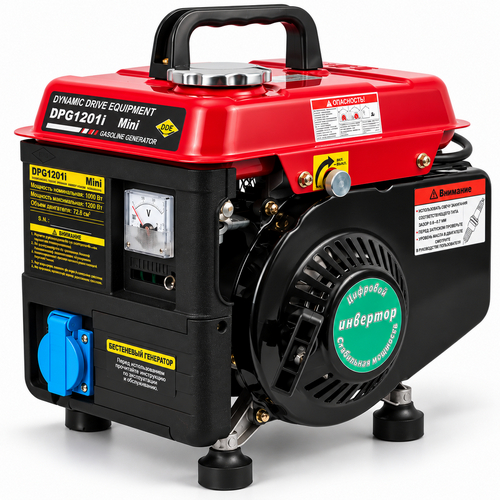
The word mini in the DDE DPG1201i name is justified. The generator weighs approximately 12 kg, occupies little more space than a large vehicle battery, and is carried using a single top handle. It delivers up to 1 kW continuously, a reasonable result for an appliance that fits in a car boot without substantially displacing other belongings.
However, the model's main characteristic is internal. Inverter electronics are paired with a simple two-stroke engine whose speed is adjusted manually. This is an interesting combination: the electrical section provides stable power for modern appliances, while the engine retains the characteristics of conventional petrol equipment. The generator is compact and relatively inexpensive, but cannot be described as silent or entirely trouble-free.
Design: Compactness without a Complex Enclosure
The DPG1201i mini has a utilitarian appearance. A red metal fuel tank sits above a black body containing the generator, engine, and controls. Four rubber feet reduce vibration transmission to the surface, and a carrying handle is secured on top.
The unit is small, measuring approximately 330x270x350 mm. It is convenient to transport in a car, store in a utility room, and bring out when needed. However, the handle position relative to the centre of gravity is not ideal: the housing may tilt slightly during carrying. This minor detail becomes noticeable with a full tank.
The engine and silencer remain sufficiently exposed for ventilation and maintenance. There is no complete sound-reducing enclosure with extensive internal insulation. This reduces weight, but the running engine is clearly audible to others.
An important design detail is the two-stroke engine's cast-iron cylinder. This material tolerates operating loads and wear well, useful in a small high-speed motor. Naturally, durability also depends on fuel mixture quality, cooling, and air filter condition.
.Inverter and One Kilowatt of Output
The DDE DPG1201i mini is rated at 1000 W, with a maximum of 1100 W. The final hundred watts should be treated as a brief reserve. Prolonged maximum-output operation is inadvisable; leaving part of the capacity unused is more appropriate for normal operation.
The inverter arrangement works as follows: the engine drives an alternator, generated electricity passes through an electronic converter, and the output is then formed as AC at 50 Hz. Frequency stability therefore depends less on engine speed than in a conventional non-inverter generator.
This is particularly useful for lighting, chargers, televisions, computers, and other electronics. However, detailed output sine-wave distortion limits are not specified for the DPG1201i. An inverter alone does not guarantee compatibility with every sensitive device.
Starting currents introduce another limitation. A 700 W heater and a pump with the same rated consumption present very different tasks. The heater switches on relatively smoothly, while the pump motor may require several times more energy during starting.
The DPG1201i therefore suits several lamps, a television, and device charging. A small power tool may also operate, particularly with soft starting. Refrigerators, pumps, and compressors are more complicated: the motor may start successfully, or inverter protection may trip. Everything depends on the individual load and its starting characteristics.
When permissible load is exceeded, electronic protection disconnects electrical output, although the petrol engine may continue running. To restore power, remove the overload and restart the generator. This protects the electronics appropriately, but must be considered when selecting generator output.
Two-Stroke Engine: Simplicity with Conditions
The DPG1201i mini uses a single-cylinder two-stroke DDE YK1E45F-2 engine with a displacement of 69 cubic cm. Output is approximately 2 hp, cooling is by air, and starting uses a manual recoil starter.
The two-stroke design avoids a separate crankcase oil lubrication system. There is no routine crankcase oil change procedure as on four-stroke engines. Instead, oil must be mixed with petrol beforehand in the correct proportion. Lubrication reaches engine components with the fuel.
An undesirable documentation inconsistency appears here. A 50:1 mixture of RON-92 petrol and two-stroke oil is specified, but some units have 40:1 marked on the tank cap. This discrepancy directly concerns engine lubrication, so confirm the correct ratio for the specific generator version with the manufacturer before refuelling. Such instructions should not be ambiguous.
Preparing the mixture is straightforward, requiring a measuring container, suitable two-stroke oil, and a clean fuel can. However, the owner must repeat this regularly. A four-stroke generator is more convenient in this respect: petrol is added separately, and crankcase oil remains in service considerably longer.
A two-stroke engine also has particular light-load characteristics. The fuel mixture may burn incompletely, producing oily deposits and spark plug carbon. During prolonged no-load operation, the engine tends to run less steadily than under normal electrical demand. The manual explicitly limits prolonged idling.
.Output Adjustment: Unusual but Useful
One of the DPG1201i mini's most interesting features is its manual engine operating mode control. Turning it changes speed and matches engine performance to the expected electrical load.
At low consumption, the engine can be set to a more economical mode. Before connecting a powerful appliance, increase speed. This reduces the risk of insufficient mechanical power during a sudden load increase.
The inverter arrangement allows speed variation while retaining the specified output frequency. Here, the design solutions complement each other well.
However, the control requires owner involvement. In more expensive inverter stations, economy mode often adjusts speed automatically to consumption. With the DDE, much of this adjustment is manual. In my view, this compromise is acceptable for a budget generator: controls remain simple, and the ability to reduce fuel consumption and noise slightly is useful.
Controls, Sockets, and Appliance Connections
The generator has one 230 V AC socket with a hinged protective cover. The socket connector is rated at 16 A, but actual available output is determined by the generator itself. At 1000 W load, current is approximately 4.3 A. Connecting appliances with combined consumption corresponding to a 16 A household supply is clearly prohibited.
The second electrical option is a 12 V DC output supplying up to 6.3 A. It serves suitable low-voltage loads and battery charging, among other uses. It does not replace a complete automatic charger with intelligent battery condition monitoring.
An analogue voltmeter is fitted on the front panel. It is simple, but voltage is immediately visible without menu changes or button presses. I appreciate this arrangement on a small generating set. However, the scale provides approximate monitoring only; it does not show exact waveform or brief deviations.
The starting controls are conveniently arranged. An engine switch, fuel tap, choke lever, and starter handle are provided. For a cold start, open the fuel supply, set the choke to its starting position, switch on ignition, and pull the starter cord. Move the choke to its operating position after warming up.
Pay attention to choke markings. On some units, their placement causes confusion: sticker instructions conflict with the actual cold- and warm-engine choke positions. For such simple mechanical controls, this is a frustrating deficiency.
An earth clamp is also provided. Its use and connection arrangement depend on the supplied equipment and operating conditions. Household backup requires correctly arranged switching between mains and generator sources.
.Fuel Consumption, Operating Duration, and Noise
The DPG1201i mini fuel tank holds approximately 2.6 L of mixture. At approximately 75% rated load, consumption is about 0.55 L/h, and specified duration reaches 4-4.5 hours. Changes in speed, temperature, and load alter the result.
This reserve is sufficient for short trips. The generator can supply lighting and electronics for several hours. If electricity is required all day, additional fuel mixture must be prepared regularly and the engine stopped for refuelling.
Noise is less satisfactory. Approximately 70 dB(A) is quoted, but comparison with other models is difficult without identical measurement conditions. The DPG1201i sounds like small petrol-powered equipment: high rotational speed, pronounced two-stroke exhaust, and a relatively thin housing.
The running station is clearly audible even from some distance. Speed adjustment can improve matters slightly but does not make it silent. This may be tolerable while fishing on a remote bank, but is unlikely to please neighbours beside their tents.
However, low weight and the handle offer an important benefit: the unit can easily be moved away from the rest area using an extension lead with suitable conductor cross-section. A petrol generator must operate outdoors only, at a safe distance from windows, doors, and ventilation openings. Exhaust gases contain potentially fatal carbon monoxide.
Maintenance: Filters, Spark Plug, and Fuel Tap
The small generator requires no complex maintenance, but care must not be neglected, particularly for the air filter. A separate cover provides access, avoiding complete housing dismantling for routine cleaning.
The porous filter element needs periodic washing and light impregnation with clean engine oil. A dirty filter restricts airflow, while excessive oil increases intake resistance. Both are undesirable for a low-power two-stroke engine.
Filter element fit raises questions. Some generators have noticeable gaps and inadequate air filtration. Inspecting filter condition and seating before first use is advisable, particularly for operation on dusty sites.
The fuel tap has a sediment bowl and filter elements. This is sensible: fine contamination from the tank is caught before reaching the carburettor. Fuel system maintenance access is relatively simple, an important consideration for carburetted equipment.
The spark plug requires periodic inspection, carbon removal, and gap checks. With unstable light-load operation, inspect it early in diagnosis. Prolonged storage with fuel mixture in the carburettor is also undesirable: evaporating petrol leaves deposits that can impede the next start.
The manual requires regular spark plug, air filter, and fuel filter checks. Recommended annual operation for this non-professional backup station is up to 500 hours. Treating this as guaranteed engine life would be incorrect: it describes expected usage intensity.
.Package Contents and Operating Details
Besides the generator and documentation, the DDE DPG1201i mini package generally includes a spark plug spanner, combination screwdriver, AC socket plug, and 12 V output leads. This is practical for an inexpensive mini generating set. Check the specific package before purchasing.
The device has no electric starter or starting battery system. This reduces weight, component count, and maintenance cost. The starter cord will still need pulling periodically, but there is no battery to discharge during prolonged storage.
There is also no automatic transfer system, hour meter, or full digital display. The missing hour meter is particularly unfortunate: maintenance follows engine operating time, so the owner must track hours manually. For a generator started a few times annually, this is tolerable. With regular use, a meter would be valuable.
Reliability varies. Functional units can operate for tens or hundreds of hours without major intervention, particularly under moderate load and with the correct mixture. However, reported problems include cold starting, unstable low-speed operation, fuel leaks, and oily traces near the silencer. These cannot be attributed to every generator, but justify careful inspection of a new purchase.
Electronic repairs also require consideration. A conventional petrol generator with a simple alternator is often easier to diagnose electrically. Here, an inverter unit is added, and its failure can make repairs expensive relative to the complete device's price. Effective overload protection and a sensible power margin are therefore particularly important.
Assessment: A Reasonable Purchase for Small Loads
The DDE DPG1201i mini is interesting primarily for its combination of low weight, inverter conversion, and a simple two-stroke engine. It includes effective engineering choices: compact layout, a cast-iron cylinder, an accessible air filter, a fuel tap with filtration, and manual operating mode adjustment.
However, mini describes dimensions rather than noise. The generator is fairly loud, requires petrol-oil mixture preparation, and is inconvenient for prolonged uninterrupted supply. Its 1 kW output is also quickly exhausted by appliances with electric motors and high starting currents.
In my view, the DPG1201i is best suited to occasional use: country property lighting, cordless equipment charging, a television, small tools, or electronics during trips. Compactness has real value here, and two-stroke limitations have less opportunity to become troublesome.
For permanent household backup, I would prefer a more powerful four-stroke generator with automatic speed adjustment and a larger tank. The DDE DPG1201i mini remains a good option when a relatively small electricity source is needed that can be lifted in one hand without excessive effort and moved wherever required.
Related articles:
DDE DPG1201i Inverter Petrol Generator Operating Instructions in Questions and Answers