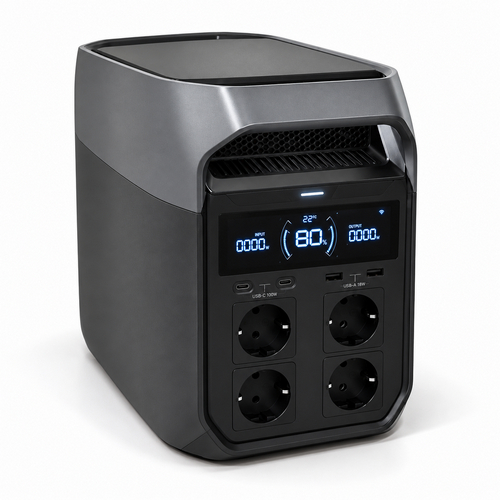
EcoFlow DELTA 3 - Portable Power Station Review
The EcoFlow DELTA 3 has a particularly useful feature: a depleted battery can be fully charged from a standard mains socket in approximately one hour. For a portable power station with a capacity of 1 kWh, this is a substantial advantage, particularly when power outages follow a schedule and little time is available between interruptions.
However, this model also has a characteristic that is easy to overlook among the attractive specifications. Under a light load, it consumes a considerable amount of energy for its own operation. The result is an interesting situation: the station can supply powerful electric tools, yet it is less economical than desirable when powering low-consumption equipment for extended periods.
Consequently, the EcoFlow DELTA 3 is primarily worth purchasing for backup power for household appliances, short periods of operation with powerful equipment, and situations requiring rapid recharging. For continuous power to a router, several LED lamps, or other low-power electronics, I would consider more economical alternatives.
A Kilowatt-Hour in the Battery: How Much Energy Reaches the Load?
The internal LiFePO4 battery has a capacity of 1024 Wh. The manufacturer specifies a service life of 4000 charge and discharge cycles before the original capacity falls to 80%. This is a good figure for a device that may be used daily. Even with regular operation, the battery should not become the principal factor limiting service life over the next several years.
However, 1024 Wh is the energy stored in the battery. When appliances are connected to the sockets, some of this energy is consumed by DC-to-AC conversion, electronic circuitry, and cooling.
Under a continuous load of approximately 380 W, the measured usable energy delivered by the DELTA 3 reached approximately 900 Wh, or about 88% of its rated capacity. Another test at a higher load produced approximately 870 Wh. These results are entirely reasonable for a portable station with an inverter.
At a consumption of only 34 W, however, the situation changed: approximately 530 Wh could be obtained through the socket. This is only slightly more than half the rated energy reserve. The reason is the station's own consumption, which becomes particularly significant when operating a low-power appliance for an extended period. Consumption by the enabled inverter and AC outputs was estimated at approximately 16 W.
The practical implication is that the DELTA 3 is suitable for a refrigerator, computer, or television, but operating time should be calculated with a margin. If the only requirement is to charge a smartphone or laptop, a direct USB connection is more appropriate. This avoids spending energy on conversion to 230 V and back again.
.1800 W: Substantial Output, but Limited Duration
The inverter's rated output is 1800 W, and it can withstand up to 3600 W briefly. The output voltage has a pure sine wave form, making the station suitable for various household electronics and appliances with electric motors, provided that their starting currents remain within the inverter's capabilities.
A refrigerator, television, computer, or electric tool can be connected. A 1500 W electric kettle will also operate without enabling any additional modes. However, extended use is not possible: under this load, a fully charged battery will be depleted in slightly more than half an hour.
It is important here to distinguish between power and capacity. The former determines which appliance the station can start; the latter determines how long it will operate. The DELTA 3 is particularly strong in the first respect.
The proprietary X-Boost technology is also available. For the European 230 V version, support is specified for appliances rated at up to 2400 W. This is achieved by varying the output voltage under load. A heater or simple electric kettle can operate at a lower actual power. This type of supply is unsuitable for devices with sensitive electronic circuitry.
Particularly importantly, X-Boost does not operate while the station is connected to mains power, including in bypass mode. The additional 600 W should therefore not be assumed to be available when using the DELTA 3 as a backup source for household equipment.
Sufficient Connections: Select the Appropriate Regional Version
The European EcoFlow DELTA 3 has four 230 V sockets. All share the inverter's total output of 1800 W. This is generally sufficient to connect a computer, monitor, refrigerator, and small charger simultaneously, provided that their combined consumption is taken into account.
For mobile devices, there are two USB-C ports delivering up to 100 W each and two USB-A ports delivering up to 18 W. The pair of USB-C ports is particularly useful for laptop owners: two compatible devices can be charged without separate mains power adapters.
There is also a 12.6 V automotive socket supplying up to 10 A and two DC5521 connectors. The total output of this group is limited to 126 W. Connecting a vehicle refrigerator and other 12 V equipment is therefore a straightforward application for the station.
The connectors are located on different panels of the housing. The large display shows the charge level, input and output power, and estimated operating time. The main outputs are enabled using buttons, so a phone is unnecessary simply to supply power. The designers deserve credit for this control arrangement.
Pay attention to the regional version when purchasing. The European version has four mains sockets, while the American version has six and operates at 120 V. The stations look similar, but these versions are not interchangeable.
.Fast Charging Is a Clear Strength of the DELTA 3
The station accepts up to 1500 W from the mains supply. A full charge is specified to take 56 minutes, close to the approximately 55 minutes obtained in practical testing. Unlike many other claims printed on packaging, this specification is particularly accurate.
Charging power can be adjusted through the EcoFlow application. This is useful if the socket is connected to a limited-capacity circuit, a low-power generator is being used, or the load on the wiring needs to be reduced. It can also prevent the cooling system from operating continuously at maximum output.
Solar charging uses the XT60i input. Panels with a voltage of 11 to 60 V, a current of up to 15 A, and a combined output of up to 500 W are supported. In good light, the energy reserve can be replenished in approximately two hours, although the actual result depends greatly on the panels, temperature, and weather.
500 W is a reasonable limit for a camping setup using one or two panels of moderate output. For a permanent solar installation, it is somewhat limited. Moreover, there is only one solar input, restricting connection options.
Vehicle charging is also supported. Charging through a standard cigarette lighter socket is relatively slow, while fast charging at up to 800 W requires a separate compatible EcoFlow vehicle charger and an appropriate connection to the vehicle electrical system.
The standard package includes the station, mains cable, and documentation. The solar panel connection cable, solar panels themselves, vehicle fast-charging system, and additional batteries are accessories. This should be considered when comparing complete package prices.
UPS Mode: Convenient, with a Qualification
The EcoFlow DELTA 3 can operate as a backup power source, automatically switching to its battery when mains voltage is lost. The specified transfer time is less than 10 ms.
Connect the station to the mains supply and the refrigerator or computer to one of its sockets. While mains electricity is available, the load receives power through the station. When the mains supply fails, the inverter starts. This arrangement is suitable for many household appliances.
This does not, however, make the DELTA 3 a full double-conversion UPS. In bypass mode, mains voltage does not pass through a continuously operating inverter. The station does not provide the same continuous regulation and load isolation as a dedicated online UPS.
There is another undesirable detail. Some DELTA 3 units have experienced errors in determining the remaining charge and AC output shutdowns even when energy remained in the battery. There is insufficient evidence to describe this as a widespread fault, but it is a significant reason to test the individual station in practice before relying on it for important backup power.
If a home server, NAS, or work computer will be connected, switching to the battery and back should be tested several times, including after settings changes and firmware updates. For equipment that must never lose power, I would prefer a dedicated UPS.
For a refrigerator, lighting, and ordinary household appliances, however, the DELTA 3 backup mode is useful. Its capabilities must simply be understood, and the advertised 10 ms should not be regarded as a guarantee of uninterrupted operation under every possible mains fault.
.Weight, Cooling, and Maintenance
The DELTA 3 weighs approximately 12.5 kg and measures approximately 398x202x284 mm. It can be described as compact compared with a petrol generator, but its weight is significant for regular carrying over long distances. Carrying it from the car to a country house is manageable. Carrying it by hand on a prolonged walk is considerably less practical.
The housing has ventilation openings to cool the power electronics. Under a light load, the station is relatively quiet; the manufacturer specifies a noise level below 30 dB at outputs of up to 600 W. During intensive charging and high-output operation, cooling becomes more active. The device should not be placed directly against a wall or inside an enclosed cabinet.
Water protection also requires clarification. The IP65 rating applies to the internal battery pack. The complete device, with its sockets, connectors, and ventilation openings, does not have this protection. It must therefore not be left in the rain.
The battery is built in, and the design does not provide for routine cell replacement by the user. A serious fault will require service assistance. For a device whose battery could potentially last many years, this is not ideal from a repairability perspective. The five-year warranty advertised in several markets partly offsets this shortcoming, but service terms must be checked with the individual seller.
The station requires no special maintenance. Keeping the ventilation openings clean, storing the device in a dry room, and monitoring battery condition are sufficient. For prolonged storage, the manufacturer recommends performing a charge and discharge cycle approximately every three months, leaving the battery at about 60% charge.
Temperature limits also apply. Charging is permitted between 0 and 45 degrees, while discharging is permitted between -10 and 45 degrees. This matters in winter: a station left in freezing conditions may supply equipment, but it will require a suitable temperature before subsequent charging.
A Useful Application, Although Not Everyone Will Want to Use It
The station connects to a phone over Bluetooth and Wi-Fi. The EcoFlow application provides charging speed adjustment, charge and discharge limits, output control, consumption monitoring, and firmware updates.
Scheduled operation can be arranged, with the battery used during periods of expensive electricity. However, before attempting tariff savings, charging and discharging losses should be calculated. No free energy is created, and each cycle consumes part of the battery's service life.
I appreciate the retention of physical buttons for simple operations. However, control of certain important parameters has been moved into the application. For example, a separate mechanical selector for mains charging power would be more convenient, particularly when frequently using the station with a generator.
Another consideration is that new firmware can change battery, charging, and output control algorithms. Before using the station for important backup power, checking its operation after updates is advisable. Software considerations are an unavoidable aspect of modern electronics.
.DELTA 3, DELTA 3 Plus, DELTA 2, or a Competitor?
The most appropriate comparison is with the EcoFlow DELTA 2. The older model has the same 1024 Wh capacity and 1800 W rated output. The DELTA 3 offers faster charging, a longer specified battery life of 4000 cycles rather than 3000, and a higher short-duration load limit.
However, at low power consumption, the DELTA 2 may prove more economical. In comparable tests with a 34 W load, it delivered approximately 690 Wh versus 530 Wh for the DELTA 3. Buyers primarily requiring prolonged power for low-consumption appliances should therefore not dismiss the older model.
With the same basic capacity, the DELTA 3 Plus offers two solar inputs with a combined capacity of up to 1000 W, more powerful USB-C ports of up to 140 W, and additional interaction capabilities with compatible computer equipment. For regular solar charging, these advantages are significant. If the price difference is small, I would prefer the Plus.
The DELTA 3 Classic is also available. Its name is very similar and its capacity is also 1024 Wh, but it has no battery expansion capability. For anyone planning to increase the energy reserve gradually, this is a fundamental difference.
Competitors worth considering include the Anker SOLIX C1000 Gen 2, BLUETTI Elite 100 V2, and Jackery Explorer 1000 v2. They occupy a similar capacity and output class. Individual models may offer advantages in weight, conversion efficiency, or price. The choice depends on whether charging speed, portability, or the ability to connect an additional battery matters most to the buyer.
The ability to expand the DELTA 3 to approximately 5 kWh is appealing. Compatible EcoFlow additional batteries are supported, including those from earlier series. However, before assembling such a system, its total cost should be compared with the price of a higher-capacity station. An additional battery increases operating time, while the inverter's rated output remains the same.
Is the EcoFlow DELTA 3 Worth Purchasing?
Purchase it if you need a portable 1800 W station with rapid recharging, a good selection of connections, and expandable capacity. It is particularly suitable for periodic power outages, tool operation away from the mains supply, outdoor trips, and backup power for household appliances.
The principal limitation is relatively high energy consumption under light loads. For continuous power to a router, alarm system, or several lamps, this may be a decisive disadvantage. The second qualification concerns UPS mode: dedicated equipment is preferable for critical applications.
The DELTA 3 represents reasonable value if it costs only slightly more than the DELTA 2 and substantially less than the DELTA 3 Plus. At a similar price, the Plus is more attractive because of its two solar inputs and improved USB ports. If the DELTA 2 is available at a significantly lower price, its capabilities remain sufficient for ordinary household backup power.
Overall, the EcoFlow DELTA 3 is a capable power station combining substantial output, a durable battery, and very fast charging. However, I would not advise selecting it solely on the basis of the "1024 Wh" label. It is important to establish in advance exactly which appliances will be connected and how long they must operate. A substantial power margin does not necessarily mean economical energy consumption.