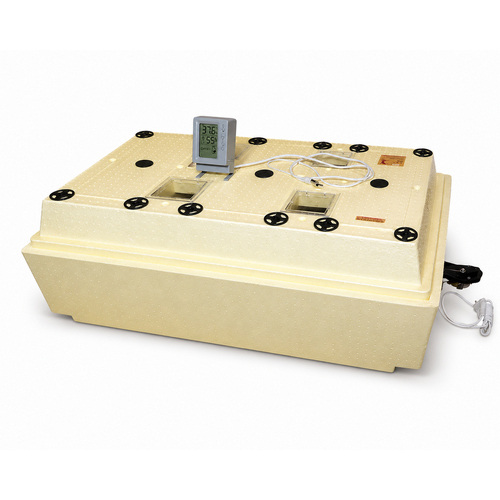
Zolushka 98 Domestic Incubator Review
The Zolushka 98 is purchased for neither an attractive control panel nor fully automatic operation. This large expanded-polystyrene incubator holds 98 chicken eggs and focuses on water heating, automatic turning, and maintaining operation during outages from a 12 V battery. It best suits a rural or country household where eggs are incubated in batches, electricity sometimes fails, and the owner is prepared to check temperature, water, and egg position daily.
The construction is simple. Plastic trays and grids sit below; the lid above contains heaters, a thermostat, viewing window, filling openings, and sensor. A powered metal grid rolls the eggs, with a specified frequency of up to 10 turns daily. The incubator itself can use 220/12 V, but the turning mechanism operates at 220 V. During emergency battery operation, heat can therefore be maintained, while turning and operating conditions still require supervision.
The Zolushka 98 specifications are attractive: maximum power of 75 W, temperature maintenance accuracy of approximately 0.2 °C, three 1 L water heaters, dimensions of approximately 885 x 550 x 275 mm, and weight of approximately 5 kg. Expanded polystyrene retains heat better than thin plastic but requires careful handling. Loading density is high: besides 98 chicken eggs, approximately 50 goose or duck eggs can be accommodated. Quail require a separate grid for proper positioning.
.Water Heating and Backup Supply
The model's principal strength is heat stored in water. With a litre of hot water in each lid heater, the incubator cools more slowly during a mains outage. For a household facing interruptions of an hour or two, this is practical protection rather than a decorative feature. The 12 V battery terminals are useful too: with a suitable vehicle battery connected beforehand, there is no urgent need for blankets and boiling water.
This arrangement has a disadvantage. A water-filled lid becomes heavy and must not be tilted: water may leave the chambers, enter unwanted areas, or disturb operating conditions. Missing lid handles are particularly noticeable with 98 eggs inside, the sensor positioned, and water needing a quick top-up or trays requiring inspection. Lift carefully, much like a tray of hot liquid: weight may be modest, but awkward movement immediately causes frustration.
Temperature: Adjustable, but Not Negligible
Temperature adjustment is manual through the thermostat. In practice, this involves several small knob adjustments and waiting for the water, lid, and internal air to stabilise. Beginners may find adjustment imprecise: the scale is less convenient than a proper digital controller with a clear setpoint. An initial error is particularly undesirable because raising temperature is easier than calmly correcting overheating afterwards.
The manual's operating range is approximately 38.3-38.7 °C, with temperatures above 39 °C prohibited. In a full batch, eggs generate their own heat during the second half of incubation, changing behaviour from the initial days. Adding hot water can also shift temperature. The Zolushka 98 therefore needs observation rather than one-time adjustment: check the reading, inspect the sensor near egg-top level, and adjust the knob only slightly.
.Automatic Turning and Egg Placement
Automatic turning substantially reduces work, particularly with a full batch of 98 chicken eggs. The mechanism rolls eggs slowly using a grid rather than turning them abruptly. Movement is almost imperceptible, making pencil marks on opposite shell sides useful rather than merely formal. They reveal whether the drive works, the grid is stuck, and the outer rows turn evenly.
The mechanism is less confident with large eggs. Duck and goose eggs occupy more space and roll less easily; actual turning may be smaller than the term "automatic" suggests. Disconnect the drive 2 days before hatching and remove the metal grid, beginning the final stage without rolling. Leaving the arrangement unchanged makes hatching less convenient for chicks.
Humidity and the Absence of Fans
Humidity is controlled through water in the lower trays. The manual gives general guidance: fill cavities symmetrically; a pair may suffice in a humid room, while a dry room may require all 8. However, precise household instructions for each bird species are insufficient. It is easy to add excessive water initially or leave edges too dry. For chicken eggs, many users begin with moderate water and adjust according to a humidity meter and chamber condition.
The basic Zolushka 98 generally has no fans, noticeable across its large 885 x 550 mm footprint. Heat distribution is less even than in forced-air models. Eggs at the edges and centre may incubate under slightly different conditions, particularly in a cool room or with frequent lid opening. A simple approach is to exchange positions after several days: move outer eggs inward and central eggs outward. This adds work but improves hatching uniformity.
.Benefits and Tasks That Become Tiresome
Capacity is welcome. One batch of 98 chicken eggs meets the needs of a small household rather than merely providing a trial with a dozen chicks. The hot-water-filled housing also avoids immediate cooling during a power failure. Expanded polystyrene is advantageous here: light, insulating, and inexpensive. Properly positioned in a 20-25 °C room, the incubator maintains conditions, but needs a level surface without draughts.
Water handling is inconvenient. Heaters need hot water, trays need warm water, and occasional draining or topping up requires attention to plugs and the drain opening. The lid must not be placed at an angle. Cooling heater water changes temperature; excessively hot water with a partial load can cause an unwanted rise. The water system provides emergency stability at the expense of everyday convenience.
Sensors are another questionable aspect. The temperature sensor must hang vertically near egg-top level without touching the shell. Removing the lid can easily move it, while one sensor cannot reveal all corner conditions in this volume. A separate reference thermometer is therefore useful, particularly on the first day while heaters, water, and eggs equalise in temperature.
Who Is the Zolushka 98 Suitable For?
This model suits owners willing to perform hands-on incubation tasks: position the sensor, check egg marks, add water, monitor humidity, and sometimes move eggs between zones. In return, it provides a large batch capacity, 12 V backup supply, and stored heat in water heaters. For an unreliable mains supply, these matter more than a tidy display or fashionable housing.
Beginners expecting a "load and forget" approach may find the Zolushka 98 temperamental. The saying about counting chickens only after they hatch is appropriate: good results depend on more than the specified 98 places, including water, temperature, sensor position, egg quality, and owner patience. For the simplest start, consider models with fans, digital adjustment, and a more convenient lid. If capacity, repairable simplicity, and retaining heat without mains power matter, the Zolushka 98 remains functional, but does not tolerate inattention.
Related articles:
Zolushka 98 FAQ