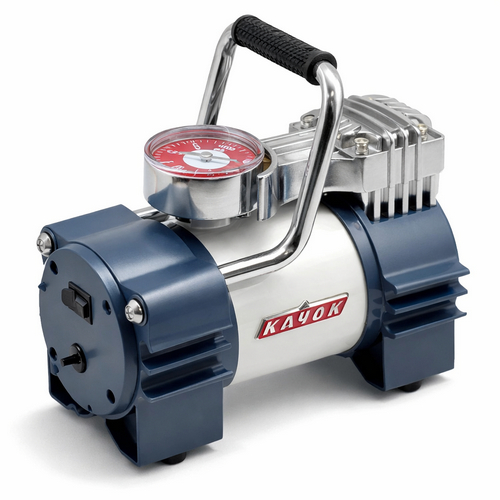
Kachok K90 Portable Automotive Compressor - Review
A good automotive compressor should have one important quality: it can be left alone until a tyre needs air. The Kachok K90 is such a device. It has no display, programmable pressure, or other electronic conveniences. Instead, it provides a piston mechanism, a sufficiently powerful motor, metal housing components, and 40 L/min output. This is convincing for an ordinary passenger car.
The K90 is also interesting because it combines reasonable inflation speed with cigarette lighter power. The result is a relatively compact compressor connected within seconds. However, convenience imposes greater demands on the socket and wiring. Its own cable also deserves closer attention than its mechanical section.
Design: Essential Components in Appropriate Positions
The Kachok K90 uses a conventional piston arrangement. A motor drives a piston through mechanical transmission, compressing air into the tyre. Unlike compact diaphragm pumps, this design produces high pressure and handles automotive wheels confidently.
The housing combines a metal central section with plastic components. Metal provides rigidity and dissipates heat. Nevertheless, this is not industrial equipment for prolonged continuous use. Modest size and substantial thermal load make time limits necessary.
A carrying handle and rubberised lower supports are provided. These reduce vibration transmission and improve stability. Naturally, they cannot completely remove piston pump vibration and mechanical noise.
The approximately 1.2 m air hose fits into housing grooves, a sensible arrangement preventing loose movement during storage. The three-metre power cable has no equally convenient storage system and must be coiled into the bag.
The metal threaded hose connector screws directly onto the wheel valve. It securely retains the hose during inflation but takes slightly longer to connect and remove than a lever quick coupling.
.40 Litres per Minute: Practical Roadside Value
The Kachok K90 specifies 40 L/min, a substantial figure for a cigarette-lighter-powered portable compressor. It is considerably more useful than low-output pumps requiring prolonged patience to restore tyre pressure.
However, 40 L/min requires correct interpretation. Output depends on backpressure: higher tyre pressure makes each additional air charge harder to deliver. The nominal figure does not mean exactly 40 litres enter a pressurised tyre every minute. Nevertheless, the K90 has a reasonable margin for ordinary top-ups.
Ordinary passenger cars are the best application. Restoring pressure after cold weather, inflating the spare, or adding several tenths of an atmosphere before a long journey is comfortably covered. Crossover wheels are also manageable, although larger tyre volume necessarily increases operating time.
K90 descriptions list maximum pressures of 7 or 10 atm, reflecting inconsistent specifications for different versions. More important is that most passenger tyres operate at approximately 2-3 atm, where a sufficient working margin exists. Pursuing the highest pressure figure provides little benefit here.
Continuous operation for the K90 is generally specified at approximately 20 minutes. This covers most roadside tasks, but several completely flat tyres in succession require attention to heating. High pressure and prolonged load can make the compressor noticeably hot.
Heating of metal parts is natural: compression releases heat, while the motor and transmission also incur losses. Allow cooling after prolonged work. Do not check hot metal outlet components with fingers.
Cigarette Lighter Power: Convenient, with Qualifications
The K90 connects to a 12 V vehicle supply through a standard cigarette lighter plug. This avoids opening the bonnet, handling battery terminals, and routing cable through the engine bay. Insert the plug, connect the hose, and switch on.
However, consumption reaches approximately 14 A, a substantial socket load. Check socket current rating and the corresponding fuse before use. Vehicles with 10 A sockets may encounter problems.
Contact condition is equally important. A worn socket, loose plug, or oxidised surfaces increase resistance. High current then causes heating, voltage loss, and reduced compressor performance. An otherwise functioning pump may inflate poorly because of inadequate contacts.
The three-metre cable and hose generally reach passenger car wheels. Large vehicles may present difficulties, particularly reaching a rear wheel from a front-cabin socket.
.Gauge and Controls
K90 operation is simple. A housing switch controls power, and an analogue gauge displays pressure without preliminary setup. The gauge matches the concept: minimal electronics, clear indication, and pressure monitoring during operation.
However, the gauge raises the most questions. Accuracy varies between units, and running readings can be influenced by air passage resistance and pressure pulsations. Final pressure is better checked after stopping and allowing stabilisation.
A separate verified gauge helps precise adjustment, particularly for equal pressure in all four tyres or specific vehicle manufacturer recommendations. Several tenths of an atmosphere can affect handling, wear, and comfort.
The threaded connector also has a characteristic: a small amount of air escapes while it is unscrewed before full separation. Loss is generally minor, but prompt handling is necessary. Secure attachment costs additional movements, an acceptable compromise for occasional use.
Package Contents and Non-Automotive Applications
The Kachok K90 includes a carrying bag, adapters, and manual. The bag keeps compressor, cable, and attachments together rather than scattered through boot recesses, while protecting against incidental scratches and dirt.
Bag quality does not always match the compressor's substantial appearance. Fabric, lining, and zip can wear. This is minor, but a stronger accessory would be appropriate for equipment often purchased for years of vehicle storage.
Adapters serve balls, inflatable rings, small mattresses, and other items. Remember that the K90 piston design primarily creates pressure, while large inflatables require high air volume at low resistance.
The K90 is therefore relatively quick for a tyre, while a large mattress or boat makes its nominal output advantage less apparent. High-volume inflatable furniture is more conveniently handled by a dedicated high-flow pump. The K90 can perform some such tasks, but they are secondary.
.Weak Point: The Power Cable
Despite substantial mechanics, the K90 has a design weakness: its power cable. Severe frost can reduce insulation flexibility. Tight coiling or repeated bending near the housing and plug then increases conductor damage risk.
Housing and cigarette lighter plug cable entries are particularly vulnerable because bending loads concentrate there. Equipment spending much of its life in a cold boot would benefit from a more frost-resistant cable and substantial strain relief.
Coil the cable loosely, leave slack near connections, and avoid forcibly straightening it after prolonged freezing storage. Cracked insulation, damaged conductors, or plug heating marks require repair or replacement in accordance with electrical safety requirements.
The built-in fuse protects against excessive current. If it blows, identify the cause before fitting a replacement of the same rating. Faulty wiring, hot contacts, and excessive motor load require investigation rather than a higher-rated fuse.
Reliability and Long-Term Use
The K90's strength is straightforward mechanics. There is no ageing battery, complex electronic panel, or automatic pressure control. Main components have clear functions, and many electrical faults can be investigated through supply, switch, and connection checks.
With normal use, it can serve for years. However, switch faults, cable problems, gauge errors, and pump wear reducing output occur. Individual quality varies, so considering the K90 indestructible would be excessive optimism.
The air passage deserves attention. Moisture in the hose or connectors can freeze and restrict airflow. After wet-weather use, allow exterior components to dry and store the set dry.
Place the compressor on a relatively clean, level surface. Sand, dirt, and water near intake openings do not benefit piston mechanisms. Periodic cable and plug inspection during storage avoids discovering damaged wiring only after a tyre has deflated.
Is the Kachok K90 Worth Purchasing?
The Kachok K90 appears a successful compromise between output, size, and price. Its 40 L/min covers most passenger car tyres, the threaded connector holds securely, controls are understandable without a manual, and the bag keeps the boot organised.
The main criticism concerns electrical construction. A relatively high-current compressor deserves better cable quality and strain relief. Gauge accuracy is the second qualification, particularly disappointing in a device whose main purpose is producing a specific pressure.
Nevertheless, the K90 remains sensible for passenger car owners wanting a capable pump without electronic complexity. It suits periodic top-ups, seasonal wheel maintenance, and unexpected roadside situations. Check socket compatibility beforehand, handle the cable carefully, and retain access to a separate pressure gauge.
In my view, the K90's main advantage is that its strengths directly concern compressor operation: output, convenient connection, and simple mechanics. Weaknesses are practical and understandable too. It is unfortunate that equally substantial wiring does not support the good pump section. With that improvement, the K90 would merit an almost unconditional recommendation.
Related articles:
Kachok K90 Automotive Compressor FAQ
InFlate FAQ
Tornado AC-580 Automotive Compressor Review
SF-007 Electric Automotive Compressor - Portable Compressor Review
Portable Tyre Compressors: SUITU ST-9624C, Inflate Smart Pump, and SF-007