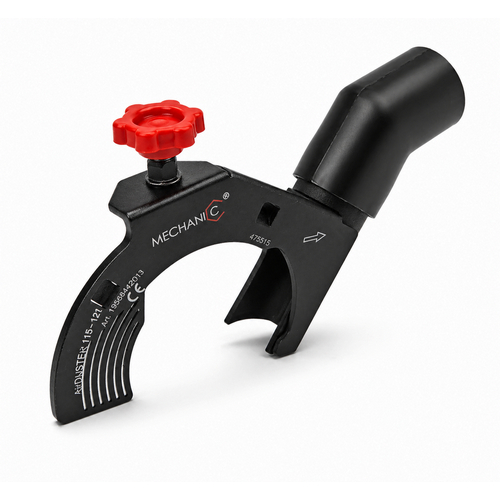
Mechanic AirDUSTER 115-125 Aerodynamic Angle Grinder Shroud Review
The Mechanic AirDUSTER 115-125 suits small angle grinders with 115 and 125 mm discs. It is an add-on dust extractor fitted to the original guard, rather than a complete enclosed wall-chaser shroud, and directs most dust away from the cutting line. Its purpose is practical: cutting bathroom tiles, trimming porcelain, and cutting brick or concrete without subsequently sweeping fine grey dust from every room corner.
It attaches to the grinder's original guard, providing broader compatibility than many enclosed systems sized for a particular gearbox neck. The metal body is open, without guide wheels or a depth stop. An aerodynamic grille at the front draws air towards the disc and into the cutting zone. The principle is to control dust and airflow around the disc rather than enclose it in a box.
A hose connection provides extraction. The AirDUSTER performs noticeably better with a suitable construction vacuum, but its design does not necessarily require a large, exceptionally powerful unit. During light cutting, even an unconnected hose can redirect some dust discharge. This does not create a sterile working environment but substantially reduces the cloud around the face and eyes.
Successful Design Features
The principal Mechanic AirDUSTER 115-125 advantage is cutting visibility. Enclosed shrouds often reduce dust while hiding the disc and markings behind a housing wall. Here, the cutting area remains open. When following a pencil line on tile or trimming porcelain near an edge, visibility matters more than additional decorative shielding. Both line and disc remain visible, making manual corrections easier.
The second strength is weight and balance. The attachment does not turn a small grinder into a heavy wall chaser. This is critical for a 125-millimetre grinder, often a light tool with a small motor: an extra half-kilogram at the front quickly impairs control. The AirDUSTER adds volume around the disc without disrupting the familiar grip. This is particularly apparent during vertical tile cuts or short trimming tasks requiring repeated lifting, turning, and repositioning.
The aerodynamic grille also cools the disc. Airflow passes over the cutting area as well as into the outlet. With a dry diamond disc cutting porcelain, this reduces edge overheating and hot dust odour and helps preserve normal cutting performance. It cannot rescue a blunt or unsuitable disc, but with good accessories the difference is noticeable on long passes as the disc heats.
.Performance on Tile, Concrete, and Metal
The AirDUSTER 115-125 is most effective on tile and porcelain. These produce fine dry dust, the cut is shallow, and the cutting line is generally short and controllable. With a vacuum connected, the surroundings remain noticeably cleaner: dust enters the hose directly behind the disc instead of forming a dense curtain before the face. For one or two tiles this is convenient; repeated indoor cuts also protect finishes and lungs.
Concrete and brick are more demanding. The attachment removes much of the dust, but a small 125 mm grinder itself is poorly suited to deep dry concrete cutting. The disc is small, tool power is limited, and dust and abrasive quantities are greater. The AirDUSTER retains visibility but does not replace a twin-disc wall chaser with an enclosed shroud. Cutting a groove, trimming an edge, or making a short pass is appropriate. Long wall channels are better handled by specialised equipment.
On metal, the attachment also provides an additional barrier against sparks and abrasive fragments. The open design does not contain all sparks, so discharge direction must be monitored. Near plastic, cables, fabric, or wood finishes, position the hose and outlet beforehand. Metal generates less mineral dust but more hot particles, making care more important than advertised extraction percentages.
Installation and Everyday Inconveniences
The Mechanic AirDUSTER mount is simple: it fits over the original grinder guard. This is convenient in a workshop with several grinder brands, but has a disadvantage. Original guards differ in shape, thickness, and locking position, so initial fitting can require angle, tightness, and outlet adjustment. Fast attachment is possible, but arranging the hose so it neither pulls the hand nor catches the workpiece may take more than one attempt.
The hose is another practical issue. The attachment is light, but a connected vacuum hose adds resistance. This is barely noticeable on a short cut; during a long floor or wall pass, the hose can catch a corner, pull the grinder backwards, and disrupt smooth movement. Use a flexible hose of suitable diameter and secure it to follow the tool rather than hang heavily from the side.
The open arrangement preserves visibility but does not provide absolute cleanliness. Some dust still escapes, particularly when starting at an edge, leaving the material, or using a vacuum clogged with fine mineral dust. A cyclone pre-separator is strongly desirable: without it, an ordinary vacuum quickly loses suction, its filter clogs, and shroud performance falls during work. Reduced airflow generally indicates a blocked extraction system rather than a faulty shroud.
.Limitations to Understand before Purchasing
The AirDUSTER 115-125 has no wheeled base or depth adjustment. Straight cutting therefore depends on the operator rather than the attachment. On tile, an edge, guide, or shallow initial pass can help. Concrete causes faster arm fatigue, and forcing the disc through in one pass can make the cut wander. The attachment removes dust but does not convert a grinder into a tile cutter or wall chaser.
Stated versatility also has practical limits. The shroud formally fits 115-125 mm grinders from various manufacturers, but convenience depends on handle position, original guard shape, gearbox size, disc rotation, and final outlet position. One tool may fit neatly while another leaves the hose pointing inconveniently. Make a trial cut on scrap before substantial work rather than starting immediately on finished tile.
Without a vacuum, the attachment does not become a device that eliminates dust. An unconnected hose directs airflow and removes some discharge from the breathing zone, but fine cement dust still disperses. Work in a flat, bathroom, or kitchen requires a vacuum with a suitable filter, a respirator, and closed doors. The AirDUSTER reduces contamination rather than eliminating dry-cutting precautions.
Who Is the Mechanic AirDUSTER 115-125 Suitable For?
This attachment suits tradespeople frequently using a small grinder for tile, porcelain, brick, stone, and occasional metal trimming. Tilers, finishers, installers, and household renovators can use it, particularly if they already own a vacuum and do not want a heavy enclosed shroud for several dozen cuts. The 115-125 mm format suits mobile work: take out the grinder, fit the attachment, connect the hose, cut, and put the tool away.
Long wall channels, deep concrete, continuous reinforced concrete cutting, and precise depth tasks are less suitable. The AirDUSTER remains useful but is not the primary solution. A small disc limits depth, the open shroud lets some dust escape, and the lack of a guide demands a steady hand. Daily cutting of metres of wall calls for a dedicated wall chaser or enclosed system with a rigid base.
Assessment
The Mechanic AirDUSTER 115-125 succeeds by avoiding unnecessary grinder complexity. A metal overlay on the original guard, open grille, hose outlet, and retained cutting line visibility form a simple but functional combination. It performs best on tiles, porcelain, and short mineral-material cuts requiring rapid dust cloud reduction without losing disc control.
The drawbacks are practical: the hose interferes, the vacuum needs maintenance, a straight line depends on the operator without a guide, and demanding concrete quickly reveals a 125-millimetre grinder's limits. These compromises are acceptable for compactness, visibility, and substantial dust reduction. The AirDUSTER 115-125 suits frequent cutting without carrying an enclosed shroud or accepting a grey coating throughout the room after every cut.
Related articles:
Mechanic AirDUSTER 115-125 FAQ