
Nomad KCST 9029AES(TD) - Tracked Snow Blower Review
The Nomad KCST 9029AES(TD) is intended for properties requiring substantial snow removal: a long driveway, the area before gates, and paths between buildings. The 74 cm intake clears a considerable strip in one pass, while tracks help it move over compacted snow and uneven ground. In a narrow passage, this width requires care. The machine weighs approximately 120 kg and needs sufficient turning space.
Engine, Auger, and Running Gear
Beneath the cover is a four-stroke Loncin G 270FD with a displacement of 270 cubic cm and output of 9 hp. The engine drives both the clearing mechanism and self-propelled transmission. Five forward and two reverse speeds are provided. Slow travel is useful when the auger tackles a dense ridge left by road clearing; a higher gear suits loose snow when the intake remains well below full load.
The clearing system is two-stage. A toothed steel auger collects and breaks up snow, then a metal impeller ejects it through a rotating chute. The 52 cm intake height provides a margin for deep drifts, although high wet ridges are better cleared gradually. A mechanical panel lever changes discharge direction, avoiding repeated reaching towards the chute itself.
Triangular track assemblies replace wheels. They distribute weight over a larger area and are less prone to slipping when an icy rut lies beneath fresh snow. The design provides track locking for manoeuvring. However, the track base occupies space and substantially resists turning on dry asphalt, particularly with the engine off.
.Why Tracks Matter More than Another Speed
The KCST 9029AES(TD)'s main advantage appears on an uneven driveway or a courtyard hardened by repeated thaws. A wheeled machine can lose traction precisely when the auger faces its most demanding work. The Nomad tracks transmit tractive effort more reliably. The operator can select a pace appropriate to snow density instead of repeatedly pushing from behind.
The 74 cm width suits open areas, requiring fewer passes than a compact 50-60 cm intake. However, the full width requires power. In heavy wet snow, using only part of the intake and selecting a low gear is sensible. This is normal for a two-stage mechanism: steady flow through the chute is better than attempting a full-speed single pass through a drift.
Cold-Weather Controls and Work near the House
The electric starter is particularly welcome after overnight storage in a cold shed: starting need not begin with energetic cord pulling every time. Drive and chute direction levers are near the controls. When snow must be directed away from windows, a fence, or a parked vehicle, direction can be adjusted while moving. Throw distance depends on snow density and moisture: dry snow travels more readily, while sticky snow accumulates in the chute sooner.
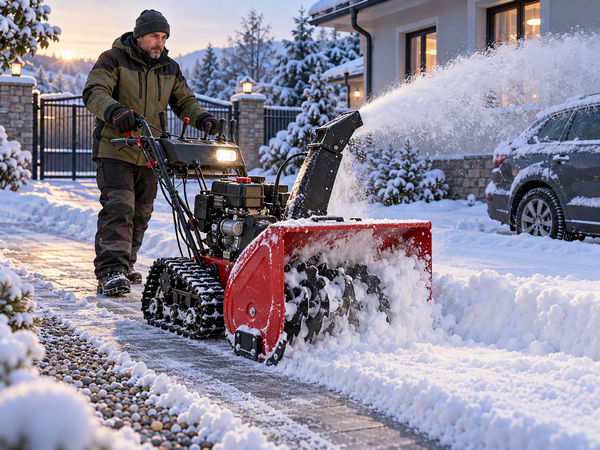
Heated handles and the headlight improve convenience during prolonged clearing. Hands remain warmer while holding levers, and lighting helps reveal path edges early in the morning. However, the headlight illuminates the area before the intake; kerbs, protruding stones, and low obstacles should be noted before snowfall. A toothed metal auger striking one may shear a protective pin.
On gravel paths, intake skid adjustment matters greatly. If the scraper is too low, the auger collects stones with the snow. On level hard surfaces, clearance can be reduced to leave a thinner layer. Near gates, consider both the 74 cm intake width and the complete tracked machine dimensions including handles. Plan the route beforehand: turning the chute too late can cover a freshly cleared path again.
.Where the Nomad Requires Patience
Approximately 120 kg provides traction but complicates storage. Manually repositioning the stopped machine, moving it over a high threshold, or turning in a confined garage is difficult. Tracks turn less readily than wheels on dry paving. For a short path to the porch, this equipment may be excessive: bringing it out and manoeuvring can take longer than clearing the snow.
The friction-drive stepped transmission is another consideration. Its design is conventional for petrol snow blowers but requires correct handling: change gears with the drive stopped and periodically inspect belts and the friction disc. After clearing, remove snow from the intake, chute, and track area. Remaining wet material freezes overnight and complicates subsequent mechanism startup.
The 270 cubic cm engine produces considerable noise and exhaust, so late-evening work near windows is unlikely to please neighbours. Fuel, oil, spark plug, and drive cable adjustment also require attention. Electric starting and heated handles simplify winter work but do not eliminate seasonal petrol equipment maintenance.
Assessment
The Nomad KCST 9029AES(TD) suits regular clearing of a wide driveway, courtyard, or parking area after substantial snowfall. Its strength is the combination of tracked traction, a 74-centimetre intake, and a two-stage metal mechanism powered by 9 hp. The costs are 120 kg weight and demanding turns. For open, uneven ground, this exchange is justified; for a couple of narrow paths beside a house, a lighter machine is more convenient.
Related articles:
Nomad KCST 9029AES(TD) FAQ