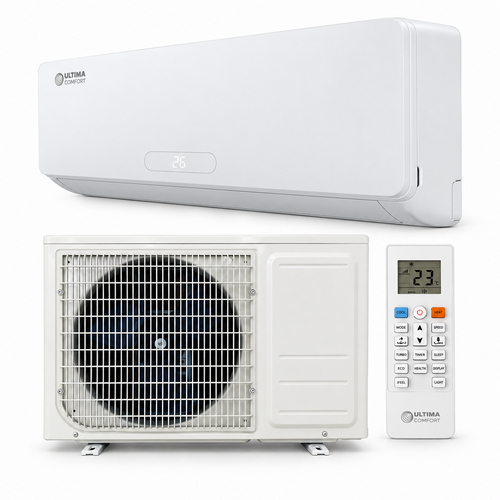
ULTIMA Comfort EXP-07PN - Explorer Wall-Mounted Split System Review
The ULTIMA Comfort EXP-07PN combines an interesting selection of features. These include exchanger self-cleaning by frost formation, automatic drying after cooling, and even separate compressor sound insulation. However, its timer requires the remote to remain within direct sight of the indoor unit. Put it in a drawer, and the scheduled start may not occur. The engineering decisions have clearly developed in different directions.
The EXP-07PN belongs to the Explorer series and is intended primarily for small living spaces. It is a conventional split system with a fixed-capacity compressor, familiar remote, and a broad selection of modes for its class. Several features are useful, although some control characteristics raise questions about who will use them and under what circumstances.
A Seven-Class Unit for a Small Room
The 07 designation indicates a cooling class of approximately 7000 BTU/h. For the EXP-07PN, capacity is 2.15 kW in cooling and 2.25 kW in heating. The approximate coverage area is 20 m2. This is adequate for an ordinary bedroom, study, or small living room with moderate heat gains.
However, floor area alone reveals only part of the situation. A room with west-facing panoramic windows heated by evening sunshine has very different requirements from an equally sized room with good insulation and north-facing windows. A running computer, television, and several occupants further reduce the cooling margin. I would therefore treat the 20 m2 upper limit with some caution.
Nominal electrical consumption is 668 W in cooling and 623 W in heating. EER 3.22 and COP 3.63 correspond to class A in both modes. Maximum power consumption reaches 905 W. These figures describe different operating conditions and must not be confused when assessing electrical load.
The compressor is a conventional non-inverter GREE unit. Upon reaching the set temperature, the system stops it and starts it again as the air warms. This arrangement is relatively simple and clear. It offers less precise capacity regulation but avoids a complex inverter power converter.
.Quietness with Qualifications
Five indoor noise values are specified: 20, 24, 27, 31, and 33 dB(A). This broad range is useful: airflow can be increased while cooling the room, then reduced for quieter operation after a comfortable temperature is reached.
Airflow ranges from 300 to 500 m3/h. The lower value is particularly interesting for a bedroom, where avoiding a constant draught matters more than maximum cooling speed. The upper value helps mix air faster in a warmed room.
Interestingly, the remote's SPEED button provides three selectable speeds and automatic mode. Separate QUIET and TURBO buttons expand fan control. However, QUIET is available only during cooling. It cannot be relied upon during nighttime winter heating.
The attractive 20 dB(A) figure applies to the minimum fan mode. In the EXP-07PN, compressor starts and stops, outdoor unit operation, refrigerant movement, and possible plastic expansion clicks remain. This design does not promise complete acoustic invisibility.
The outdoor unit is rated at 50 dB(A). The compressor has sound insulation, but wall mounting quality and vibration isolation substantially affect the result. Even a relatively quiet unit can transmit low-frequency humming through rigid brackets and the wall.
A Remote with Useful Details and an Unusual Timer
The EXP-07PN remote deserves separate discussion. I appreciate the dedicated COOL and HEAT buttons. There is no need to cycle through MODE selections every time cooling and heating must be exchanged. In daily use, this small detail saves more actions than might appear.
Separate buttons control temperature, fan speed, automatic louvre swing, timer, sleep, and economy modes. The indoor LED display can be extinguished with DISPLAY. After another command, it lights briefly and switches off again after approximately ten seconds. This is sensible for a bedroom, where bright nighttime digits are unnecessary.
Temperature can be set from +16 to +32 °C. In automatic mode, the conditioner selects cooling, heating, or dehumidification around a reference temperature of +25 °C. The setpoint cannot be changed in this mode. I prefer manual selection: personal preferences do not always match the controls' definition of comfort.
The timer schedules on or off operations in one-hour increments up to 24 hours ahead. For scheduled operation, the remote must remain pointed at the conditioner and within eight metres. The remote itself sends the command at the appointed time.
The remote therefore forms part of the timed control system. Leaving it behind an obstacle, moving it to another room, or accidentally covering it with belongings makes schedule reliability uncertain. I regard this approach as poor. A timer operating entirely inside the indoor unit, with the remote used only for initial setup, is considerably more convenient.
.Cooling, Heating, and Additional Modes
The main modes are conventional: cooling, heating, dehumidification, and ventilation. Ventilation circulates indoor air without operating the refrigeration circuit. The conditioner does not bring in outdoor fresh air, so ordinary room airing remains necessary.
During dehumidification, the EXP-07PN controls temperature and fan speed automatically. These parameters cannot be adjusted manually. This is reasonable for the moisture removal algorithm, although users preferring full equipment control may dislike the restriction.
TURBO provides rapid room cooling or heating through intensive fan operation. Use it when a rapid temperature change is actually needed: the stronger airflow produces more noticeable noise.
ECO provides an economical operating algorithm, while SLEEP reduces fan speed and adjusts temperature automatically during sleep. Sleep mode uses an eight-hour cycle, after which the conditioner switches off or returns to its previous operation according to the programmed algorithm. Consider this if continuous maintenance of a selected temperature until morning is required.
Heating includes a warm-start function. Until the indoor exchanger warms, the fan remains at low speed even if high speed is selected. I appreciate this behaviour: receiving cold air in the face when heating starts is undesirable.
The outdoor heating limit is -7 °C. The conditioner is useful between seasons when central heating has not yet started or has already stopped. As weather becomes colder, heating capacity decreases and frost may form on the outdoor exchanger. Smart Defrost provides automatic defrost cycles lasting approximately 5-10 minutes, during which indoor heat delivery stops.
I would therefore not regard the EXP-07PN as the only heating source in a freezing climate. Its capabilities better suit supplementary heating during cool autumn and spring weather.
Self-Cleaning That Treats the Heat Exchanger
AClean is among the Explorer series' most interesting functions. It first cools the indoor exchanger, creating condensation and, under suitable conditions, frost or ice. Defrosting and ventilation follow. Water carries away some accumulated contamination, and airflow dries the surface.
This is more substantive than merely continuing fan rotation after shutdown. Nevertheless, its cleaning capabilities have limits: heavy dirt on the fan wheel, a dirty drain, and dust on the removable filter require ordinary maintenance. AClean starts with the conditioner switched off in standby.
A separate mould-prevention function keeps the fan rotating for approximately 30 seconds after cooling or dehumidification to dry the indoor exchanger. Half a minute is brief, particularly in high humidity, but this airflow may reduce residual dampness somewhat.
The exchanger uses Golden Fin anticorrosion coating, intended to protect metal surfaces and retain their working properties. This is useful, particularly given regular contact with condensate.
.Filter and Routine Maintenance
Before reaching the exchanger, air passes through a high-density dust filter with a mesh size of approximately 0.54x0.54 mm. This catches coarse dust, fluff, and other relatively large particles, protecting internal components from rapid contamination.
Fine air cleaning comparable to dedicated purifiers should not be expected. Capturing fine particles requires another filter class; the standard EXP-07PN system primarily protects the conditioner and removes large contamination from circulating air.
The filter is accessed through the lifting front panel. Open it until secured, then remove the filter by its middle section. Accumulated dust can be vacuumed away, and a heavily dirty mesh washed with water. Dry the filter before refitting.
The procedure is simple. Providing convenient access during installation is more important. Mounting the unit directly against the ceiling or above a tall cupboard gradually makes even simple cleaning inconvenient.
Self-diagnostics monitor system condition and display a fault code when a problem is detected. Warnings include temperature sensor faults, indoor fan motor problems, and compressor overload protection. After shutdown, a three-minute restart delay protects the refrigeration circuit against excessively frequent starts.
Installation: Compact Units and Significant Requirements
The EXP-07PN indoor unit measures 700x250x190 mm and weighs 8 kg. Its relatively small size generally makes wall positioning easier than for a more powerful split system. The outdoor unit measures 680x420x275 mm and weighs 22 kg.
Drainage can connect from either side. This useful design detail makes condensate routing easier according to wall and pipe positioning. The drain hose must still have sufficient slope for gravity drainage. Incorrect routing can spoil the performance of even an expensive air conditioner.
Maximum refrigerant line length is 20 m, with a permissible 8 m height difference between units. Minimum pipe length is 3 m and nominal length is 3.5 m. The nominal figure matters for correct charging: longer lines may require additional refrigerant.
The system uses R410A with a factory charge of 0.33 kg. Liquid pipe diameter is 6.35 mm and gas pipe diameter is 9.53 mm. Power connects to the indoor unit. A separate interconnecting cable is purchased during installation.
The package includes both units, the remote, indoor mounting bracket, drain hose, and connection nuts. Outdoor brackets, refrigerant pipes, and other installation materials are selected separately. The conditioner price therefore does not represent the full installed system cost.
Automatic restart is an additional advantage. After power returns, the conditioner can resume with saved parameters. This is particularly useful for a country house experiencing periodic supply interruptions.
Who Is the ULTIMA Comfort EXP-07PN Suitable For?
In my view, the most sensible application is a small bedroom, study, or living room primarily requiring summer cooling, with occasional heating. The 2.15 kW cooling capacity covers moderate room heat loads, while the broad airflow range allows selection between intensive cooling and quieter circulation.
Several EXP-07PN advantages deserve emphasis: separate cooling and heating buttons, display shut-off, exchanger self-cleaning, two-sided drainage, and an accessible washable filter. Development clearly addressed everyday details as well as the main refrigeration circuit.
The main compromise is non-inverter compressor control. During regular nighttime use, periodic starts may be more noticeable than desirable. The unusual timer dependent on remote positioning adds another limitation. Particularly strange are buttons for inactive functions: HEALTH and one SWING direction appear on the remote although this series does not provide the corresponding capabilities.
Overall, the ULTIMA Comfort EXP-07PN appears a reasonably considered budget conditioner with some frustrating control characteristics. Its main working assemblies are sensibly arranged, useful maintenance and protection features are provided, and stated specifications suit a small room.
I would select it primarily for compactness, sufficient capacity, and convenient care, while using the timer cautiously. In a modern split system, putting the remote in a drawer should not become a technical problem.
Related articles:
ULTIMA Comfort EXP-07PN FAQ