VISUAL ANGLE CLOUD WiFi 360 4G 8MP 4K - Surveillance Camera Review
The manufacturer, or more precisely supplier, has clearly overextended the VISUAL ANGLE CLOUD WiFi 360 4G 8MP 4K name. It gathers almost every designation commonly used to decorate inexpensive surveillance cameras: 360 degrees, 4G, eight megapixels, and 4K resolution. The buyer is expected to be impressed. However, careful specification examination raises several substantial questions.
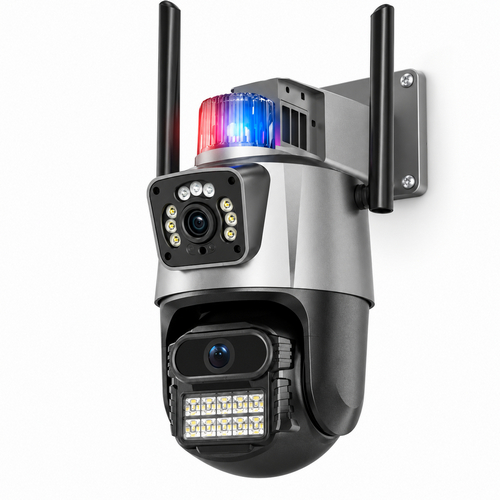
The camera itself nevertheless deserves attention. It has two lenses with different focal lengths, a motorised mechanism, automatic human tracking, night illumination, and memory card recording. For a courtyard, property entrance, or small parking area, this is a sensible combination. The dual-lens design is particularly interesting, providing capabilities generally absent from simple single-lens motorised cameras.
Why the Camera Has Two Lenses
The two VISUAL ANGLE CLOUD lenses serve different purposes. The description lists focal lengths of 3.6 and 6 mm, although some versions specify 4 and 6 mm. The shorter lens covers a wide area, while the longer lens provides a larger image scale. The first channel is useful for watching gates and surrounding ground, while the second enables closer observation near a pedestrian gate or vehicle.
This is more useful than ordinary digital enlargement. Software zoom adds no detail. A longer-focal-length lens initially forms a larger image of a distant object on the sensor. However, the increased scale reduces the viewing angle. This is precisely why combining two different lenses is a sensible engineering solution.
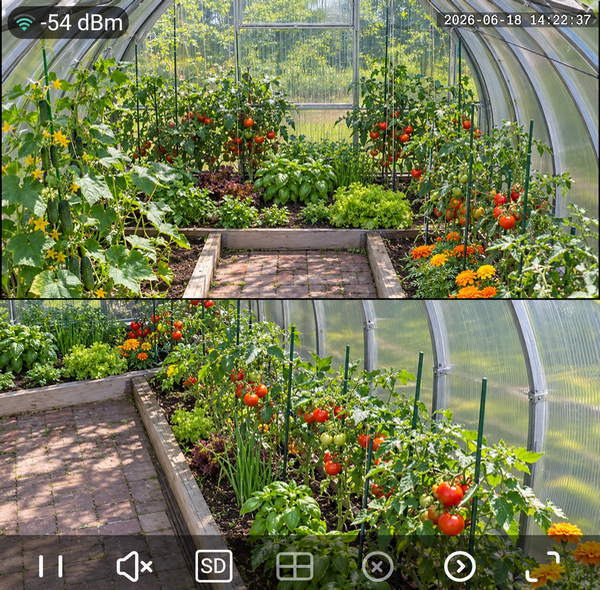
The camera supports viewing two video channels, while the motorised assembly changes the observation direction. However, "360°" must be interpreted correctly. It refers to horizontal rotation, not continuous simultaneous recording of the entire surrounding area. Each lens sees a particular sector at any moment. While the movable part faces one direction, events outside its view may be missed.
Automatic human tracking partly addresses this, but introduces a familiar PTZ compromise. Following one subject turns the movable lens away from other areas. The second channel is therefore particularly useful if it retains coverage of a selected zone. During setup, I would first determine which direction requires continuous observation, then enable automatic movement.
What Lies behind the 8MP and 4K Labels
The most interesting specification concerns resolution. The VISUAL ANGLE CLOUD lists two SC233A CMOS sensors at 2 MP each, designed for images approximately in Full HD format. The stated main resolution is 1920 x 2160 pixels, approximately 4.15 million pixels.
A complete 4K UHD frame is 3840 x 2160 pixels, containing approximately 8.3 million pixels. The difference is substantial. Moreover, 1920 x 2160 may simply combine two 1920 x 1080 streams stacked vertically. This is technically understandable for a dual-lens system but does not increase detail in either individual channel.
There is therefore no basis for expecting a true eight-megapixel image from one lens. A two-megapixel sensor may be sufficient for a gate, path, or outbuilding entrance. Reliable number plate reading at substantial distances or recognition of fine details requires considerably more capable optics and sensors. Attractive figures in the name create excessive expectations.
The specifications also mention fourfold zoom. Since fixed-focal-length lenses are listed, a complete motorised variable-focal-length optical zoom is unconfirmed. Digital enlargement or switching between the two lens images is more likely. This is an important distinction for buyers.
.Outdoor Design and Installation Considerations
The VISUAL ANGLE CLOUD is intended for outdoor use. The stated IP66 rating means a dust-tight housing resistant to powerful water jets. Such protection is necessary for a camera exposed outdoors throughout the year. However, rain resistance says nothing about the positioning mechanism after several winters or permissible operating temperatures. These parameters are not detailed for the version examined.
The housing measures approximately 224 x 120 x 130 mm. The camera is conspicuous, particularly with its bracket and external components. This helps potential intruders notice it and provides some deterrence. Conversely, facade placement must avoid obstructing window opening, gutter maintenance, and other property tasks.
Power is 12 V DC, requiring a cable from the adapter to the installation site. Wireless video transmission does not imply complete independence. The camera relies on electricity, and recording stops during a power outage unless an external backup source is provided.
Cable joints deserve particular attention. Even a well-protected housing offers little benefit if the power or network connector is exposed to rain. Outdoors, I would place connections in a sealed junction box and route the cable from below with a small drip loop. This simple measure is often more useful than additional sealant around the housing.
Mounting height introduces another consideration. A motorised camera needs unobstructed movement space. If installed too close to a roof projection or facade ornament, part of its movement range becomes unusable. Check extreme lens positions and obstacles in the frame before installation.
Wi-Fi, Ethernet, and the Uncertain 4G Designation
Wireless connection uses IEEE 802.11b/g/n Wi-Fi at 2.4 GHz, common in budget surveillance. This frequency generally penetrates walls better than 5 GHz, although thick masonry, metal structures, and distance from the router can substantially impair communication.
A camera advantage is its 10/100 Mbit/s Ethernet interface. For a permanent installation where cable routing is feasible, I would prefer this connection. Streaming video requires stable data transmission, particularly with two simultaneous channels. A wired network avoids many random delays and interruptions associated with congested Wi-Fi.
The 4G designation in the full name is questionable. Detailed specifications list Wi-Fi and Ethernet but provide no confirmed LTE modem, cellular frequency, or SIM slot information. Direct mobile network connectivity therefore cannot be assumed for this version. For a country property or remote site without wired internet, establish this before purchasing. Otherwise, a separate SIM-capable router will be required.
A mobile application controls the camera. It provides image viewing, movable lens direction adjustment, and motion detection functions. However, the exact application name and available settings depend on installed firmware. This matters for inexpensive cameras sold in several hardware versions under similar names.
ONVIF and NETIP support suggest connection to a compatible network video recorder, a substantial advantage for a multi-camera system. Before installation, however, check access to both channels, positioning control, and detection event transmission. Protocol support does not guarantee every function will work with a third-party recorder.
Video Recording: Memory Card, Cloud, and H.265
Local storage uses a microSD card up to 256 GB. Network recorder storage and cloud recording are also specified. Multiple storage options allow an arrangement matched to the task. Local recording can cover a small courtyard, while a central archive is more convenient for a multi-camera site.
The video stream uses H.265 encoding. At comparable image quality, this is more efficient than H.264 and generally requires less storage. Savings are particularly apparent during prolonged recording. Actual archive duration still depends on bitrate, frame rate, simultaneous recorded channels, and recording mode.
Local storage has an obvious vulnerability: if an intruder removes the camera, the memory card disappears too. A network recorder or remote storage addresses this, although cloud recording may require a subscription. VISUAL ANGLE CLOUD service terms must be checked for the installed application.
For continuous recording, use a memory card designed for repeated overwriting. An ordinary inexpensive microSD intended mainly for photos and documents may exhaust its life relatively quickly in surveillance. Periodically check the archive as well: a card in the slot does not guarantee recording is actually occurring.
.Night Observation and Visual Alarms
Infrared and white LED illumination support recording in darkness. The specification lists 11 infrared and 12 white LEDs. The camera provides monochrome night images with infrared light, colour recording with visible illumination, and a combined mode.
These options have practical differences. Infrared illumination suits relatively discreet observation. White LEDs illuminate the scene visibly and retain colour images, useful for identifying a vehicle or clothing colour. However, recording is no longer discreet, and bright lighting near windows can disturb occupants.
Optical limitations also apply. In rain, snow, or fog, light directed almost along the lens axis reflects from droplets and snowflakes, creating bright spots and glare. This is particularly apparent with budget cameras whose lighting surrounds the lenses. I would therefore treat promises of excellent long-range night visibility cautiously.
Visual alarms supplement illumination, including a specified red-and-blue mode resembling police beacons. An audible siren is also provided. In theory, this combination can deter an intruder. In practice, accurate event detection matters greatly. If alarms trigger whenever a cat appears or branches sway, neighbours will soon form their own opinion of this feature.
Automatic Tracking and Two-Way Audio
The VISUAL ANGLE CLOUD supports human motion detection and automatic subject tracking. After detecting movement, its motorised mechanism can direct the lens after the person. For a small courtyard, this is interesting: the camera changes direction independently to keep the subject in view.
However, system response speed is limited. Detection, image processing, motor startup, and lens movement take time. A fast-moving person, particularly close to the camera, may leave the frame. Automatic tracking can also divert attention from a more important area. I would treat this as a useful supplement to appropriate positioning, rather than a replacement for well-planned surveillance.
A microphone and speaker provide communication. Two-way audio allows speaking directly to a visitor through the camera, useful near gates, an entrance door, or a small warehouse. Outdoor conversation quality depends strongly on wind, distance, and ambient noise. A camera with a small built-in speaker is unlikely to replace a complete intercom.
Maintenance and Everyday Use
In use, the camera primarily requires attention to lenses, protective windows, and network connection condition. Outdoor optics gradually collect dust, rain marks, and cobwebs. Cobwebs are particularly troublesome at night: strands near the lens reflect infrared light brightly and can turn an otherwise clear image into a hazy scene.
The positioning mechanism adds another assembly whose long-term reliability matters. Frequent automatic movement increases drive wear. Constantly moving the lens back and forth unnecessarily is therefore unwise. For a defined observation zone, choose a primary position and enable tracking where it actually provides benefit.
Software deserves separate attention. A remotely accessible camera continuously interacts with the local network and possibly cloud servers. During initial setup, establish a unique password, check firmware update availability, and restrict unnecessary remote access. This is particularly important where device origin and software support duration are poorly documented.
.Assessment
The VISUAL ANGLE CLOUD WiFi 360 4G 8MP 4K is interesting primarily for combining two lenses, motorised observation, and several recording methods. This is a broad feature set for a budget camera. Different focal lengths divide tasks sensibly between general observation and more distant areas, while Ethernet and stated ONVIF support make it suitable for a small surveillance system.
The principal doubts concern specification accuracy and predictability of the individual version. Two 2 MP sensors do not provide the detail buyers reasonably expect from an 8MP 4K label. The 4G designation also needs separate verification. This is unfortunate because the camera appears technically sensible for its price class. It need not promise more than it can deliver.
I would consider the VISUAL ANGLE CLOUD for a small private courtyard, property entrance, or utility area with stable electricity and local network access. Its dual-lens design can be useful there. For important sites requiring guaranteed recording quality, dependable alarm events, and long-term software support, equipment with an unambiguously specified hardware configuration is preferable. A good camera begins with good optics rather than numerous impressive abbreviations on the box.
Related articles:
VISUAL ANGLE CLOUD WiFi 360 4G 8MP 4K FAQ