VNIISSOK A1400I - Compact Inverter Generator Review
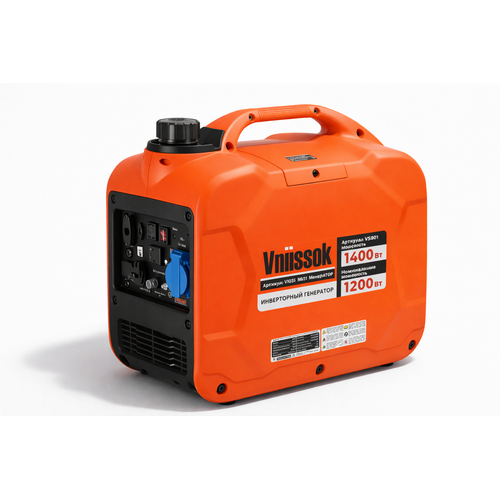
The VNIISSOK A1400I housing prominently states 1400 W. This is an attractive figure, but generator selection should focus on another: 1200 W. That is the output the station can provide continuously. The difference determines whether the purchase meets expectations or the generator starts shutting down when another appliance is switched on.
Essentially, this is a small electricity source for lighting, battery charging, electronics, and moderate household loads. Its strengths are an inverter arrangement, enclosed housing, several connection options, and an economy engine mode. Nevertheless, the A1400I remains a complete petrol generating set with all the associated requirements: fuel, oil, maintenance, and exhaust gases.
A Compact Housing with Noticeable Weight
The VNIISSOK A1400I resembles a small plastic suitcase. The orange housing has rounded corners, a carrying handle on top, and controls grouped at one end. This layout is convenient for transport: the generator occupies relatively little space and has fewer protruding metal parts than a conventional station in a tubular frame.
However, the 14.5 kg weight moderates the initial impression. Carrying it from a garage to a car is straightforward, but a long walk along a forest path is less appealing. The model is therefore better suited to car trips, country properties, and stationary use on a plot than to hiking.
The enclosed plastic cover performs several tasks. It shields the engine and electrical components from accidental contact, directs cooling airflow, and partly contains mechanical noise. However, it complicates access to internal components. Air cooling requires unobstructed space around ventilation openings, particularly during prolonged operation in hot weather.
The fuel tank cap with its ventilation valve is on top. During transport, close the ventilation correctly and keep the generator upright. The streamlined housing looks tidy, but even an elegant shape cannot prevent petrol odours in the boot if the cap leaks.
.Control Panel: Essential Connections and a Useful Display
The A1400I front panel is well equipped for a generator of this output. The main socket supplies 230 V AC and has a protective cover. Its IP44 protection resists foreign particles and water splashes. This is useful for equipment frequently used outdoors, although the generator itself must be protected from rain and snow.
Additional equipment includes a 12 V output rated at up to 5 A, USB-A, and Type-C. The latter is particularly appropriate on a modern portable generating set, avoiding the need to find an adapter for a phone or another device with a suitable cable.
However, Type-C alone does not imply fast charging. The low-voltage USB outputs supply 5 V, so full charging of a powerful laptop through this connector should not be expected. For a laptop with its own mains adapter, the 230 V socket is more appropriate.
The panel also contains the engine switch, ECO selector, fuel system controls, circuit breaker, fault reset button, and earth terminal. Separate indicators report normal operation, overload, and insufficient oil level.
The digital display is particularly welcome. It shows output voltage, frequency, and accumulated operating hours, with readings selected by a button. For an inexpensive petrol station, this information is considerably more useful than decorative lighting or another LED of unclear purpose. The hour meter enables maintenance planning based on actual engine use.
The single 230 V socket limits direct appliance connections. Several loads require a suitable distribution unit rated for the relevant current and operating conditions. Naturally, additional sockets do not increase generator output.
Why 1400 W Is Not a Continuous Output Rating
The A1400I uses a 60 cubic cm petrol engine to drive an alternator. The electricity then passes through an inverter converter that produces 230 V at 50 Hz.
An important advantage of this arrangement is that output frequency is not directly tied to engine speed. The electronics produce a stable supply while the load remains within permissible limits. This makes the station suitable for televisions, computers, chargers, routers, and other equipment requiring good power quality.
The rated 1200 W can simultaneously supply several relatively low-power appliances. Lighting, a router, laptop, and television generally leave an adequate margin. Connecting a power tool of approximately 1000 W is less straightforward: consumption during starting and changes in mechanical load may substantially exceed the tool's stated rating.
Refrigerators, pumps, and compressors require particular attention. Their motors can briefly draw several times their operating current at startup. A refrigerator with low rated consumption is therefore not necessarily an easy load for the A1400I.
The maximum 1400 W is intended for brief peaks. I would aim for a sustained load of approximately 800-1000 W, leaving a margin for consumption changes and brief transients. The specific permissible load depends on the connected equipment.
The generator is clearly too small for a 2 kW kettle, powerful heater, or welding machine. If construction work with demanding power tools is planned, the next output class is more appropriate from the outset.
.ECO Mode: Economy with an Important Condition
Economy mode is one of the A1400I's most useful functions. At light load, the electronics reduce engine speed, lowering petrol consumption and mechanical noise. As consumption rises, speed increases automatically.
ECO mode is most appropriate below half rated output, approximately 600 W. This covers lighting, chargers, and low-power electronics. Maintaining elevated engine speed for a pair of LED lamps would be wasteful.
However, there is a disadvantage. When a powerful load is suddenly connected, the engine needs time to accelerate. If a refrigerator compressor or pump starts at that moment, brief available output may be insufficient. Economy mode is therefore best disabled for equipment with high starting currents.
The A1400I differs noticeably in noise from large open generators with tubular frames. Its enclosed cover and variable speed make it more suitable for camping and country properties. The reported noise figure of approximately 56 dB must be considered in relation to load and measurement distance. At maximum speed, the petrol engine remains clearly audible. "Quiet generator" is a relative term here: placing it beside a tent in pursuit of nighttime quiet would be an unusual decision.
Fuel Tank: Operating Duration Depends on Load
The petrol tank holds 2.2 L. The engine uses RON-92 petrol, while oil is added separately to the crankcase because the engine is four-stroke.
At consumption of approximately 0.7 L/h, a full tank provides roughly three hours of operation. Under a light load in ECO mode, operating time increases considerably and may extend several hours beyond this. There is no universal figure: charging phones and powering an electric heater impose entirely different engine demands.
The small tank complements the compact housing. However, extended emergency supply requires regular generator stops for refuelling and waiting for the engine to cool. With frequent power outages, this limitation becomes much more significant than on occasional outdoor trips.
First Start and Maintenance: A Screwdriver Is Required
For the A1400I, the developers have attempted to avoid a complex starting sequence. A manual recoil starter and fuel and choke controls are provided. The generator has no electric starter, battery, or automatic transfer system.
Add engine oil before the first start. Crankcase capacity is 0.35 L, and recommended viscosity is SAE 10W-30. Oil is not included, and starting with an empty crankcase can cause serious damage.
The oil filler is accessed through a side service cover. Removing it requires undoing a retaining screw with a Phillips screwdriver. This is simple and secure, but a more convenient latch would be preferable for regular oil checks. Since the level must be checked before every start, a screwdriver becomes a permanent generator accessory.
Oil changes also require care. To drain the oil, remove the cover and tilt the housing over a suitable container. On a small station, this avoids a separate drain system but increases the chance of soiling the housing or ground, particularly during maintenance in a cramped shed.
The first oil change is scheduled after 20 operating hours or the first month of use. Thereafter, follow the maintenance schedule. The hour meter is justified here: there is no need to estimate total engine operation over the summer.
The air filter is also behind the service panel. Inspect its condition and clean it periodically, particularly on dusty sites. The element is cleaned, dried, and lightly impregnated with clean engine oil, with excess removed. This is standard for the design but must not be overlooked: a dirty filter impairs carburetted engine operation.
The spark plug has separate access. The standard plug is an A5RTC with a 0.7 mm gap. A spark plug spanner is included, together with a filling funnel and operating documentation. This is a sensible basic kit, although buyers must obtain engine oil separately.
.Overload Protection and Backup Supply Considerations
If the permissible load is exceeded, the generator signals a fault and disconnects electrical output. The engine may continue running. After the cause is removed, normal operation can be restored, including by using the reset button.
Low-oil protection also automatically stops the engine. This is useful, particularly on a compact generating set with a small crankcase. The generator must stand level; otherwise the sensor may activate prematurely.
For gas boiler backup, the A1400I is interesting because of its rated 1200 W output and inverter supply. Many household boilers consume substantially less electrical power. However, circulation pumps, starting currents, and the boiler's own electrical arrangement must be considered.
Neutral and earthing arrangements are a separate issue. Some polarity-sensitive boilers require a particular supply connection for correct flame monitoring. Sufficient generator output alone is not enough. Connection must follow boiler requirements and electrical safety rules.
Supplying household wiring requires a properly installed changeover device that prevents opposing mains voltage. The A1400I has no automatic starting during power failure. At every outage, the owner must start the engine manually.
Another essential limitation is that the generator operates outdoors only, away from doors, windows, and ventilation openings. Carbon monoxide is dangerous even when no exhaust smell is apparent. An enclosed garage, basement, or balcony is unsuitable for operating a petrol generating set.
Points Requiring Consideration
The main concern about the VNIISSOK A1400I concerns the combination of capabilities and limitations rather than a single shortcoming. Its connections and panel equipment appear modern, but electrical output is only 1.2 kW, shared by the single socket and other connected loads within the permissible total.
The screw-secured service cover and oil draining by tilting the housing are also compactness compromises. On a generator used several times per season, they are unlikely to cause serious difficulties. With regular operation, maintenance convenience becomes considerably more important.
Inspect the fuel system and housing carefully after transport, particularly cap sealing, leakage, and connection condition. Leak-tightness is especially important for portable petrol equipment because the generator is frequently transported with other belongings.
Durability depends on the quality of the individual unit, timely maintenance, and spare parts availability. The design includes serviceable filters, a spark plug, and conventional carburetted engine components, but inverter electronics repairs are substantially more complex than ordinary mechanical work. Consider local service availability when purchasing. The model has a one-year warranty.
Is the VNIISSOK A1400I Worth Purchasing?
I consider the VNIISSOK A1400I a good small emergency supply option for someone who understands the intended load beforehand. Lighting, a router, television, laptop, chargers, and individual low-power household appliances are its most useful applications. Inverter conversion, ECO mode, a digital display, and varied outputs form a sensible combination.
The principal shortcoming is the limited power margin. This requires continual consideration, particularly with electric motors. The small fuel tank, manual starting, and need to open a cover for oil maintenance also underline that this is a portable station for moderate tasks.
The generator deserves credit for its well-considered control panel and useful economy mode. The screw-secured service cover deserves some criticism. Overall, however, the design appears appropriate for its class. The A1400I is particularly suitable when several hundred watts of stable electricity are needed without carrying and maintaining a large generating set.
For an entire house, powerful tools, or prolonged high-load operation, choose a more substantial generator. If the task is surviving a temporary mains outage or supplying a small camp, the VNIISSOK A1400I's capabilities fit its intended purpose. Remember that the prominent 1400 W designation does not override physical limits.
Related articles:
VNIISSOK A1400I Inverter Generator - Operating Instructions in Questions and Answers