Yamaha EF5500EFW - Petrol Generator Review
The Yamaha EF5500EFW is intended for outages lasting several hours while the house still requires a pump, refrigerator, lighting, and heating controls. Its rated 3.8 kVA accommodates this selection with a margin for starting individual motors. The 5500 designation reveals little here: maximum output is 4.6 kVA and cannot be treated as continuous capacity. This single-phase 220 V station is better used for selected backup circuits than for the entire house simultaneously.
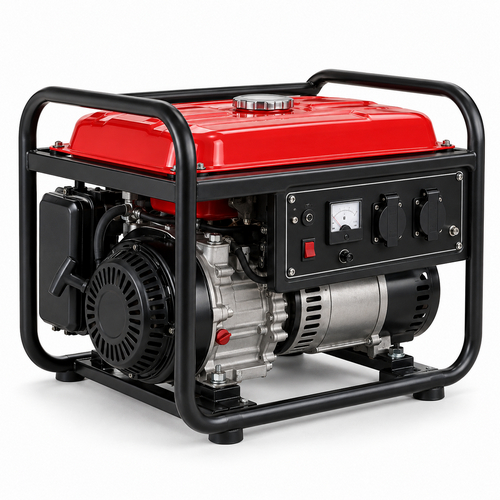
The construction is more substantial than might be expected of a four-kilowatt household generator. The open steel frame measures 670 x 535 x 565 mm, a 28 L tank sits above, and dry weight reaches 90 kg. Two people can move it, but crossing a threshold becomes a separate task. A wheel kit is optional. The EF5500EFW is therefore best assigned a permanent site with access to the tank cap, controls, and serviceable components.
MZ360 Engine and Generator Design
The engine is a Yamaha MZ360, a single-cylinder four-stroke of 358 cm3 with overhead valves and forced-air cooling. The crankcase holds 1.1 L of oil, and fuel is unleaded petrol. It starts by key-operated electric starter, with a manual starter retained for a discharged battery. An automatic choke handles cold starting, avoiding choke lever adjustment before starting the EF5500EFW. For frequent brief outages, this combination is more convenient than manual starting alone.
The panel avoids excessive electronics: an engine switch, sockets, AC protection breaker, and an instrument displaying voltage and operating hours. A low-oil sensor stops the engine before inadequate lubrication causes damage. Add oil before the first start of a new generator and check battery connection. A VRLA battery is specified for electric starting; confirm its actual inclusion when purchasing the individual unit.
.FW System, AVR, and Power Margin
The alternator is brushless with a Yamaha FW damper winding. This improves output waveform and reduces distortion with loads containing motors and electronic modules. Specifications for the Russian-market version also list AVR automatic voltage regulation, which compensates for voltage changes as load varies. Nevertheless, the EF5500EFW remains a conventional synchronous generator: 50 Hz frequency depends on engine speed, and supply quality cannot be equated to an inverter station. Check voltage and frequency under the intended load before connecting particularly sensitive equipment.
The 3.8 kVA limit becomes noticeable when a pump or compressor is added to lighting and a refrigerator. Their brief starting current may be several times running current. The station can supply this equipment, but starting several large motors simultaneously is poor planning. A 2 kW heater leaves a relatively small reserve for everything else. Each socket's output and permissible current also matter: total generator capability does not mean all 3.8 kVA may be drawn through one connector.
The built-in voltmeter is useful in this context. After starting, it shows whether operating voltage has been reached, and a prolonged voltage dip can be observed when a demanding load starts. AVR reduces voltage fluctuations but does not eliminate engine overload or maintain frequency if speed falls substantially. A circulation pump, refrigerator, and power tools need this practical power margin rather than merely a nameplate figure.
A 28-Litre Tank, Noise, and Starting
Long operation without refuelling is an EF5500EFW strength. A full tank is specified to provide 17.5 hours at half load or 12 hours at rated load. These figures imply approximately 1.6 and 2.3 L of petrol per hour respectively. For an evening-to-morning outage, the tank avoids a nighttime trip with a fuel can. Consumption remains noticeable under light load: there is no reduced-speed economy idling mode as on some inverter generators.
.Extended operating duration has an acoustic cost. Sound pressure is 70.7 dB(A) at 7 m. The open frame provides little attenuation of engine and exhaust noise, particularly near rated load. On a confined property, position it farther from bedrooms and neighbouring windows. The site must remain outdoors with proper exhaust dispersal; starting in a garage, shed, or basement is dangerous because of carbon monoxide, even with doors open.
The combination of electric starting, automatic choke, and an hour meter improves operation. Open the fuel tap, start with the key, wait for stable running, and apply the load through the breaker. However, the starter requires a functioning charged battery, which may prevent a quick start after winter storage. The manual backup helps, although cranking a 358-cubic-centimetre engine by cord is considerably harder than starting a compact one-kilowatt generator.
Household Connection and Maintenance
Resolve wiring before the first emergency. Supplying household circuits requires source changeover preventing voltage backfeeding into the utility network. AVR automatic voltage regulation and an automatic transfer switch, also abbreviated AVR in Russian, perform different tasks. The EF5500EFW electric starter simplifies adding external automatic starting, but the generator alone does not provide fully automatic backup. Controller selection requires correct connector pin assignments: a 12 V D+ signal, for example, can easily be mistaken for another control contact.
The heating boiler, electronic pump modules, and computer equipment deserve separate attention. Boiler connection may require consideration of neutral arrangement and protective earthing, while a compatible UPS is useful for a computer. An ordinary synchronous generator responds differently from mains electricity to sudden compressor starting. Test actual loads individually and the largest motor's starting behaviour before leaving the installation ready for backup duty.
EF5500EFW maintenance is conventional but should not be postponed. Change engine oil, clean the foam air filter, and inspect the NGK BPR4ES spark plug and silencer screen. The hour meter provides a convenient schedule reminder. With infrequent outage-only use, storage may create more concerns: petrol deteriorates in the carburettor, and the battery loses charge. After prolonged inactivity, test operation under moderate load before an outage causes an unexpected problem.
.Assessment
The Yamaha EF5500EFW suits permanent backup installation for a country house, workshop, or small site where electric starting and up to 12 hours at rated load without refuelling matter. The MZ360 engine, brushless FW alternator, and 28 L tank support prolonged work. The disadvantages are equally tangible: 90 kg dry weight, pronounced open-generator noise, and the need to plan distribution board connection separately. It is too heavy for occasional trips requiring car loading, but on a prepared site it can power several essential loads for extended periods if consumption is allocated carefully.
Related articles:
Yamaha EF5500EFW FAQ