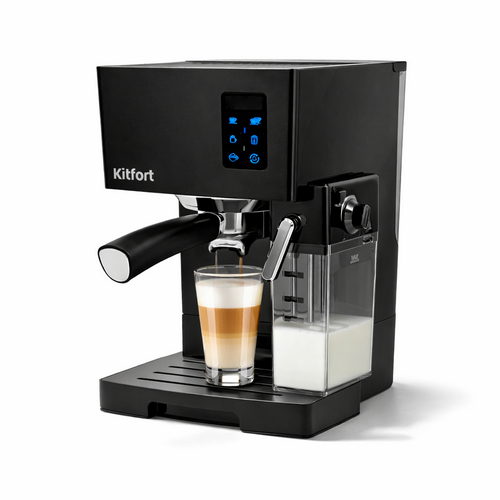
KITFORT KT-743 Portafilter Espresso Machine Operating Manual
(!)
If you have difficulty using our equipment, please call the Kitfort hotline before contacting the retailer:
8-800-775-56-87
(Monday-Friday, 9:30 to 17:30 Moscow time)
[email protected]
We can explain how the appliance works and answer any other questions.
General Information
The KT-743 portafilter espresso machine makes espresso, cappuccino, latte and many other coffee drinks to suit your taste.
Espresso is a distinct method of preparing coffee. Articles and books offer various interpretations of the word "espresso". The most common are "under pressure", "quick" and "expressive". Some historical and linguistic studies explore the term in detail. One gives the interpretation "coffee made at that moment especially for you".
In the espresso method, water is poured into the tank, heated to 92-95 °C and forced through ground coffee at a pressure of 19 bar. The high pressure extracts as much of the coffee's beneficial and aromatic compounds as possible. A serving takes 25-30 seconds to prepare. The resulting coffee is flavorful and aromatic, with a layer of foam called crema. Crema consists of carbon dioxide, essential oils and coffee particles. Its quality can indicate the freshness of the coffee. The more abundant and persistent the crema, the fresher the coffee. The manual states that despite its strong aroma and full flavor, a serving of espresso contains 2-3 times less caffeine than a serving of tea, Turkish-style coffee or instant coffee.
With a portafilter espresso machine, place the ground coffee in the portafilter and tamp it.
Compressing the grounds is known as tamping. In music, the term "equal temperament" describes a tuning system that emerged from the search for ideal tuning. Similarly, an ideal cup of coffee calls for evenly tamped grounds. The comparison is a joke, but it comes close to the truth. Proper tamping requires precision. Tamp too firmly and water takes much longer to pass through the dense bed of grounds, making the coffee very bitter. Tamp too lightly and water passes through the loose grounds too quickly, making the coffee sour and watery.
The durable metal filter has laser-drilled holes and requires no consumable parts. The espresso machine has a removable water tank.
Package Contents
1. Housing - 1 unit.
2. Single-cup filter basket - 1 unit.**
3. Two-cup filter basket - 1 unit.**
4. Measuring scoop with tamper - 1 unit.
5. Operating manual - 1 copy.
6. Collectible magnet - 1 unit.*
- Water tank - 1 unit.
- Milk frother - 1 unit.
- Drip tray with removable grille - 1 unit.
- Portafilter - 1 unit.
(!)
* optional
** One of the filter baskets may already be fitted in the portafilter.
Espresso Machine Components
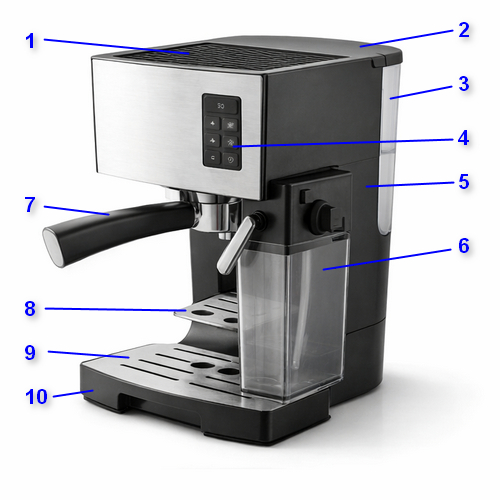
1. Cup warming platform
2. Water tank lid
3. Removable water tank
4. Control panel
5. Housing
6. Milk frother
7. Portafilter with filter basket
8. Fold-down platform for small cups
9. Grille
10. Drip tray
Control Panel
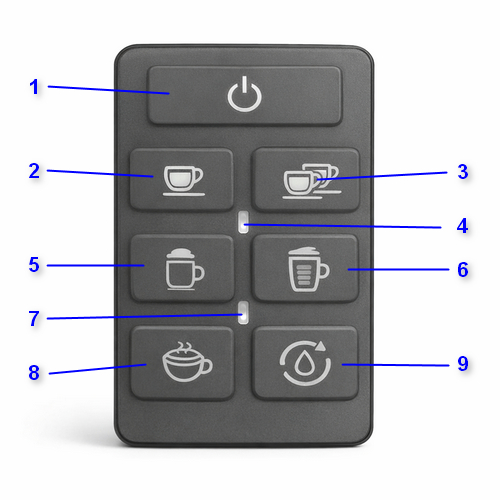
1. Power button
2. Espresso button
3. Double Espresso button
4. Empty water tank indicator
5. Cappuccino button
6. Latte button
7. Scale indicator
8. Milk frother on/off button
9. Self-cleaning button
Milk Frother
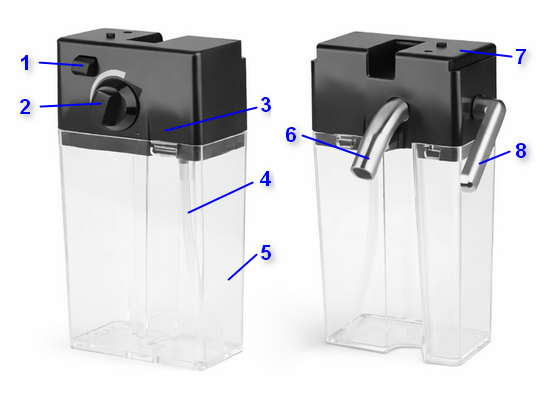
1. Milk frother release button
2. Milk and milk foam flow control
3. Milk reservoir release button
4. Milk intake tube
5. Milk reservoir
6. Steam wand
7. Milk frother lid
8. Steam wand handle
Use the control panel buttons to select the drink type and serving size. All buttons flash while the machine heats up. They stop flashing when the machine is ready.
All buttons are illuminated in standby mode.
The machine has an automatic shutoff function. It enters sleep mode after 30 minutes of inactivity. Press the power button on the control panel to return it to standby.
The cup warming platform uses heat generated by the machine during operation and has no dedicated heater. Place cups on it to warm them or help them dry after washing.
The empty water tank indicator lights when the tank runs out of water.
.Preparation and Use
Unpack the machine and remove all packaging materials. Place it on a level, stable, dry, horizontal surface. Connect it to the mains. The machine is ready for operation.
Before First Use
Wash the water tank, portafilter, milk frother, filter basket and drip tray.
Wipe the housing with a damp cloth. Then follow these steps:
1. Fill the water tank up to the "MAX" mark and close its lid.
2. Fill the milk frother reservoir with water up to the "MAX" mark and close the lid.
3. Insert the portafilter with an empty filter basket and turn it counterclockwise to the locked position. Place an empty cup beneath it.
4. Plug the machine into the mains and press the power button. The buttons and indicators on the control panel begin flashing. Press the Espresso button and wait for the buttons to stop flashing, indicating that the machine has heated up.
5. Press the Espresso button. After a short delay, water begins to flow into the cup. Perform this step twice.
6. Use the handle to position the steam wand so its tip is inside or directly above a cup. Place a cup or another container beneath the wand. Press the milk frother button, wait for water to pass through the frother and repeat the procedure.
7. Empty and thoroughly rinse the water tank and milk reservoir.
(!) Do not operate the machine without water. Make sure all removable parts are installed correctly. The machine may make noise while brewing. This is normal.
Making Espresso
1. Press the power button. The buttons light up and flash as the machine heats. You can fill the portafilter while it heats. The buttons stop flashing when the machine is ready.
2. Turn the portafilter handle clockwise (to the left) to the "Open" position and lower the portafilter to remove it. Make sure the filter basket is installed.
3. Place 1 or 2 scoops of ground coffee in the filter basket. 1 scoop makes 1 cup (50 mL) of espresso. A double espresso requires 2 scoops. Use no more than two scoops for a double serving (Double) or one scoop for a single serving (Single).
4. Level the grounds, then press down with the tamper on the reverse side of the measuring scoop. You can rest the portafilter on the countertop. The ideal tamping force is 10-20 kg. Avoid exceeding this value to prevent damage to the filter basket. After tamping, lightly rotate the tamper on the surface of the grounds without applying pressure to keep coffee from sticking to the tamper.
Note. You can tamp the coffee in one quick, short movement. The preferred technique uses two stages. First, touch the grounds lightly with the tamper, then tap the sides of the portafilter twice and tamp firmly. Some users also rotate the tamper inside the basket. After tamping, brush stray grounds off the rim to ensure a close fit in the mounting point. Fold down the small-cup platform if you are using a small cup.
5. Insert the portafilter from below with its handle in the "Open" position. Turn the handle to the right to the "Close" position.
6. Place a cup beneath the portafilter. Press Espresso or Double Espresso. The machine is set to extract espresso in 30 seconds and double espresso in 45 seconds. Watch the cup to prevent overflow. If necessary, press the espresso button again to stop the water flow. Wait 2-3 seconds for the last drops to drain from the portafilter. The coffee is ready.
7. Turn the portafilter clockwise to the "Open" position and lower it to remove it. Knock out the grounds and rinse the portafilter. Wipe the portafilter mounting point with a cloth. Take care, as it may be hot.
(!) Warning! The machine has a pressure relief system that drains excess water from the boiler into the drip tray. Do not let the tray overflow.
Making Cappuccino
1. Before making cappuccino, set the amount of foam with the milk flow control. Turn it clockwise for more foam or counterclockwise for less.
2. Make sure the machine has heated up. The control panel buttons remain steadily lit when it is ready and flash while it is heating.
3. Place 1 scoop of ground coffee in the filter basket.
4. Level the grounds and press down with the tamper to compress them.
5. Insert the portafilter from below with its handle in the "Open" position. Turn the handle to the right to the "Close" position.
6. Fit the milk frother to the machine. Install the milk reservoir before switching on the frother. Hot steam can escape from the nozzle and cause burns if the reservoir is missing.
7. Place a cup beneath the portafilter. Use the handle to position the steam wand so its tip is inside or directly above the cup. Press Cappuccino to make the drink.
8. Turn the portafilter clockwise to the "Open" position and lower it to remove it. Knock out the grounds and rinse the portafilter. Wipe the portafilter mounting point with a cloth. Take care, as it may be hot.
(!)
Note. Cappuccino is a coffee with thick foam, made with one-third espresso, one-third milk foam and one-third milk. In Italy, cappuccino is mainly served at breakfast.
Use pasteurized milk with a fat content of 2.5-3.5%, as used in bars and coffee shops. Choose milk with at least 2% protein (more than 2 g per 100 mL). The protein helps produce foam of the required thickness.
Making Latte
1. Follow the same general procedure as for cappuccino.
2. Make sure the machine has heated up. The control panel buttons remain steadily lit when it is ready and flash while it is heating.
3. Place 1 scoop of ground coffee in the filter basket.
4. Level the grounds and press down with the tamper to compress them.
5. Insert the portafilter from below with its handle in the "Open" position. Turn the handle to the right to the "Close" position.
6. Fit the milk frother to the machine. Install the milk reservoir before switching on the frother. Hot steam can escape from the nozzle and cause burns if the reservoir is missing.
7. Place a cup beneath the portafilter. Use the handle to position the steam wand so its tip is inside or directly above the cup. Press Latte to make the drink.
8. Turn the portafilter clockwise to the "Open" position and lower it to remove it. Knock out the grounds and rinse the portafilter. Wipe the portafilter mounting point with a cloth. Take care, as it may be hot.
(!) Note. A latte is a milk-based coffee drink with loose foam. It consists of one-quarter espresso, one-half milk and one-quarter foam. Recipes vary, but milk is the main ingredient and is used in a much greater proportion than in cappuccino.
(!) Warning! If the water tank runs dry during brewing, a red indicator lights on the control panel and repeated beeps sound. Open the lid, refill the tank and press Espresso or Double Espresso.
.Programming
You can program the amount of water delivered through the portafilter using the Espresso or Double Espresso button:
1. Press the power button and wait for the machine to heat up.
2. Install the portafilter with the filter basket and ground coffee.
3. Press and hold the button you want to program. The machine records how long you hold the button and uses that duration when you select the program. Release the button when the desired brewing time has elapsed.
4. The coffee is ready. Each subsequent cup brewed with that program takes exactly as long as you held the button.
(!)
Note. The programmed serving volume cannot exceed twice the default serving volume.
Note. You can program both the Espresso and Double Espresso buttons.
To restore the factory settings:
1. Switch off the machine. Press and hold Espresso and Double Espresso together, then press the power button while holding both buttons down. Keep all the buttons pressed.
2. The machine beeps and restores its factory settings. All control button indicators flash after the reset.
3. Press Espresso or Double Espresso to dispense a test serving of water into the cup.
4. When the machine is ready, it beeps and the control panel indicators remain steadily lit.
Espresso Variations
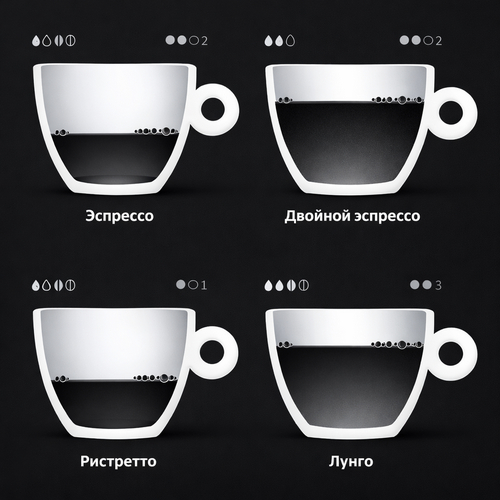
Doppio (Italian for "double") is a double espresso. It uses twice as much ground coffee and makes twice the volume of a standard espresso. Doppio has an intense flavor and aroma. In Italy, "doppio" is added to the names of coffee and milk drinks when ordering a drink twice as strong or twice as large, such as doppio ristretto, doppio lungo or doppio cappuccino.
Ristretto has the most concentrated flavor of the coffee types described here. It uses the same amount of ground coffee per serving as espresso (7-11 g) but less water. In Italy, ristretto is regarded as the most authentic coffee, and those who order it are said to earn the barista's respect.
Ristretto is also known as Corto, Literal, Shrunk or Short.
To make ristretto, use 7 g of coffee and 15-20 mL of water. The extraction takes 15-20 seconds. Press Espresso again during brewing to stop the flow at the desired time. Adding sugar to ristretto is considered poor form because it masks the drink's flavor.
Ristretto is traditionally served with a glass of cold drinking water. According to the manual, taking a sip of water before each sip of coffee cleanses the palate, helps prevent dehydration and lets you taste each sip afresh.
Lungo (long espresso) is a less concentrated coffee. It uses more water, takes longer to extract and contains more caffeine than ristretto. It is made by the same method, with a longer extraction allowing more water through the grounds. Lungo tastes more bitter than espresso. Coffee varieties with a delicate aroma and subtle flavor profile are best suited to it.
To make lungo, use 7-9 g of finely ground coffee, or one measuring scoop. Press Double Espresso for a longer extraction.
An Americano is made by adding hot water to espresso or by pouring espresso into hot water. For lungo, all the water passes through the ground coffee. A lungo is usually smaller than an Americano.
The illustration shows the amounts of coffee and water used to make the espresso variations and their resulting strengths.
Espresso-Based Drinks
Americano is a classic espresso diluted with hot water. The additional water is poured into the finished espresso. In a lungo, it passes through the coffee puck.
Three Ways to Serve an Americano
Classic Italian Americano - add hot water (120 mL at 84-92 °C) to espresso.
Modern Scandinavian Americano - add espresso to hot water (120 mL at 84-92 °C).
European serve-yourself style - serve hot water (120 mL at 84-92 °C) and espresso separately so each person can choose how and in what proportion to dilute the coffee.
The classic method completely breaks up the crema. Many coffee enthusiasts say that the first sip of an Americano made by the Scandinavian method tastes smoother and fuller.
Russian coffee shops and bars often serve a drink made by extending extraction in the espresso machine from 25 seconds to 50 seconds or more and call it an Americano. This drink tastes burnt and bitter. The manual also states that it contains harmful substances, resins and carcinogens.
A thin flavor with a pronounced sour aftertaste is considered a sign of poor preparation. The manual identifies white spots on the crema as a sign of excess caffeine in the cup.
Coffee Varieties
Many coffee varieties are grown around the world. Their names come from the people who discovered or bred them. Some varieties have names made up of letters or numbers. The profile of each blend or single-variety coffee includes the country of origin, the species and variety of the coffee tree, the growing altitude, the processing station and the name of the plantation or grower. Each coffee variety has a distinctive flavor and aroma.
Detailed information about coffee varieties is widely available online.
Coffee quality grades:
- AA and A - highest quality;
- AB - high quality;
- B and BA - medium quality;
- BB and C - low quality.
High-quality single-variety coffee can be difficult to find in ordinary stores, where blends are more common. Premium varieties produce lower yields than lower-grade varieties. Producers therefore combine expensive and inexpensive varieties in different proportions to achieve an acceptable balance of quality and price. Specialty shops sell premium varieties at higher prices.
Roast Level
Roast level is one of the main factors affecting the taste of brewed coffee. Coffee enthusiasts distinguish many roast styles. Packaging commonly identifies the most widespread roast levels using numbers from 1 to 5.
1. Very light roast (Cinnamon) gives the coffee a slightly sour taste and a watery consistency. The beans are light brown, almost beige. This roast is suitable only for high-quality Arabica varieties.
2. Light roast (American) produces slight bitterness. The beans should release no oil during roasting. The coffee has a pleasant aroma.
3. Medium roast (City, Viennese) releases a small amount of essential oils. The beans become glossy and develop brown spots. The coffee tastes slightly sweet and bitter.
4. Dark roast (French, Espresso) gives the beans a deep chocolate color. The beans release substantial amounts of oil, and the coffee becomes noticeably bitter and astringent.
5. Very dark roast (Italy) produces very oily, almost black beans and a rich, velvety taste. Use freshly roasted beans whenever possible. If you buy roasted beans, check the production date.
Coffee Grind Size
Grind size is one of the main factors in proper coffee extraction. For the best flavor, grind the beans immediately before brewing. Match the grind size to the brewing method.
| Grind Size | Description | Extraction Time |
|---|---|---|
| Coarse Coarse grind | Large coffee particles release flavor and aroma compounds slowly. Coarse grounds are recommended for drip coffee makers and French presses. The large particles are retained by the French press screen or drip coffee filter and stay out of the cup. | 6-8 minutes |
| Medium Medium grind | This is considered an all-purpose grind suitable for preparing any coffee drink by any method. | 4-6 minutes |
| Fine Fine grind | Used in filter coffee makers and moka pots. | 1-4 minutes |
| Fine espresso Fine espresso grind | Used in espresso machines, which force water through a bed of finely ground coffee under pressure. | Up to 4 minutes |
| Powder Pulverized | Suitable for a Turkish coffee pot (cezve). The large amount of suspended grounds in the cup gives the coffee a thicker, more viscous texture. | 7-10 minutes |
Use an extra-fine grind only for Turkish-style coffee.
Espresso machines require a grind that is neither too fine nor too coarse. Grounds that are too fine may clog the portafilter and prevent water from passing through. If the grounds are too coarse, water passes through too quickly for proper extraction. The resulting drink is watery and lacks flavor and aroma.
.Choosing a Coffee Grinder
Coffee enthusiasts pay close attention to how the beans are ground. Commercially ground coffee is sifted to give it a uniform particle size. Coffee loses its aroma quickly after grinding, so grind small batches at home whenever possible.
Types of Coffee Grinders
Coffee grinders can be grouped as follows:
- by burr type (conical or flat);
- by drive type (manual or electric).
Coffee connoisseurs prefer manual grinders. According to the manual, the lower grinding speed improves quality by limiting heat buildup and preserving the aroma of the beans.
Electric coffee grinders are widely used. Professional grinders have conical burrs that prevent the beans from overheating during grinding. The different particle sizes produced by conical burrs give the coffee a richer, more varied flavor. Compact household grinders use blades to chop the beans. When using a blade grinder, pause periodically to keep the grounds from overheating and losing their aroma.
Barista Glossary
Barista - a specialist who prepares coffee.
Espresso - coffee made by forcing hot water under pressure through a filter containing ground coffee.
Americano - espresso diluted with hot water to reduce its strength.
Cappuccino - an espresso-based drink with milk and milk foam.
Tor - an espresso-based drink. Spoon thick milk foam onto the espresso so that it forms a mound 1-2 cm above the rim and holds its shape. Tor uses thick foam alone as the topping and is usually made with twice the volume of espresso used for cappuccino.
Crema - the foam on brewed coffee.
Latte art - a design made with milk foam on the surface of a cappuccino. Techniques include pouring the foam in a particular way or using a toothpick, grated chocolate or cocoa, chocolate or other syrups, or food coloring.
3D latte art - three-dimensional designs and sculptures made of thick milk foam on a cappuccino.
Pannarello - an attachment for the steam wand used to froth milk for cappuccino and latte.
Pitcher - a jug for frothing milk for cappuccino and latte. Also known as a milk jug.
Demitasse - a small cup for serving Turkish coffee, espresso or ristretto. It also serves as a standard measure for preparing Turkish coffee.
Cleaning and Maintenance
Rinse the portafilter after each use. After rinsing and between uses, leave the portafilter on the drip tray grille to dry. This also prevents the portafilter gasket in the machine from becoming compressed during storage.
Periodically remove the filter basket and rinse it and the area beneath it. Raise the steam wand after each milk-frothing cycle to prevent milk residue from sticking to it.
Rinse the water tank regularly to prevent biological growth on its surfaces. If the machine has been unused for 1-2 days with water in the tank, empty and rinse it. To keep the water fresh for longer, use water that has been boiled and allowed to cool. Do not pour hot water into the tank.
Empty the drip tray regularly or as it fills. To remove the tray, grip the grille by its openings and lift it off. Then remove the tray. Rinse the tray and grille and reinstall them in reverse order.
Wipe the machine housing with a damp cloth.
Milk Frother Cleaning Cycle
First, empty the milk reservoir and rinse it with water. Fill it with water and reinstall the frother. Insert the portafilter with an empty filter basket and turn it counterclockwise to the "Close" position. Switch on the machine and allow it to heat up. Place a large cup underneath and use the handle to position the steam wand so its tip is inside or directly above the cup. Press the self-cleaning button. The cleaning cycle starts and ends automatically after a few seconds. Press the button again to stop the cycle manually. Repeat if necessary. Empty the reservoir and cup afterward.
For more effective cleaning, use clean water at 50-70 degrees. This helps loosen milk deposits from the inside of the tubes in the frother lid.
(!) Note. Clean the frother after each cycle, once all the milk in the reservoir has been used. The scale indicator on the control panel tells you when to clean the frother. When the indicator starts flashing, the machine prevents brewing until cleaning is complete. The machine beeps twice at the end of cleaning.
Descaling
The machine automatically prompts for descaling after 50 liters of water have passed through it. Depending on water hardness, you may descale it periodically before the indicator lights up.
1. Switch on the machine and wait for it to heat up. All control panel indicators light up.
2. Fill the water tank to its maximum level with water mixed with descaling agent. A 3% citric acid solution may be used. Insert the portafilter with an empty filter basket and turn it counterclockwise to the "Close" position. Install the empty milk frother. Place an empty container with a capacity of at least 1.4 L under the portafilter and aim the frother wand into the container.
3. Hold the self-cleaning button for 3-5 seconds until cleaning starts.
4. The first descaling stage begins. The machine dispenses water in short pulses for 15 minutes, long enough to empty a full tank. The self-cleaning button indicator flashes during this stage.
The first stage ends when the water tank is empty. The self-cleaning button indicator stops flashing and remains steadily lit.
Note. If you omit the second stage, the scale indicator remains lit.
5. Start the second descaling stage when the self-cleaning button is steadily lit. Empty the used water from the container and fill the tank to the maximum level with clean water. Place an empty container of at least 1.4 L under the portafilter and aim the frother wand into it. Press the self-cleaning button.
6. The second descaling stage begins. The machine dispenses water continuously for 5-6 minutes, long enough to empty a full tank.
7. When the second stage ends, the machine automatically returns to operating mode and the scale indicator goes out.
Storage
Before storing the machine, empty, rinse and dry the water tank. Rinse and dry the portafilter, filter basket, grille and drip tray.
Store the portafilter detached from the machine to prevent damage to the gasket.
Store the machine in a cool, dry place out of reach of children.
Troubleshooting
Water Remains in the Portafilter
It is normal for water to remain in the portafilter after brewing. As the pump forces water through the coffee, pressure builds between the portafilter mounting point and the bottom of the filter basket. When you stop the water flow, pressure returns to normal as the last drops drain. Any remaining water then passes through the grounds by gravity alone. Several factors can leave water in the portafilter. First, coarser grounds leave less water because it drains more readily through the larger gaps between particles. Second, tamping affects drainage. Water cannot drain by gravity alone through very tightly tamped fine grounds. It passes through under pump pressure and remains behind when the pump stops. Third, if you wait at least 30 seconds before removing the portafilter, the remaining water can seep through the coffee bed and drip into the cup. Any water left in the portafilter has no effect on flavor and is normal.
Empty Water Tank Indicator Flashes
| Possible Cause | Remedy |
|---|---|
| The water tank is empty or the water level is too low | Refill the water tank |
Scale Indicator Flashes
| Possible Cause | Remedy |
|---|---|
| Scale has accumulated in the machine | Follow the instructions in the "Descaling" section |
Water Leaks at the Portafilter Gasket
| Possible Cause | Remedy |
|---|---|
| The gasket is dirty | Wait for the machine to cool, unplug it and leave it for 2-3 hours. Use the scrub side of a dishwashing sponge to clean the portafilter rim that contacts the machine. Clean the gasket that seals against the portafilter |
Water Leaks onto the Countertop
| Possible Cause | Remedy |
|---|---|
| The drip tray is too full and the red float has risen above the grille | Empty the drip tray |
| Water spilled after the machine was tilted during a move or the full tank was accidentally bumped | Fill the tank only up to the MAX mark. Empty the tank before moving the machine |
The Coffee Tastes Sour
| Possible Cause | Remedy |
|---|---|
| The machine was inadequately rinsed after descaling | Rinse the machine with water several times |
| The ground coffee has spoiled after prolonged storage in a hot, humid place | Use fresh ground coffee. Store it in a cool, dry place. After opening the package, reseal it tightly and refrigerate it to preserve freshness |
The Machine Does Not Switch On
| Possible Cause | Remedy |
|---|---|
| No mains power | Check whether mains power is available |
| The machine is unplugged | Connect the machine to the mains |
Unable to Make Cappuccino Foam
| Possible Cause | Remedy |
|---|---|
| The cup is too large or has an unsuitable shape | Use a tall, narrow cup |
The Milk Does Not Froth
| Possible Cause | Remedy |
|---|---|
| The milk may be unsuitable for frothing | Use pasteurized milk with a fat content of 2.5-3.5%. Choose milk with at least 2% protein (more than 2 g per 100 mL) |
If your issue is not listed above, email [email protected] with photos or videos showing the problem. Include a photo of the serial number label on the bottom or back of the housing.
Technical Specifications
1. Voltage: ~220-240 V, 50/60 Hz
2. Power: 1200-1400 W
3. Electric shock protection class: I
4. Water tank capacity: 1.4 L
5. Milk reservoir capacity: 0.4 L
6. Pressure: 19 bar
7. Cord length: 0.9 m
8. Device dimensions: 210 x 250 x 300 mm
9. Package dimensions: 310 x 260 x 365 mm
10. Net weight: 4.2 kg
11. Gross weight: 5.0 kg
Service life: 2 years
Warranty period: 1 year
The product is certified
Manufacturer: Interna Guangdong Tech Electric Co., Ltd., B5 South Luzhou Road, Luyangjiang Residential Committee, Lunyang Town, Shijiang District, Foshan City, Guangdong Province, China.
Importer: Aero-Trade LLC, 197022, St. Petersburg, 3 Instrumentalnaya Street, Building X, Office 1.
Country of origin: China.
Organization authorized to handle claims in the Russian Federation: Aero-Trade LLC, 197022, St. Petersburg, 3 Instrumentalnaya Street, Building X, Office 1.
Manufacturer's hotline: 8-800-775-56-87 (Monday-Friday, 9:30 to 17:30 Moscow time), [email protected]
For service center addresses, call the hotline or visit kitfort.ru
This product requires special disposal. To avoid environmental harm, separate it from ordinary waste and dispose of it safely, for example by taking it to a designated collection facility.
The month and year of manufacture are marked on the bottom of the box.
The manufacturer may change the design, package contents and technical specifications as part of ongoing product improvements without further notice.
Warranty Terms
The warranty excludes blockages caused by organic, salt or mineral deposits. Clean the machine regularly as described in "Cleaning and Maintenance" to prevent deposits.
The warranty excludes mechanical damage to the housing, accessories and components.
Darkening or yellowing of the filter basket and other parts in contact with brewed coffee is normal and is excluded from warranty coverage.
Safety Precautions
Read the operating manual carefully. Pay particular attention to the safety precautions. Keep the manual readily available.
1. The appliance is intended for household use in apartments, country homes, hotel rooms, offices and similar locations for nonindustrial and noncommercial use.
2. Use the appliance only for its intended purpose and in accordance with this manual. Use for any other purpose is considered improper operation.
3. Before plugging the appliance into an outlet, make sure the electrical ratings marked on it match the power supply.
4. To prevent electric shock, do not immerse the appliance in water or other liquids.
5. Do not carry the machine by its power cord. Grip the plug when disconnecting it from the outlet.
6. Do not use the appliance if the power cord, plug or other parts are damaged. To avoid electric shock, have a qualified technician repair the appliance. Improper reassembly increases the risk of electric shock during operation.
7. Children and people with reduced physical, sensory or mental capabilities or insufficient knowledge and experience may use the machine only under the supervision of a person responsible for their safety or after receiving instructions on its use. Do not allow children to play with the machine.
8. Supervise the machine when children or pets are nearby.
9. Do not operate the machine without water. Doing so may damage it.
10. Never leave the machine unattended during operation. Switch it off and unplug it before maintenance or if it will remain unused for an extended period.
11. The housing can become very hot during operation. Keep your hands away from hot surfaces to avoid burns.
12. Brewed coffee may be hot. Check the temperature of the drink before taking a sip.
13. Place the machine on a stable, level surface at least 10 cm from the wall and the edge of the countertop. Position the machine so that children cannot accidentally touch hot surfaces.
14. Do not attempt to bypass the power-on interlock.
15. Protect the machine from drops and impacts.
16. Keep the appliance out of reach of children.
17. Use only accessories or components offered by the manufacturer. Other accessories may damage the appliance or cause injury.
18. The appliance has a heated surface. People with reduced sensitivity to heat must use it with care.
19. Stop using the appliance if water leaks from the housing.
20. If the power cord is damaged, the manufacturer, its service department or similarly qualified personnel must replace it to prevent a hazard.
21. Do not remove the portafilter while water is flowing.
22. Fill the water tank with water only.
Related Articles:
KITFORT KT-743 FAQ
| De'Longhi Magnifica S Coffee Machine User Manual |
| Gorenje GN Series GN-5111 - GN-5112 Gas Cooker User Manual |
| HUALIAN DZ-290P Vacuum Sealer User Manual |
| Vitek VT-1517 BN Coffee Maker Instructions |