Boxbot BGA 1000 - Petrol Generator Review for Small Loads
A thousand watts for relatively little money. At first glance, the Boxbot BGA 1000 looks appealing: a compact petrol generator, four-stroke engine, and six-litre tank. It can be taken to a country property, positioned outdoors, and used during a power outage, or taken somewhere without any sockets at all.
However, there is a qualification concerning those thousand watts. Maximum output is indeed 1000 W, but rated output is 900 W. For prolonged operation, the manufacturer also recommends limiting load to 75% of rated output, approximately 675 W. That figure is the appropriate starting point for discussing the model's capabilities.
This is sufficient for lighting, chargers, a television, and other low-power equipment. Attempting to connect an electric kettle, powerful pump, or construction tool will quickly demonstrate the limited versatility of a small generator.
I would consider the Boxbot BGA 1000 primarily as an inexpensive electricity source for a limited selection of loads. It is interesting in that role. Purchasing it for comprehensive household backup supply is more questionable.
An Open Frame, Simple Engine, and Few Extras
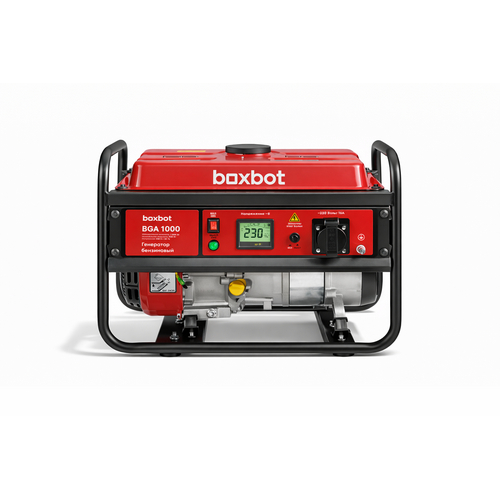
The device follows the conventional inexpensive petrol generator arrangement. The engine and generator section are below, with a metal fuel tank above. All are secured inside a tubular steel frame. Major components are accessible for inspection and maintenance, with almost no protective plastic panels.
Dimensions are 450x350x365 mm, modest for a petrol generating set. However, its 24 kg weight makes the term "portable" require qualification. Carrying it from a vehicle to its operating position is possible, but long-distance carrying is unappealing. There are no wheels or separate transport handle; it must be lifted by the frame.
The four-stroke 98 cm3 engine produces 3 hp. It uses air cooling, overhead valves, and a conventional carburettor. The design is straightforward and relatively simple, with no complex engine control electronics to complicate ordinary mechanical maintenance.
A recoil starter is provided. For a cold engine, close the choke, open the fuel tap, switch on the ignition, and pull the cord. After starting, move the choke to its operating position and allow the generator to warm briefly.
The BGA 1000 choke movement differs from the more powerful models in this series. For a cold start, move the lever right; after warming up, move it left. This is a minor detail worth remembering when becoming familiar with the generator.
.What Can Be Connected to a 900-Watt Generator?
The panel has one 230 V socket, an analogue voltmeter, engine switch, and protective circuit breaker. A fuel level indicator is provided. Controls are mechanical, without menus or settings. I appreciate this simplicity: if something switches off, checking the load, breaker, and meter reading is sufficient.
However, the analogue voltmeter shows only voltage. It does not display AC frequency, current output power, or accumulated operating hours. Separate equipment is required to monitor these parameters.
The main limitation is the available power margin. LED lighting consumes tens of watts, and a laptop with its charger generally consumes several tens. A television, router, and small lighting system can operate simultaneously. Correct calculation of combined consumption is essential.
Electric motors are more complicated. Starting a refrigerator compressor or pump can briefly require several times the running current. A refrigerator rated at 120-150 W does not guarantee reliable compressor starting from this source.
A small angle grinder, drill, or pump also requires starting power verification. I would not recommend operating at the limit for a few additional watts, particularly when the tool experiences varying mechanical loads.
For demanding power tools and household equipment with electric motors, selecting a generator with several kilowatts of margin from the outset is more appropriate.
Voltage Stability: Qualifications Apply
The Boxbot BGA 1000 uses a synchronous alternator. It is a conventional petrol generator without inverter conversion of its output. Power quality therefore depends partly on engine speed and the nature of the connected load.
Model descriptions mention AVR regulation, although sellers disagree about the regulation system. Even an electronic voltage regulator does not make the generator an inverter type: sudden load changes can cause brief voltage and frequency deviations.
For lamps, chargers with suitable input ranges, and simple electrical appliances, this is generally not a serious problem. For sensitive electronics, particularly expensive equipment, I would prefer an inverter generator with verified output voltage characteristics.
A less obvious limitation is the isolated neutral. Some polarity-sensitive gas boilers require a particular supply and earthing arrangement for correct operation. Connecting this equipment is best assigned to an electrician who checks boiler-generator compatibility.
Automatic starting when mains voltage fails is not provided. The device cannot independently switch between mains and generator supply either. Household backup requires properly arranged source changeover that prevents backfeeding voltage into the mains network.
How Long Will Six Litres of Petrol Last?
The 6 L fuel tank appears substantial for an engine of this output. Specified operating time per fill is approximately 6 hours at 75% load. Actual duration depends on consumption, engine condition, and operating conditions.
Another point matters more. The manufacturer recommends limiting continuous operation to four hours followed by a half-hour break. Assuming uninterrupted operation throughout the night merely because fuel remains would therefore be mistaken.
The small engine is relatively economical in absolute fuel consumption. However, if the task is powering one lamp or charging a phone, a petrol generating set still consumes fuel and requires maintenance. For such tasks lasting several hours, a battery power station is often more convenient. It operates silently and produces no exhaust.
For off-site work where batteries cannot be recharged and electricity is required for several consecutive hours, however, a petrol generator becomes more appropriate.
.Noise and Vibration: An Engine Remains an Engine
The open layout benefits cooling and component access but does virtually nothing to contain sound. Commercial BGA 1000 descriptions give different noise figures, including an implausibly optimistic 40 dB. Other specifications state 67 dB.
The quietness of an inverter station in a sound-reducing enclosure should not be expected. This is an ordinary air-cooled four-stroke petrol engine. Changes in load alter its sound, and mechanical vibration occurs.
Rubber vibration mounts are included. These are useful on a hard surface, reducing vibration transmission from the frame. Position the generator level to avoid problems with engine operation and oil level monitoring.
This degree of acoustic comfort can be accepted on a country property or construction site. At a quiet campsite near tents, it is less suitable, particularly in the evening when even a small engine is clearly audible.
The generator must operate outdoors at a safe distance from windows, doors, and ventilation openings. Exhaust contains carbon monoxide. An open garage, shed, or room with a partly open door does not become a safe location for an operating petrol generator.
Oil, Filters, and Other Owner Responsibilities
Add engine oil before the first start. Crankcase capacity is 0.37 L, recommended viscosity is SAE 10W-30, and quality must be at least API SF. Fuel is RON-92 petrol and does not require mixing with oil.
A useful protection system prevents engine starting when oil level is insufficient, reducing the risk of expensive damage. Nevertheless, check the level before every start with the generator positioned horizontally.
The oil filler neck is low. A small funnel with a flexible spout or a dedicated filling syringe is useful for neat filling. Oil capacity is small, but careless filling can readily soil the engine and frame.
The first oil change is performed after five running-in hours. Regular maintenance then follows the established schedule, including oil changes, air filter cleaning, and spark plug inspection. Dusty conditions require more frequent filter cleaning.
The package includes a spark plug spanner, electrical plug, and rubber vibration mounts. This is a modest but useful set. Engine oil must be obtained separately.
Budget equipment has an undesirable characteristic: an individual unit's condition after assembly may require additional attention. Cases involving the BGA 1000 include unstable speed, difficult starting, and a need to check adjustments. Valve clearances and carburettor settings should be checked by a service centre in these circumstances. Independently changing engine speed can disturb output frequency.
How Much Confidence Can Be Placed in Reliability?
The simple design favours repairability. A carburettor, spark plug, filter, conventional recoil starter, and accessible engine are familiar components for workshops. Simplicity alone, however, does not guarantee manufacturing quality.
Complaints about the Boxbot BGA 1000 include loss of output voltage, unstable engine operation, and stopping under load. Other units continue performing their tasks after prolonged use. Evidence is insufficient to classify each problem as a widespread defect, but checking operation before purchase is essential.
Alternator winding material is a separate question. Some commercial specifications state copper, others copper-clad aluminium. This is a substantial difference for buyers, particularly under heating and prolonged load. I would therefore confirm the winding material of the specific version with the seller rather than rely on one product listing entry.
Another interesting figure appears in the operating documentation: calculated generator life is specified as 500 operating hours when maintenance requirements are followed. This is a calculated indicator rather than an exact failure time, but it clearly characterises the expected operating regime.
For occasional use during power outages or trips, this life may be sufficient. For daily operation lasting six to eight hours, equipment of another class is preferable.
Given its relatively affordable price and one-year warranty, the BGA 1000 appears acceptable for infrequent use. Reliability requirements should be higher for important backup supply where generator failure could leave a house without heating.
.Is Paying Extra for a More Powerful Generator Worthwhile?
The principal BGA 1000 competitor is in the same range: the Boxbot BGA 3000. Rated output is 2.8 kW and maximum output is 3 kW. This provides substantially different capabilities, with a margin for a refrigerator, tools, and household appliances with significant starting currents.
The difference is particularly interesting in relation to price. When the BGA 1000 costs approximately 10-12 thousand roubles and the BGA 3000 approximately 14 thousand, the larger model deserves attention. The price increase is relatively small, while rated output more than triples.
The costs are greater weight and dimensions. The BGA 3000 weighs approximately 43 kg, has a larger engine, and requires more storage space. Carrying it alone is considerably harder. If the generator is regularly transported in a passenger car and supplies only a few low-power appliances, the smaller model is more convenient.
However, for backup supply to a country property, particularly with a refrigerator, pump, or power tools, I would prefer the BGA 3000 at a moderate price difference. The power margin is considerably more useful than a small purchase saving.
Purchase the Boxbot BGA 1000 or Look Elsewhere?
The Boxbot BGA 1000 has a clear purpose. It suits lighting, battery charging, low-power appliances, and straightforward off-site work. A simple four-stroke engine, accessible controls, small tank, and relatively compact frame make it a convenient budget-class unit.
However, it should be purchased only with its limitations understood. A practical guide for prolonged operation is approximately 600-675 W, four-hour working intervals with breaks, manual starting, and regular maintenance. Pumps, refrigerators, and other high-starting-current appliances require a carefully calculated margin. Noise and exhaust remain unavoidable.
My verdict: purchase for small loads and periodic use if the price remains around 10-12 thousand roubles. At substantially higher prices, the BGA 1000 quickly loses its appeal. If a 2.5-3 kW generator requires only a small additional payment, I would choose the higher-output model, particularly for a country property.
The Boxbot BGA 1000 can help during a power outage. The essential point is to understand beforehand exactly what it must supply. A thousand watts on the housing does not mean a thousand watts for every situation.
Related articles:
Boxbot BGA 1000 - Specifications and Operation
Warning: Undefined array key 1 in /var/www/u220194/data/base_php/functions/myfunctions_manualika.php on line 495