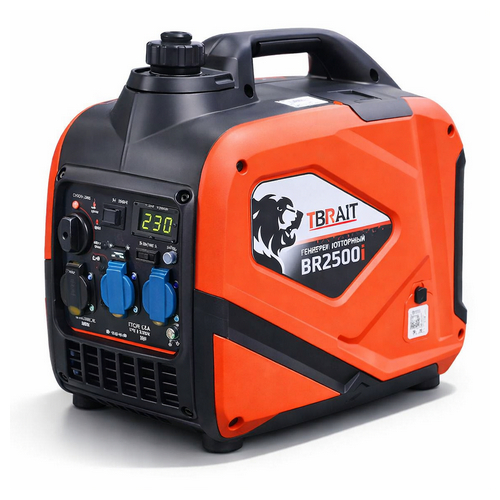
BRAIT BR2500i: Inverter Petrol Generator Review
The BRAIT BR2500i offers an attractive combination: approximately 2 kW output, inverter voltage conversion, and a weight of approximately 20 kg. It can be carried to a vehicle without assistance, taken to a country property, or installed near a small workshop. Available power covers not only lighting and phone charging but also a refrigerator, a small pump, or a power tool, provided total load is considered.
The model's main advantage is supply quality. The inverter produces stable voltage with a proper sine waveform, making the BR2500i particularly interesting as backup power for electronics. A conventional petrol generator of comparable output often costs less, but an inverter generator can vary engine speed with load. At low consumption, this reduces noise and petrol use.
Nevertheless, the BR2500i remains a petrol generating set with all the associated requirements. It needs fuel, engine oil, periodic maintenance, and a suitable operating location. A compact housing does not eliminate exhaust gases, and an inverter arrangement does not silence the engine. Understanding what to expect and where convenience must be sacrificed is particularly important.
Output: How Much Can Be Connected?
There is some confusion over the BR2500i output designation. Figures of 1.8-2 kW sustained load and 2-2.2 kW maximum output appear for this model. When selecting loads, approximately 2 kW is therefore a sensible reference, with the exact limit checked against the individual unit's marking. Maximum output should be treated as a brief reserve.
This output comfortably covers lighting, a television, laptop, router, and chargers. Their combined consumption is generally substantially below one kilowatt. A refrigerator can also be connected, but compressor starting must be considered: the brief starting load substantially exceeds steady consumption.
A 2 kW kettle or heater is different. One such appliance can occupy almost the entire available power budget. Adding a refrigerator, pump, or tool becomes risky. Simultaneous motor starts are particularly problematic: several loads may require more power than the generator can briefly deliver.
In my view, the BR2500i is best used at a continuous load of approximately 1-1.5 kW, leaving a reserve for brief consumption changes. This is technically appropriate for a small air-cooled generating set. Hours of operation directly at the output limit increase thermal stress on the engine and electronics.
.Inverter and Economy Mode
In a conventional generator, output frequency is directly linked to engine speed. To obtain the required 50 Hz, the engine must maintain a particular speed. In the BRAIT BR2500i, electrical energy passes through an inverter converter that produces output voltage at the specified frequency.
This allows engine speed changes without corresponding changes in socket supply frequency. It is a substantial advantage for sensitive electronics. Computers, modern televisions, and devices with switch-mode power supplies receive more predictable power. However, sine waveform quality alone does not guarantee compatibility with every appliance.
ECO mode uses this inverter characteristic. At low load, engine speed falls, reducing fuel consumption and mechanical noise. If the generator supplies several lamps, a television, and chargers, there is no need to keep the engine at elevated speed.
However, an important detail applies. When a powerful load is suddenly connected, the engine must accelerate and the inverter must provide a brief output increase. If a compressor, pump, or another motor with high starting current begins operating, economy mode may impair starting conditions. Normal operation at higher speed is preferable for such loads.
Inverter control implements a sensible principle here: fuel consumption should correspond to the work performed. The essential point is not to expect ECO to increase maximum output. Economy and the ability to withstand demanding starts do not always coincide.
Compact Housing and Engine
The BR2500i uses a single-cylinder four-stroke petrol engine with a displacement of 79.7 cm3. Cooling is forced-air, and fuel flows to the carburettor by gravity. Ignition is electronic, of the transistor T.C.I. type. The relatively simple design benefits mechanical maintenance.
A plastic enclosure covers the engine and generating assembly. This shields internal components from accidental contact and partly attenuates noise. Rubber dampers reduce vibration transmitted to the base. These are useful provisions for a portable model that may be placed on a hard floor or outdoors beside a country house.
Dimensions are approximately 540x340x505 mm, and unpackaged weight is approximately 20.1 kg. A carrying handle is provided, so loading into a car or moving a short distance is generally straightforward. However, twenty kilograms remain twenty kilograms. Wheels would be more convenient for frequent movement around a property.
The enclosed cover requires unobstructed space around ventilation openings. The engine and inverter produce heat that must escape. Position the generator on a level, stable outdoor site with rain protection and adequate ventilation. Operation in living spaces, garages, basements, and other enclosed or partly enclosed locations is dangerous because of carbon monoxide.
The specified noise level of approximately 65 dB is attractive, but should not be regarded as constant loudness at every load. Noise depends on engine speed, distance, and measurement conditions. In economy mode, the BR2500i is noticeably less intrusive than at full output. It will still be audible near a rest area. Appropriate positioning at a safe distance and a correctly selected cable are the best noise-control measures.
.Control Panel: Essential Functions within Reach
The BRAIT BR2500i mainly uses mechanical switches. This is a good choice for a petrol generator. During cold starts or gloved operation, conventional controls are more convenient than touch panels and complex menus, which provide little benefit in this equipment.
Load connections include two 220 V AC sockets and a 12 V low-voltage output. The panel has output voltage, overload, and low-oil indicators, a protection reset button, and economy mode control. An earth terminal is provided. The 12 V circuit has separate protection.
A useful feature is the hour meter. A petrol engine requires maintenance according to actual operating time rather than calendar age. The generator may remain unused for a month, then accumulate several dozen hours during outages. The meter enables timely oil changes and scheduled checks.
Two sockets are convenient for separate loads but do not increase total output. If a heater is connected to one and a power tool to the other, the generator is unaffected by the number of sockets used. It responds to the combined electrical load.
The 12 V output is useful for suitable low-voltage equipment, but its purpose and permissible current require separate consideration. When working with batteries, follow the connection arrangement specified for the particular generator version. A DC connector does not make the station a universal intelligent charger.
Engine Starting and Load Operation
The BR2500i starts with a manual recoil starter. The basic version has no battery-powered electric starter. This reduces cost and weight and avoids starter battery maintenance. However, every start requires using the cord, which is not convenient for everyone, particularly in winter.
Add engine oil and petrol before the first start. The four-stroke engine uses unmixed RON-92 petrol; mixing it with oil is unnecessary. Lubrication uses a separate crankcase space. SAE 10W-40 oil with a quality class meeting engine requirements is suitable, with ambient temperature considered.
The subsequent sequence is conventional for carburetted equipment: open the fuel supply, set the choke for cold starting, switch on ignition, and pull the starter handle. After starting, gradually move the choke to its operating position and allow the engine to warm. Connect electrical loads after operation stabilises.
Before stopping, disconnect loads and allow the engine to run briefly without load. For prolonged storage, it is also advisable to consume the carburettor fuel according to the prescribed shutdown procedure. Stale petrol can leave deposits in jets, making starting a separate maintenance task after several months of inactivity.
Automatic protections are also provided. Under overload, the inverter may disconnect voltage to the sockets. After the cause is removed, operation is restored with the reset button. Low-oil protection stops the engine or prevents starting. Following an unexpected stop, first check oil level and indicators before suspecting a serious fault.
.Fuel Tank and Operating Duration
The fuel tank holds 5.6 L, a moderate reserve for this output class. It helps keep weight reasonable but requires regular refuelling during extended backup supply.
Fuel consumption depends primarily on electrical load and engine speed. For the BR2500i, approximate guidance is 0.77 L/h at about 75% load and up to 0.96 L/h at full load. These are calculated guidelines, not guaranteed values for every condition. At these rates, a full tank theoretically lasts approximately 6-7 hours; under light load, economy mode can extend operating time.
For a country property requiring several hours of refrigeration, lighting, and communications, this duration is acceptable. For round-the-clock household supply, the tank is relatively small. Fuel level must be monitored, and the unit stopped for refuelling. Petrol must not be added to a running or hot generator.
Remember that an inverter generator's efficiency is particularly beneficial under variable load. If it continuously delivers nearly its maximum 2 kW, fuel savings against a good conventional generator become less pronounced. Engine speed and noise also rise.
Maintenance: Compactness Has a Cost
The principal operating compromise of the enclosed housing is engine access. The protective cover looks tidy, but some procedures require opening service panels. This is particularly noticeable when checking and changing oil. The filler neck has limited space, so a small funnel and suitable used-oil container are useful.
In my view, convenient oil access should be a primary design requirement for a four-stroke appliance. Oil is changed regularly, particularly after running-in. A complicated procedure with an awkward plug increases the likelihood of postponed maintenance. Insufficient lubrication is far more dangerous to a small high-speed engine than a few extra operating minutes.
Oil quantity depends on crankcase capacity and filler neck level. For the BR2500i, it is approximately 0.35-0.4 L, but the final quantity must be checked against engine version and the level mark. Overfilling is as undesirable as underfilling. Before the first start after purchase, always check oil presence: the generator may be transported with an empty crankcase.
The air filter also requires attention. It becomes dirty faster on dusty sites, and restricted airflow affects fuel mixture preparation. Periodically inspect the spark plug, fuel hoses, connections, and fasteners. The engine uses F6TC, F7TC, or equivalent spark plugs.
Carburettor fuelling is simple and repairable but sensitive to contamination and prolonged petrol storage. Some units may experience fuel system connection leaks. A petrol smell or signs of leakage require immediate shutdown and correction. Inspect hoses particularly carefully after transport and prolonged storage.
The plastic housing also requires careful handling. It protects components and reduces noise, but heavy impacts, poor transport restraint, or excessive fastener tightening can damage panels. This matters for equipment frequently carried in a boot alongside tools.
.Household Backup and Boiler Compatibility
The BR2500i inverter design makes it interesting for supplying a gas boiler, circulation pump, refrigerator, and networking equipment, particularly when maintaining heating and basic household conveniences during an outage.
However, a proper sine wave addresses only part of the task. Some gas boilers monitor phase and neutral, while portable generators may have an isolated or floating output neutral. A boiler that operates normally from household mains therefore does not always start when connected directly to a generator.
The connection to household wiring must be selected according to the earthing arrangement, boiler requirements, and protective devices. A backup input requires a changeover switch preventing simultaneous connection to the external mains supply. A qualified electrician should arrange this connection. An improvised connection through an ordinary socket creates a dangerous backfeeding risk.
Uninterruptible power supplies deserve separate attention. Not every UPS responds equally to a small petrol generator. Beyond waveform, compatibility depends on frequency, stability under load, and the UPS input monitoring algorithm. This is particularly noticeable when powerful loads are suddenly connected.
The BR2500i is underpowered as a permanent station for an entire country house. An electric cooker, water heater, several powerful heaters, or a large pump quickly exhaust available output. For a separate backup circuit with lighting, communications, heating controls, and a refrigerator, its capabilities are more convincing.
Package Contents and Selecting the Correct Version
The basic BR2500i package includes the assembled generator and operating manual. Additional accessories, including a spark plug spanner, funnel, cables, or adapters, must be confirmed for the specific delivery. Oil and fuel must always be provided separately.
Another important selection detail is that BRAIT offers similarly named BR2500i, BR2500iO, and BR2500iOL generators. The final letters matter. Versions exist with open frames and different tank capacities, weights, and layouts. Comparing them solely by the number 2500 would be incorrect.
For the enclosed BR2500i, product code 02.01.105.100 is one reference. Check the factory plate designation, control panel equipment, output, and main engine parameters when purchasing. This is particularly important online, where similar-looking versions are sometimes grouped in one listing.
Assessment: A Good Option for a Sensible Load
The BRAIT BR2500i is a small backup source well matched to its purpose. Its inverter arrangement, economy mode, enclosed housing, hour meter, and two sockets make it convenient for trips and periodic outages. Weight of approximately 20 kg avoids the need for a permanent location and specialised transport equipment.
I particularly appreciate the combination of inverter conversion and engine speed adjustment. Supplying low-power electronics does not require consuming petrol and producing noise as though the entire workshop were connected. This is sound engineering with benefits apparent in ordinary household use.
The main limitations are modest output, a 5.6 L tank, and engine maintenance inside an enclosed housing. The manual starter also requires some familiarity. Appliance selection must account for starting currents, while household backup connections require attention to neutral arrangements and electrical protection.
The BR2500i suits a country property, campsite, garage, or backup supply to a few essential loads. Its strength is relatively economical delivery of good-quality electricity to a moderate load. If round-the-clock supply to a large home is required, a more powerful station with a larger tank is preferable. A small engine can provide substantial benefit when its limitations are understood beforehand.
Related articles:
BRAIT BR2500i - Manual, Specifications, and Questions Answered
Warning: Undefined array key 1 in /var/www/u220194/data/base_php/functions/myfunctions_manualika.php on line 495