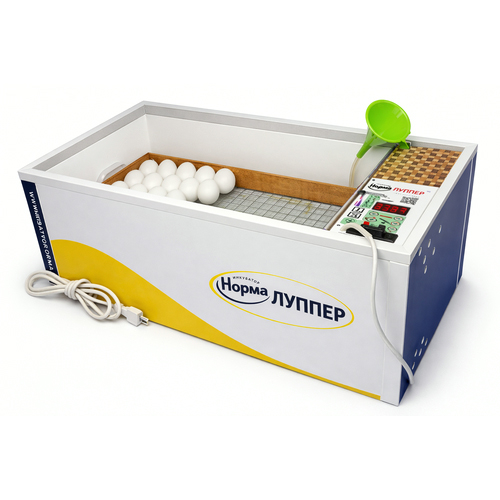
Norma Lupper - Domestic Incubator Review
Model Overview
The Norma Lupper is a household incubator for small-scale poultry keepers seeking to move beyond foam boxes with unstable temperature. Its essential features include electronic heating control, automatic turning, a fan, 12 V battery connection, and approximately 72 chicken egg capacity. At approximately 6.1 kg, it can be repositioned by one person. However, operation is not entirely automatic: it maintains temperature, while humidity and some routine tasks remain manual responsibilities.
Blitz Norma Lupper Design and Operation
The sandwich-panel housing is more practical than bare foam: walls are stiffer, internal surfaces wash more easily after hatching, and the box does not appear disposable. Inside are a turning tray, circulation fan, heater, and water trays, with a transparent lid allowing observation without unnecessary opening. Primary power is 220 V and backup is 12 V, important for rural properties where spring outages are common.
Operation is typical for this class. Temperature is set electronically, the tray changes position automatically, and humidity comes from water evaporation. In theory, this is coherent. In practice, manual tasks determine how convenient the model is. It does not provide automation that allows eggs to be loaded and left unattended for three weeks. Water must be monitored, the damper adjusted to conditions, and the actual microclimate preferably verified with a separate hygrometer, particularly for a first batch or more demanding poultry.
.The Model's Principal Success
The Norma Lupper's strength is combining capacity, backup supply, and simple basic automation without moving sharply into an expensive class. It is an accessible starting point for a small household: one chicken egg batch fits without occupying excessive space or causing concern over every light flicker. When assembly is careful and no adjustment is needed, it produces good results particularly with chicken eggs. It is purchased for effective household hatching without a heavy farm cabinet rather than elegant construction.
The housing and general serviceability are another advantage. After hatching, the unit does not resemble fragile appliance packaging. The chamber can be washed, disinfected, and reused. For several cycles each season, this is a tangible benefit rather than a decorative specification.
Practical Operation
Household users appreciate how quickly the Norma Lupper can be prepared. Switch on, warm up, check turning, add water, perform a trial run, and load eggs. The panel is uncomplicated, the transparent lid supports observation without unnecessary opening, and battery connection reduces concern over unreliable mains power. For a first experience, an unintimidating interface matters.
Details then reveal the equipment class. Humidity needs active adjustment. Some owners find the standard water trays adequate; others buy a separate hygrometer to avoid indirect guessing. Complaints concern awkward water addition, a lid without a proper handle, and fan noise tolerable by day but audible at night. Actual capacity also attracts comments: 72 average-sized eggs may fit, but larger eggs quickly reduce the attractive listed figure.
.The most questionable aspect is uneven chamber conditions in some units. When temperature differences between zones become excessive, routine incubation turns into continuous checking. This explains reports of additional thermometers, damper adjustments, corner monitoring, and other interventions. An experienced poultry keeper may tolerate this inconvenience; a beginner faces unnecessary anxiety.
The Most Frustrating Issues
The principal Norma Lupper criticism concerns inconsistent execution rather than the concept. One unit works through a season without trouble; another immediately prompts modifications. Complaints include flimsy tray elements, imperfect bonding, turning mechanism failures, and questionable component quality. When incubation equipment needs a screwdriver, sealant, and additional monitoring, confidence falls quickly. The cost of error is substantial: an egg batch rather than a merely inconvenient button is involved.
Smaller persistent irritants also exist. Full digital humidity monitoring is absent in the configuration many expect at this price. Water addition is inconvenient. Quail eggs and small bird hatching require attention to tray gaps. Fan noise is irrelevant to some owners and very irritating to others. The model functions, but its imperfections are not merely cosmetic.
Assessment
The Blitz Norma Lupper should be considered a domestic incubator with a good foundation and inconsistent execution. It suits one substantial household batch where 12 V operation matters and manual humidity monitoring is acceptable. With careful setup and no manufacturing surprises, it can produce good chicken egg results. It is less suitable for buyers wanting complete automation without adjustments, additional thermometers, or the risk of a temperamental unit. The owner retains control of the process, while the equipment removes the most demanding part of the work; maximum convenience is not its priority.
Related articles:
Norma Lupper Incubator FAQ
Nesushka Domestic Incubator User Manual
BARBUS Aquarium Filter User Manual
Motor Sich 100 Milk Separator User Manual
XH-W3001 Temperature Controller User Manual