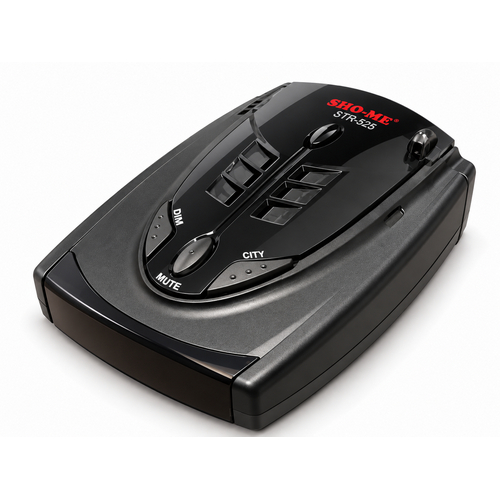
SHO-ME STR-525: Radar Detector Review
The SHO-ME STR-525 has an interesting history. In its day, it was one of the more successful inexpensive radar detectors. It reliably received signals from common police radars, recognised "Strelka", offered clear controls, and cost relatively little. For its time, it was a very sensible purchase.
However, time has passed, and roadside cameras have changed substantially. Today, the STR-525 is more interesting as an inexpensive supplementary receiver of radar emissions. I would no longer rely on it as the sole source of road enforcement warnings. Equally, dismissing it solely because of its age would be incorrect. Its radio-frequency section has substantial capabilities.
Why the STR-525 Was Once Considered Successful
The device is based on a double-conversion superheterodyne receiver with a horn antenna. This is a conventional but proven design for a compact automotive radar detector. It receives X-band (10.525 GHz), K-band (24.150 GHz), Ka-band (34.700 GHz), and Ku-band (13.450 GHz) signals. Short-pulse detection and dedicated recognition of the "Strelka-ST" system are provided.
Its performance with "Strelka" was one of the model's principal advantages. Early radar detectors often struggled to recognise its distinctive signal, so a dedicated detection algorithm provided a noticeable benefit.
In comparative tests conducted in 2013-2014, the STR-525 detected "Strelka" from approximately 1200 m and "Kordon", "Kris", and "Binar" radars from approximately 1700 m. These were excellent results at the time. Naturally, these distances apply to specific test conditions: radar positioning, terrain, emission direction, and obstacles can substantially alter warning range.
The important point is that the STR-525 radio receiver was designed for substantive performance. Even now, a functioning unit can detect certain active radars operating in its supported bands. However, these radars represent only part of modern speed enforcement equipment.
.Three Operating Modes, One Requiring Particular Caution
Sensitivity is controlled through the City button. "Highway", "City 1", and "City 2" modes are available. At first glance, this is familiar: maximum receiver sensitivity outside urban areas and fewer false warnings in the city.
However, the STR-525 City modes take a fairly decisive approach. "City 1" disables the Ka and Ku bands while retaining K, X, "Strelka", and laser reception. This combination can be reasonable for urban driving.
"City 2" is quite different. It disables all ordinary radar bands. Only "Strelka" detection and the laser receiver remain active. If another K-band speed meter is nearby, no warning will be given.
This is a significant characteristic to understand before driving. Pressing the button is easy; establishing exactly what the device has stopped receiving is harder without the manual. I would reserve "City 2" for exceptional circumstances where the nature of road enforcement is known beforehand.
There is another unusual detail. The Ka band is disabled by default and requires holding the Mute button to enable it. This setting is not retained after power is switched off. If Ka is actually required, it must be activated every time the device starts. Other main settings, including the selected operating mode and display brightness, are retained.
Well-Designed Audible Alerts
When a signal is detected, the STR-525 identifies the corresponding band through sound and LED indication. The display shows X, Ku, K, and Ka designations, a dedicated CT indicator for "Strelka", the selected City mode, and received signal strength.
There is no full screen showing distance to a camera. The device does not know camera coordinates or calculate distance using GPS. Changes in signal strength provide only an approximate indication of approaching a radio source. With weak or reflected signals, this estimate can be misleading.
Volume adjustment is well implemented. A conventional wheel on the side panel also incorporates the power switch. Turning it selects the required sound level. A separate Mute button quickly silences an alert.
Automatic muting is also provided: five seconds after signal reception begins, volume decreases by 50%. The warning then continues more quietly for a period. This is a useful detail. Constant loud beeping in dense urban traffic can become more tiring than the journey itself.
The Dark button selects three display settings: normal brightness, dimmed brightness, and a dark mode in which the display illuminates only when signals are detected. The latter is particularly convenient at night. Bright LEDs near the windscreen can be more distracting than they appear during daytime.
False Alarms: The Cost of Sensitivity
The main everyday complaint about the SHO-ME STR-525 is frequent warnings about unrelated signals. Automatic doors at shops and filling stations, certain driver assistance systems, and other radio sources can trigger alerts, particularly in the K band.
This does not necessarily indicate a fault. The receiver detects a signal in the relevant band but cannot always determine its origin. Modern signature processing distinguishes characteristic speed meter signals from interference much more accurately. The STR-525 lacks this advanced filtering.
A more restrictive City mode can of course be selected. However, this creates an undesirable compromise: along with interference, the device stops receiving some genuine radars. Reducing the number of beeps is easy. Retaining comprehensive detection is more difficult.
There is also a psychological factor. When a device warns too frequently, the driver gradually stops responding to every signal. Eventually, a warning may be genuine. Excessive sensitivity without effective filtering becomes a disadvantage in this respect.
.The Laser Receiver and Cameras the STR-525 Cannot Detect
The laser receiver covers wavelengths of 800-1100 nm. Omnidirectional reception is specified, meaning the ability to detect laser signals from different directions. This is technically useful, but should not be relied upon as dependable protection against laser speed measurement equipment.
A laser beam is relatively narrow, and speed measurement can occur very quickly. If the beam strikes the vehicle directly, the warning often arrives while measurement is already taking place. In comparative STR-525 tests, laser detection was also noticeably weaker than ordinary radar reception. I therefore regard the laser sensor primarily as an additional capability.
The model's most significant problem, however, lies elsewhere: it has no GPS receiver or camera coordinate database.
This is natural for an older radio-frequency detector. It detects emissions from an operating speed meter. If a camera monitors a public transport lane, a stop-line crossing, or average speed between two points, there is often simply nothing to detect. Such systems can operate without emissions that the STR-525 can recognise.
"Avtodoria" provides a particularly clear example. Speed is determined from the time taken to travel between cameras. An ordinary radio receiver is ineffective here. An alert system with current enforcement point coordinates is required.
Consequently, even a functioning, sensitive STR-525 may now pass an active camera in complete silence. This is not a failure; its capabilities are simply insufficient for that task.
Housing, Mounting, and Power Supply
The device is fairly compact: approximately 106 mm long, 67 mm wide, and 32 mm high. It weighs 115 g. The plastic housing has rounded edges and a raised central section on its top panel. It looks somewhat dated, but there are no serious ergonomic objections. The buttons are on top, and the volume wheel is on the side.
The standard package includes a windscreen bracket with suction cups, a cigarette lighter power lead, and hook-and-loop fasteners for alternative dashboard mounting.
The suction cups and bracket are less satisfactory. Prolonged use can bring problems retaining the device on the glass and play in the latch. For equipment continuously exposed to vibration, this detail matters. A loose detector starts shaking and may gradually slip off its mount.
Fortunately, the device is light and can be mounted on the dashboard. In this position, the receiving antenna must face forward, the housing must remain horizontal, and the sensors need an unobstructed view. Metal components and certain windscreen coatings can impair reception.
Power comes from a 12-15 V vehicle supply. Nominal current consumption is approximately 150 mA, with a maximum of 300 mA. There is no built-in battery for independent operation. When external power is disconnected, the device switches off.
For permanent use, the cable needs careful routing along the windscreen and dashboard. If the device will be removed frequently, inspect the power connector and bracket latch beforehand, particularly when purchasing a used unit.
The specified operating temperature range is -20 to +70 degrees. This is substantial, but the detector housing can become very hot in a vehicle left in summer sunshine. Given the model's age, I would avoid leaving it in direct sunlight unnecessarily.
.What to Check before Purchasing a Used STR-525
The model is sufficiently old that the condition of the individual unit now matters more than its original reputation. A tidy exterior says nothing about receiver sensitivity.
Begin with the power supply. When switched on, the STR-525 performs a self-test with light and sound signals. If power is absent, check the cigarette lighter plug, cable, fuse, and side power wheel. These faults are generally easier to resolve than damage within the receiver circuit.
Next, check the buttons, City mode selection, audible alerts, and all brightness settings. The self-test confirms operation of part of the electronics and indicators, but does not prove the device actually detects radar.
The essential check is therefore reception from a known active radar source. If the device previously detected a particular system reliably but no longer responds, the cause may be a receiver fault or changed operating conditions. A self-diagnostic signal alone is insufficient.
Another important consideration is the presence of the original cable and mount. If the power adapter, suction cups, and bracket must be purchased separately, the saving on an old device quickly loses its value.
Does Purchasing the SHO-ME STR-525 Make Sense Today?
Everything depends on price and intended use. If the STR-525 is offered very cheaply, is fully functional, and a navigation system with an updatable database already provides fixed-camera warnings, the purchase makes some sense. The device can additionally report active radars whose emissions it is able to receive.
However, I would not recommend purchasing it as the main radar detector for modern roads. The lack of GPS, outdated interference filtering, and limited recognition of newer systems substantially restrict its usefulness.
For comparison, consider the more modern SHO-ME G-525 Signature. It provides GPS alerts with an updatable camera database, voice warnings, and signal signature processing. This is a fundamentally different equipment level. Similar names can be misleading, but the STR-525 and G-525 Signature are different devices.
If the price difference is small, I would choose a modern model with GPS and signature filtering without hesitation. The additional cost purchases specific capabilities: warnings about non-radar cameras, fewer false signals, and updated road enforcement information.
Assessment: A Good Older Model, with Purchasing Qualifications
The SHO-ME STR-525 earned its reputation. Its sensitive receiver, dedicated "Strelka" detection, convenient volume wheel, automatic sound muting, and simple controls are all well implemented. Even years later, it is clear why drivers appreciated the device.
However, settings can no longer overcome its principal shortcoming. Modern cameras do not always emit a recognisable radio signal, while the STR-525 can warn only about what its own antenna and laser sensor receive. False alarms and ageing mount problems add to this limitation.
My verdict: purchase only at a low price, in working condition, and as a supplement to navigation equipment with a current camera database. For independent use, a modern GPS-equipped radar detector is preferable. If an old STR-525 costs almost as much as a new model with an updatable database, there is no reason to purchase it. It was good in its time, but time has continued to advance.