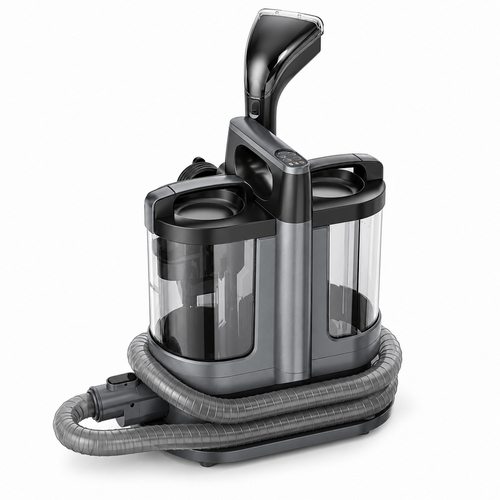
Takara SVC-22: Review of a Wet and Dry Vacuum Cleaner with Steam
A wet and dry vacuum cleaner, steam cleaner, and household deep cleaning machine, all in the Takara SVC-22: an appealing proposition. This is particularly true when a sofa is overdue for cleaning, armchairs bear food marks, and the car has fabric seats. Buying a separate machine for each task is expensive, and all the machines also require storage.
Versatility is precisely what makes the SVC-22 attractive. The appliance can deliver liquid, collect dirty water, and treat surfaces with steam. These capabilities are useful when employed regularly. However, combining several functions in one housing does not mean each is implemented equally well.
I would primarily consider the Takara a household appliance for periodic upholstery cleaning and localised dirt removal. It is interesting for this work. Purchasing it for professional deep cleaning, extensive treatment of large carpets, or continuous floor washing raises substantial questions.
What the SVC-22 Can Do and Why It Uses Steam
The appliance's central concept is to combine several cleaning methods. Dry suction removes loose dust and debris. During wet treatment, cleaning solution helps separate dirt from fibres, and the suction system retrieves the liquid. Steam softens certain types of dirt and treats surfaces that tolerate heating.
This combination is useful for fabric upholstery. For example, a chair seat can first be vacuumed, treated with a suitable cleaning agent, and then have the solution extracted together with the dirt. Where an ordinary brush merely spreads a stain, extraction can provide more thorough cleaning.
Steam broadens the capabilities, particularly on hard surfaces and dirt affected by heat. However, it requires caution on upholstered furniture. Not all fabrics tolerate high temperatures, and some fillings, adhesive joints, and decorative finishes react poorly to heat and moisture.
The presence of a steam cleaner therefore does not justify treating every surface indiscriminately. First check the furniture manufacturer's recommendations and test the chosen method on an inconspicuous area.
.1900 W Sounds Powerful: What Does It Deliver?
The Takara SVC-22 specifications list 1900 W power consumption and 215 W suction power. These are impressive figures, but their distinction must be understood.
1900 W describes the appliance's electrical load. Given the presence of a steam generator, a substantial proportion of the energy may be used to heat water. High power consumption alone says nothing about how effectively the nozzle extracts moisture from upholstery.
For a wet and dry vacuum cleaner, the combination of vacuum pressure, airflow, and working nozzle design matters considerably more. A good attachment should fit closely against the fabric and collect liquid evenly. Otherwise, repeated passes will be necessary, and the upholstery will remain excessively damp after cleaning.
The specified 215 W of suction power appears reasonable, but comparison with other manufacturers is difficult without information about the measurement method. Independent instrumental measurements specifically for the SVC-22 are also insufficient for a confident conclusion.
There are isolated complaints about weak suction and excessive liquid delivery. Successful cleaning of fabric chairs has also been reported, although water spraying prompted comments in that case too. There is currently too little information to regard these characteristics as common to all units. Nevertheless, checking the sprayer and water collection immediately after purchase is advisable.
The noise information is unusual. One commercial listing describes the appliance as quiet at 50 dB, while the detailed specifications state 85 dB. The difference is enormous. Without a proper measurement in a defined operating mode, I would not expect quiet cleaning.
Numerous Attachments: Will They All Be Useful?
The SVC-22 accessory package is one reason to consider it. The list includes a steam brush, fabric attachment, glass brush, large and small round brushes, angled nozzle, adapter, and complete hose assembly. A system self-cleaning cap is also provided.
Each accessory has a specific task. The fabric attachment is used on upholstery, round brushes help clean accessible hard surfaces, and the angled nozzle targets areas difficult to reach with a wide brush. Glass surfaces require a separate approach, particularly when using steam.
A broad selection is beneficial if the attachments install easily, lock securely, and do not leak at their connections. Joint reliability is particularly important in a design combining steam and suction. Hot water accidentally reaching hands or furniture is undesirable.
The few complaints about the SVC-22 include a report of a delivered unit with a damaged attachment fitting. This may be an isolated manufacturing defect or shipping damage. Nevertheless, the locking mechanisms deserve inspection before the appliance is first switched on.
There is another consideration. Although the SVC-22 is also positioned for wet floor cleaning, the published accessory list does not clearly identify a dedicated wide floor washing attachment. The package appears more convincing for a sofa than for regular room cleaning. I would verify the actual accessories before purchasing.
.Cable, Housing, and Minor Everyday Inconveniences
According to the specifications, the Takara SVC-22 weighs 4.85 kg and its housing measures 34.5 x 25 x 40 cm. This is a relatively compact appliance that can be stored in a cupboard or utility room. However, the hose, cable, and attachment set add to the housing dimensions and require their own storage space.
The 4.5 m mains cable is adequate for cleaning an individual sofa or several armchairs near a socket. Power supply is more complicated when cleaning a vehicle interior: a suitable nearby socket or an extension lead rated for the corresponding load will be required.
There is no battery. For an appliance with a steam generator, this is a sensible decision: mains power avoids limited operating time and the need to charge a heavy battery. However, movement is not unrestricted. Both cable and hose must be considered.
Correct handling is particularly important for a device containing liquid. Before moving it, ensure the reservoirs are properly fitted, lids are closed, and the hose will not catch on furniture. The permitted housing tilt and operating requirements with a filled tank must follow the manual.
Containers, Cleaning, and After-Use Maintenance
The least interesting part of household deep cleaning begins after the sofa is clean. Dirty water must be emptied, containers, attachments, and the hose rinsed, and everything allowed to dry. This is particularly easy to forget when the appliance is used infrequently.
The SVC-22 specifications state a 1.25 L dust container, although another listing gives 0.7 L. It is not always clear whether these refer to the same reservoir or different water containers. The figures require clarification. For wet cleaning equipment, clean and dirty water tank capacities should ideally be known separately.
A small reservoir requires more frequent emptying when cleaning a large sofa or carpet. This is not a critical problem, but repeated interruptions substantially reduce the convenience of a versatile appliance.
A useful supplied accessory is the system self-cleaning cap, intended for maintaining the water circuit. This is a welcome feature: detergent and dirt residues inside the hose can eventually cause unpleasant odours and blockages.
However, self-cleaning does not replace proper maintenance. After use, dirty water should preferably be drained immediately, accessible containers and attachments rinsed, and all components thoroughly dried, particularly if the vacuum cleaner will be stored for several weeks.
Spare parts are a separate issue. Before purchasing, check whether replacement seals, attachments, hoses, and filter elements specifically for the SVC-22 are available. Brand service support does not guarantee that every damaged accessory can quickly be purchased separately. This matters more than might initially appear for an appliance with several water connections.
.A Versatile Takara or a Dedicated Spray Extraction Cleaner?
The closest alternatives to the SVC-22 are compact upholstery extractors such as the Karcher SE 3 Compact Home and SE 3 Compact Home Floor. Their primary purpose is to apply cleaning solution to textile surfaces and retrieve the dirty liquid.
The Karcher SE 3 Compact Home Floor consumes 500 W, with a 1.7 L clean water tank and a 2.9 L dirty water tank. A system rinsing function is provided. This model has no steam generator, but its design focuses directly on wet cleaning, and the corresponding versions include floor and upholstery attachments.
Directly comparing 500 and 1900 W is meaningless: the appliances use energy for different tasks. Consider the result, water delivery system design, accessory availability, and repairability.
The Takara retains a substantial argument in its favour: steam. For buyers who regularly need to clean various hard surfaces as well as textiles, this versatility may be more useful than narrow specialisation. However, if the main requirement is effective moisture extraction from thick sofa filling, I would prefer an appliance designed primarily for that purpose.
A third option is to purchase a simple extractor and perform steam treatment with a separate device. This takes more space, but makes each machine easier to select for a specific task and to replace independently.
When Purchasing the SVC-22 Makes Sense
The main argument for the Takara SVC-22 is its combination of wet cleaning and steam in one relatively compact housing. If the household includes several armchairs, fabric chairs, and a vehicle with upholstery, while suitable hard surfaces also require periodic steam treatment, the appliance may see substantial use.
However, the price should reflect the degree of uncertainty. Independent testing and long-term reliability observations for the SVC-22 remain insufficient, and some published specifications contradict one another. Given these circumstances, purchasing is reasonable at a substantial discount compared with a proven dedicated extractor, from a seller offering clear warranty terms.
I would check three aspects particularly carefully:
- Suction system operation and the moisture remaining in fabric after several passes.
- Uniform liquid spraying, steam delivery, and leak-tight connections.
- The complete attachment set, proper locking mechanism operation, and replacement accessory availability.
If furniture cleaning is the primary concern, assess the additional steam generator realistically. It does not automatically shorten upholstery drying time or guarantee removal of old stains. Good results still require a suitable cleaning agent, correct technique, and sufficiently strong moisture extraction.
Verdict: An Interesting Concept, but Purchase with Caution
The Takara SVC-22 is worth considering if one appliance is required for several cleaning methods, the steam function will actually be used, and the price is substantially lower than that of more established alternatives. Its capabilities appear promising for localised cleaning of furniture, chairs, and vehicle upholstery.
I would not purchase the SVC-22 as the principal wet cleaning vacuum for a large home. Too much depends on attachment design and actual water collection efficiency, and convincing information remains insufficient. For frequent, thorough textile cleaning, a dedicated extractor with known tank capacities, available spare parts, and clear maintenance arrangements is preferable.
The resulting assessment is reserved: purchase at a substantial discount and with the opportunity to test the appliance immediately after delivery. Paying a premium solely for promised versatility makes little sense. The Takara SVC-22 offers many useful capabilities on paper, but their implementation determines its ultimate value. Greater certainty is needed in this respect.
Related articles:
Takara SVC-22 FAQ