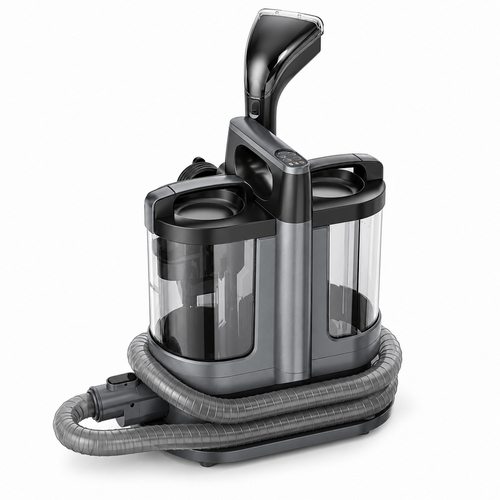
Frequently asked questions about the Takara SVC-22 wet and dry vacuum cleaner
- Intended use and principal functions
- Construction, package contents, and attachments
- Preparation for operation and use of cleaning agents
- Operating modes and controls
- Cleaning furniture, carpets, and textile items
- Cleaning hard surfaces and glass
- Maintenance, self-cleaning, and storage
- Faults and diagnostic checks
- Spare parts and compatibility
- Takara SVC-22 technical specifications
Intended use and principal functions
What is the Takara SVC-22 wet and dry vacuum cleaner designed for?
Takara SVC-22 is a domestic wet and dry vacuum cleaner with a steam cleaning function, designed for dry vacuuming, wet cleaning, liquid collection, and deep cleaning of various surfaces. The appliance is also identified as TAKARA SVC-22, Takara SVC 22, and a "6 in 1 wet and dry vacuum cleaner for deep cleaning."
The principal applications are:
- Cleaning sofas, armchairs, chairs, and other upholstered furniture.
- Removing contamination from carpets, flatwoven rugs, and carpet runners.
- Wet cleaning mattresses and textile upholstery.
- Collecting liquid from suitable surfaces.
- Cleaning hard floors, ceramic tiles, and grout joints.
- Cleaning windows, mirrors, and glass surfaces.
- Refreshing fabrics with steam, including curtains while hanging.
- Removing pet hair and contamination from household textile items.
Interchangeable attachments are used for different tasks. When selecting a mode, consider the material's resistance to moisture and heat.
Which functions are combined in the appliance?
The vacuum cleaner combines suction, water delivery, application of cleaning formulation, and hot steam treatment. For wet cleaning, liquid is applied to the contaminated surface and then drawn into the collection reservoir together with the dissolved contamination.
Operation with cold and heated water is provided. A dedicated cleaning agent stored in a separate container can be used for deep cleaning. Steam mode is intended to soften contamination, clean areas that are difficult to access, and refresh fabrics.
The ability to use all functions simultaneously depends on the attachment installed. Some steam accessories operate without recovery suction for the liquid.
.How does wet cleaning differ from conventional dry vacuuming?
During dry vacuuming, the appliance collects dust, pet hair, and other debris by suction. During wet cleaning, the surface is additionally wetted with water or cleaning solution, after which the contaminated liquid is extracted from the material.
For upholstery and carpets, wet cleaning is particularly useful for contamination that has penetrated between the fibers. Water is applied through the liquid delivery system and recovered through the cleaning attachment and suction hose.
Removing dry debris beforehand reduces the amount of dust that would otherwise become wet during subsequent treatment.
Can the vacuum cleaner be used to collect spilled water?
Yes. Takara SVC-22 supports liquid collection. Water is drawn through a suitable cleaning attachment and hose into the collection container.
Automatic shutdown is provided when the dirty water tank is full. After this protection activates, stop cleaning, disconnect the appliance from the mains supply, and empty the reservoir.
Use an attachment that supports suction when collecting liquid. Steam brushes connected through an adapter without a water recovery passage are unsuitable for this task.
Is Takara SVC-22 suitable for professional deep cleaning?
The model is a domestic wet and dry vacuum cleaner and can be used for independent deep cleaning of furniture, carpets, and other textile items. Cleaning agent delivery and water recovery suction make it suitable for periodic deep cleaning.
Performance during prolonged operation depends on water consumption, reservoir capacities, attachment condition, and liquid extraction efficiency. Cleaning large carpets may require repeated water refilling and emptying of the collection container.
The continuous-duty capability and certain specifications required to assess professional use have not been established.
Can the steam cleaner be used for disinfection?
Steam treatment is primarily intended to soften contamination and clean surfaces. Its effect on bacteria and other microorganisms depends on the temperature at the material itself, the exposure time, and the properties of the treated surface.
No confirmed test results for disinfection effectiveness are available for SVC-22. Steam use alone therefore does not guarantee complete disinfection.
Construction, package contents, and attachments
What is included with Takara SVC-22?
The package includes the main unit, a removable hose assembly, six cleaning attachments, an adapter, and a self-cleaning accessory.
- Main vacuum cleaner unit.
- Flexible hose assembly.
- Fabric brush.
- Glass brush.
- Steam brush.
- Small round brush.
- Large round brush.
- Angled attachment.
- Attachment adapter.
- System self-cleaning cap.
- Operating manual.
The six cleaning attachments correspond to the quantity stated in the specifications: 6 items. The adapter and self-cleaning cap are additional accessories.
.What tasks are the different attachments intended for?
The application of each attachment depends on the surface type and the required cleaning action:
- Fabric brush - cleaning upholstered furniture, fabric upholstery, carpets, and other suitable textile surfaces.
- Glass brush - cleaning windows, mirrors, and glass coverings.
- Steam brush - applying hot steam to contaminated areas.
- Small round brush - localized mechanical cleaning of small areas and deposits.
- Large round brush - cleaning larger surfaces with additional mechanical action.
- Angled attachment - cleaning joints, recesses, narrow areas, and grout joints.
The adapter is used to connect compatible cleaning accessories. The stated applications, including pet hair removal and cleaning dust, floors, and mattresses, do not imply that a separate dedicated attachment is supplied for each task.
Is water extracted when steam attachments are connected through the adapter?
Some steam attachments connected through the adapter provide steam treatment without extraction of contaminated liquid. In this configuration, steam reaches the surface, but water is not recovered into the vacuum cleaner.
The material may therefore remain wet after treatment. To remove moisture, fit an attachment with a suction passage and make a separate pass.
Simultaneous steam generation and suction have not been confirmed for every individual attachment. When selecting an accessory, distinguish steam cleaning from wet spray-extraction cleaning.
Which reservoirs are provided, and what are their capacities?
The design uses containers for clean water, cleaning agent, and collection of contaminated liquid. Values of 1.25 L for the water reservoir and 0.7 L for the dust container are given for Takara SVC-22.
Another specification identifies the dust container capacity as 1.25 L. This discrepancy prevents unambiguous determination of each container's capacity without checking the markings on the particular appliance.
Clean water and cleaning agent are stored separately. The chemical formulation compartment may be incorporated into the overall clean water tank assembly while retaining a separate volume for the agent.
What filtration system is installed in the vacuum cleaner?
Takara SVC-22 has a container-type dust collector and a water filtration system identified as an aquafilter. The specifications also mention a standard filter.
One specification states that a separate fine filter is not provided. The presence of a HEPA filter of a particular class has not been confirmed; maintenance should therefore be based on the filter elements actually installed in the individual unit.
Filter condition and correct seating are important for normal airflow and suction system operation.
How are the hose and interchangeable attachments secured?
The vacuum cleaner uses a removable flexible hose and a spring-loaded latch for interchangeable attachments. The suction tube is described as flexible and made of plastic.
To connect the hose, insert it into the corresponding socket until it is fully seated and latched. The cleaning attachment is secured by a spring-loaded button.
The plastic projections on the locking button require careful handling. If the retaining components are damaged, the attachment may not remain in its working position.
.Which controls and indicators are provided?
Takara SVC-22 provides controls on the handle. A button or trigger for water and steam delivery is located there. An LED display is also included in the feature list.
Switching the operating functions selects the corresponding treatment method: suction, water delivery, or steam. Pressing the trigger starts liquid or steam delivery according to the selected mode.
The complete functions of the display indicators, all control buttons, and their combinations have not been established. Consult the manual supplied with the appliance for the specific symbols.
Can the vacuum cleaner be moved during cleaning?
Yes. The Takara SVC-22 main unit is mounted on wheels and moves across the floor while the hose is in use.
Power is supplied from the 220 V mains through a 4.5 m cable. The actual working area also depends on the hose length and socket locations. In some apartments, the cable was long enough to clean every room without changing sockets; however, the size and layout of those apartments are not specified.
The model has no battery-powered operating mode.
Preparation for operation and use of cleaning agents
How should Takara SVC-22 be prepared for first use?
Before the first cleaning session, check the condition of the reservoirs, hose, cleaning attachment, and retaining components. After assembly, test the appliance's principal functions in sequence.
- Inspect the housing, mains cable, reservoirs, and their plastic latches.
- Check that the required filter elements are correctly installed.
- Install the containers in their designated positions, making sure they are firmly seated.
- Connect the hose to the main unit until the latch engages.
- Fit a suitable cleaning attachment and check that the spring-loaded button retains it.
- Fill the clean water reservoir without exceeding the permissible level.
- If necessary, prepare the separate cleaning agent compartment.
- Connect the appliance to the mains supply and check suction.
- Test cold water delivery and spray uniformity.
- Check water heating and steam delivery, allowing for the possibility of hot water being discharged initially.
- Inspect the underside of the housing and the connections for leaks.
If a damaged latch, leak, or heating malfunction is found, stop further testing and disconnect the appliance from the mains supply.
How can the hose be connected if it does not reach the latch?
The hose must enter the socket far enough for the latch to engage fully. If a small gap remains between the mating parts, first check the locking button position and correct alignment of the connectors.
In one case, the hose stopped approximately 1 mm short of the locking point even with the button fully depressed. The connection latched after reinsertion, but the cause of the initial difficulty remained unknown.
During assembly, obtain a secure connection without excessive force that could damage the plastic latch. Operating with an unsecured hose may result in loss of sealing and disruption of water delivery.
What cleaning agent may be added to the vacuum cleaner?
A dedicated deep cleaning agent may be used with Takara SVC-22. The cleaning formulation is placed in the separate chemical reservoir, while clean water is placed in its corresponding container.
When selecting an agent, consider its compatibility with wet and dry vacuum cleaners and the material being treated. A specific list of approved formulations, permissible foaming characteristics, and precise solution concentrations for SVC-22 have not been established.
Prepare the agent using the dosage specified by its manufacturer and the requirements of the vacuum cleaner manual. Before cleaning furniture, test the formulation on a small inconspicuous area of upholstery.
.Can clean water be used without a chemical cleaning agent?
Yes. Takara SVC-22 can be used for wet cleaning with water alone, without adding a cleaning formulation.
This method was used to clean a carpet after preliminary dry vacuuming, and to clean a baby stroller. In both cases, water delivery and subsequent extraction were performed without a chemical agent.
This may be sufficient for contamination that is readily removed with water. Greasy and deeply ingrained stains may require pretreatment with a suitable cleaning formulation.
How can cleaning agent consumption be controlled?
Agent consumption depends on how long the liquid delivery trigger is held and on the characteristics of the dosing system.
In one case, approximately 3 minutes of continuous delivery reduced the formulation level in its separate container by 3-4 cm. Since the container's shape and dimensions are unknown, this reduction cannot be converted into a precise volume.
For economical application of solution, treat the surface in individual sections and release the trigger between passes. After applying the agent, extract the liquid using the appropriate attachment.
The presence of a separate reservoir does not establish that the concentration of the delivered solution can be adjusted precisely.
Operating modes and controls
How does cold and hot water delivery operate?
The vacuum cleaner provides water delivery for wet cleaning, including a heated mode. Liquid reaches the cleaning attachment when the corresponding function is activated and the trigger is held.
During testing of one unit, hot water reached approximately 50 °C after the delivery button had been held for 20-25 seconds. This is an approximate value for that particular appliance, rather than a confirmed stable temperature under all operating conditions.
Spray intensity may differ between modes and individual units. Insufficient delivery of both cold and heated water has been reported despite the other functions remaining operational.
How is steam activated, and why may hot water be discharged first?
When steam mode is selected, hot water may initially emerge from the attachment before steam appears. On some units, the delivery button had to be held for a period before a steam flow formed.
Operating sequence:
- Check that water is present and the reservoir is correctly installed.
- Fit an attachment intended for steam treatment.
- Select the corresponding operating mode.
- Direct the attachment at a surface that can withstand hot water and steam.
- Activate delivery and wait for steam flow to appear.
- Treat the material while observing its temperature limitations.
In one observation, the behavior resembled hot water mode, for which a period of 20-25 seconds was stated. The precise time until steam emerges depends on the actual operation of the heating assembly.
If only warm water continues to emerge after waiting and no steam forms, the appliance must be checked for a fault.
.What steam temperature does Takara SVC-22 provide?
A specified steam temperature of 110 °C appears in the appliance's specifications and descriptions. Estimates of the actual outlet temperature differed between units.
- 110 °C - the specified steam temperature.
- Approximately 50 °C - the estimated heated water temperature after holding the button for 20-25 seconds on one unit.
- No more than 40 °C - the estimated outlet flow temperature on an individual unit with inadequate heating.
The measurement conditions, instruments used, and distances from the nozzle have not been established in these cases. The values refer to different modes and conditions and therefore cannot be directly compared as a single specification.
On correctly functioning units, the steam function produced noticeable heating. However, the heating assembly temperature and the steam temperature at the actual cleaning surface may differ.
Is steam delivered continuously?
The steam delivery pattern depends on the heating assembly and water delivery system. Some units delivered steam intermittently: a short discharge was followed by a pause before the next discharge.
Neither the pause duration nor the steam volume per cycle was measured. This behavior limits convenience during prolonged intensive steam cleaning, although wet cleaning and suction may remain operational.
If steam does not appear at all, or only warm water flows continuously instead, the heating and liquid delivery systems require diagnosis.
How does automatic shutdown operate when the tank is full?
Takara SVC-22 switches off automatically when the dirty water reservoir is full. Activation of the overfill protection has been confirmed during use of several units.
After shutdown:
- Stop water and cleaning agent delivery.
- Disconnect the vacuum cleaner from the mains supply.
- Remove the collection container.
- Empty the collected dirty water.
- Reinstall the reservoir and secure it correctly.
- Resume cleaning after checking the connections.
The tank may fill repeatedly during prolonged carpet cleaning. Emptying frequency depends on the quantity of liquid applied and recovered.
How much noise does the vacuum cleaner produce?
Two substantially different noise levels appear in the Takara SVC-22 specifications: 50 and 85 dB. The value of 50 dB has also been included in the appliance's full commercial name.
Assessments of operating noise varied during use. In one case, the noise was slightly lower than that of a conventional Samsung domestic vacuum cleaner of unknown model. Other cases described a very loud and unpleasant sound.
The measurement conditions for the 50 and 85 dB levels have not been established. Neither value can therefore be regarded as a guaranteed noise level in every operating mode.
Cleaning furniture, carpets, and textile items
How should a sofa, armchair, or upholstered chairs be cleaned?
Wet cleaning of upholstered furniture uses the fabric attachment to apply water or cleaning solution and subsequently extract the contaminated liquid.
- Remove dry debris, dust, and pet hair from the upholstery.
- Check that the fabric and dye tolerate moisture, the cleaning formulation, and the expected temperature exposure.
- If necessary, pretreat contaminated areas with a suitable deep cleaning agent.
- Leave the agent to act for the dwell time specified in its instructions.
- Fit the washing attachment and apply water or cleaning solution.
- Press the cleaning attachment firmly against the material and collect the contaminated liquid.
- If chemicals were used, rinse the area with clean water and extract the moisture again.
- Make additional suction passes to reduce residual moisture in the upholstery.
When heavily soiled chairs were cleaned, a suitable grease-removing agent was applied beforehand and left to soak. Subsequent rinsing and water extraction removed noticeable contamination.
Deep cleaning of an old upholstered armchair produced heavily contaminated dark water. After treatment, the upholstery felt almost dry to the touch.
.Must the attachment be pressed firmly to remove water from upholstery?
For effective liquid extraction, the washing attachment must contact the fabric closely. During cleaning of a kitchen chair, considerable physical effort was required to recover moisture fully.
Close contact promotes airflow through the wetted area. If a gap remains between the attachment and the upholstery, some air enters from outside, and water extraction from the fabric may become less effective.
Attachment pressure should be matched to the strength and resilience of the upholstery to avoid damaging the material or plastic mounting.
How should a carpet or flatwoven rug be cleaned with the appliance?
Two principal wet cleaning methods are used for carpets: rinsing with clean water and cleaning after preliminary application of a suitable cleaning agent.
Cleaning procedure:
- First collect dry dust, pet hair, and debris. A conventional vacuum cleaner may be used for this purpose.
- Check that the particular carpet covering permits wet cleaning.
- If necessary, apply a dedicated carpet cleaning formulation.
- Treat the surface with the washing attachment using water.
- Collect the contaminated liquid with successive passes.
- Repeat treatment of the most heavily soiled areas if necessary.
- Allow the covering to dry completely.
On one carpet, a satisfactory result was obtained without adding chemicals after preliminary removal of dry debris. In other cases, a cleaning agent was applied beforehand.
Takara SVC-22 has been used to clean a light-colored kitchen rug in a home with a cat and a dog. Wet cleaning removed the accumulated contamination. The result and time required depend on the carpet material, contamination type, and formulation used.
How much water is used when cleaning a large carpet?
Water consumption may be substantial and depends on the covering area, degree of contamination, spray intensity, and number of repeated passes.
When a large flatwoven rug was cleaned, approximately 10 L of water, equivalent to two five-liter containers, was used for roughly half its surface. The rug dimensions and initial condition have not been established, so this value cannot be used as a consumption standard per square meter.
During prolonged cleaning, monitor the clean water reservoir and empty the contaminated liquid tank in good time. Automatic shutdown activates if the collection container becomes full.
Can mattresses be cleaned, and how wet do they remain?
Yes. Takara SVC-22 has been used to clean adult and children's mattresses, as well as sofas and armchairs. Wet cleaning uses a suitable attachment followed by liquid extraction.
Residual moisture after treatment depends on the material's thickness and structure, the quantity of water applied, and the number of suction passes. In some cases, armchair upholstery felt almost dry after deep cleaning, but this result cannot be guaranteed for every mattress.
A mattress must dry completely before further use. The characteristics of its internal filling must be considered, as heavy wetting may be undesirable for some materials.
Can a baby stroller be cleaned?
Takara SVC-22 has been used to clean a baby stroller with plain water and no chemical agent. Water delivery and extraction operated normally in this mode.
When cleaning a stroller, consider the fabric composition and the presence of moisture-sensitive inserts, adhesive joints, and non-removable padded components. After wet cleaning, the materials must dry completely before further use.
.Is steam suitable for curtains hanging from a curtain rod?
The steam function has been used to treat curtains without removing them from the rod. Hot steam refreshed the fabric and partially smoothed the creases.
The result depends on the fabric composition and its response to temperature and moisture. The material type, working distance, and actual temperature during this treatment have not been established.
Before steam treatment, make sure that the fabric manufacturer permits this care method. Accessories operating through the steam adapter without suction leave moisture on the treated material.
How quickly does furniture dry after wet cleaning?
After use of Takara SVC-22, the fabric surface may remain only slightly damp. During cleaning of an old armchair, the upholstery felt almost dry after the contaminated liquid had been extracted. Soiled chairs also dried relatively quickly after presoaking and rinsing.
The precise drying time has not been established. It depends on the upholstery material and thickness, room temperature, ventilation, quantity of solution applied, and suction effectiveness.
Additional passes in moisture extraction mode reduce the amount of residual water. When assessing the result, check both the outer fabric and the possibility of wetting in the inner filling layers.
Cleaning hard surfaces and glass
How should the vacuum cleaner be used to wash floors?
Takara SVC-22 is intended, among other applications, to remove contamination from hard floor coverings. Wet cleaning may be performed after preliminary collection of dust and debris.
Operating sequence:
- Remove dry contamination from the floor.
- Select an attachment and mode suitable for the covering.
- Apply the required quantity of water or an approved cleaning formulation.
- Treat contaminated areas.
- When using an attachment with suction, collect the remaining liquid.
- Allow the surface to dry completely.
The appliance is used to clean kitchens, entrance halls, and other rooms with moisture-resistant coverings. Floor drying speed depends on the amount of water delivered and the operation of the recovery suction system.
For coverings sensitive to moisture or high temperatures, select the mode according to the material manufacturer's requirements.
How are grout joints and areas that are difficult to access cleaned?
The angled attachment is used to clean grout joints. It directs the cleaning action onto the narrow area between tiles where contamination may accumulate.
In practice, ceramic tile joints have been cleaned using the angled attachment with additional mechanical brushing. This method removed contamination from the recesses between tiles.
Round brushes are also suitable for localized mechanical cleaning. When using steam, consider the resistance of grout, sealants, and adjacent materials to high temperatures.
If the selected attachment is installed through an adapter without suction, the remaining water must be removed separately.
How can windows and mirrors be cleaned without streaks?
A dedicated brush is provided for glass surfaces. Takara SVC-22 has been used with this brush to clean windows and mirrors.
In practical use, a surface without noticeable streaks was obtained after several passes. The initial treatment did not produce the required result.
To reduce streaking, control the quantity of liquid and promptly remove contaminated moisture from the glass. The availability of recovery suction depends on the construction of the fitted attachment.
When steam cleaning glass, consider the temperature difference, particularly on cold windowpanes.
.Maintenance, self-cleaning, and storage
How does the Takara SVC-22 self-cleaning system operate?
A dedicated cap for self-cleaning the internal passages is included. Its presence indicates that a system flushing method is provided by the design.
The self-cleaning function was activated during use of some units and appeared to operate normally. However, the precise cap installation sequence, controls used, required water volume, and cycle duration have not been established.
Follow the instructions supplied with the individual appliance when performing this procedure. Self-cleaning does not replace checking steam delivery through the cleaning attachment: cases have been reported in which the self-cleaning cycle operated but no steam emerged from the installed attachment.
What type of water is recommended?
When operating Takara SVC-22, the mineral composition of the water must be considered. A high concentration of hardness salts promotes white deposits in narrow liquid delivery passages.
In one case, mineral deposits blocked a very narrow attachment opening and disrupted spraying. Water delivery was restored after the passage was cleaned.
To reduce the risk of deposits, use low-mineral-content water that meets the appliance manual's requirements. The specific permissible water hardness for SVC-22 has not been established.
How is a blocked water delivery nozzle cleaned?
If water spraying stops, a narrow passage may be blocked by mineral deposits or other contamination.
Initial inspection procedure:
- Disconnect the appliance from the mains supply.
- Wait until heated components have cooled completely and steam delivery has stopped.
- Remove the cleaning attachment if its construction permits.
- Inspect the spray opening for white deposits and foreign particles.
- Carefully clean the accessible nozzle with fine wire or a needle without damaging the edges of the calibrated opening.
- If possible, flush the blocked passage with water without excessive pressure.
- Reassemble the system and check spray uniformity.
In one case, attempting to clear the opening with a needle was unsuccessful. Spraying was restored after the blocked passage was flushed with a water jet from an oral irrigator. This is an individual cleaning experience whose effectiveness depends on the blockage location and attachment design.
During mechanical cleaning, preserve the original spray opening diameter. If the passage cannot be restored without damaging the component, the attachment requires servicing.
.What must be done after wet cleaning?
After operation, disconnect the vacuum cleaner from the mains supply, empty the dirty water reservoir, and clean accessible components that contacted the collected contamination.
Recommended maintenance sequence:
- Stop water and cleaning formulation delivery.
- Disconnect the power supply and wait for heated components to cool.
- Remove the collection reservoir and empty the dirty water.
- Rinse the container and remove accumulated contamination.
- Check the cleaning attachment and accessible liquid delivery openings.
- Clean and dry the filter elements according to their construction.
- Make sure that the reservoirs and connections are free of contamination that could prevent firm seating.
- Allow the accessories to dry before storage.
If necessary, flush the internal passages using the built-in self-cleaning function, the cap, and the procedure specified in the manual.
How should the vacuum cleaner and its attachments be stored?
The Takara SVC-22 housing can be stored upright. The appliance dimensions are 345 × 250 × 400 mm, so storage must allow for a width of 345 mm, depth of 250 mm, and height of 400 mm.
The removable working hose is convenient when preparing the appliance for storage. The housing has wheels and components intended for positioning or securing accessories.
However, in one case, the attachments could not be secured directly to the housing for storage. Separate space may therefore be required for the interchangeable brushes and adapter.
Before prolonged storage, allow the cleaned reservoirs and attachments to dry, and arrange the mains cable without sharp bends.
Faults and diagnostic checks
Why does Takara SVC-22 extract water poorly?
Insufficient suction may be associated with poor seating of the cleaning attachment, filter element condition, the hose connection, or a suction system fault.
For initial diagnosis:
- Check that the hose is fully inserted and secured.
- Make sure that the reservoirs and filters are correctly seated.
- Inspect the airflow path for blockages.
- Check the collection tank fill level and the condition of the overfill protection.
- Fit an attachment for wet cleaning furniture or carpets.
- Press it firmly against a suitable surface and check extraction of the applied water.
- If necessary, test collection of a small quantity of water from a separate container while observing the collection tank's permissible fill level.
Assessing suction at the open hose without an attachment can be misleading. In a wet and dry vacuum cleaner, airflow passes through the hose, filter elements, and water collection system. Operating conditions with the washing attachment installed differ from those during a test at an unobstructed inlet.
The specified suction power is 215 W, but the vacuum pressure generated in pascals has not been established.
.Why does water spray sideways or emerge unevenly?
Irregular spraying may appear as splashing beyond the working area, a weak jet, or complete loss of delivery. This behavior has been observed during cleaning of chairs and other surfaces.
Possible causes include blocked spray openings, restricted water delivery passages, a loose hose connection, and a fault in the delivery assembly.
For inspection, disconnect the appliance and allow it to cool, inspect the nozzle, remove accessible contamination, and check that the hose is correctly connected. After reassembly, the spray pattern can be tested on a suitable surface.
If the opening is clear but water continues to scatter in different directions or delivery remains too weak, the spray attachment, valve, or pump may require inspection.
What should be done if steam is delivered but water does not spray?
The presence of steam without water spraying indicates that the liquid delivery passage requires a separate check.
- Disconnect the appliance from the mains supply and allow it to cool.
- Check the water level and correct reservoir installation.
- Inspect the connection between the hose and main unit.
- Check accessible sections of the connecting hose for blockages.
- Inspect the cleaning brush nozzles.
- If necessary, carefully remove deposits from the accessible opening using fine wire or a needle.
- Refit the accessories and check spraying.
If the passages are clear but water is still not delivered, a valve or pump fault is possible. Further diagnosis is required to determine the precise cause.
Why does warm or hot water emerge from the attachment instead of steam?
During a normal transition to steam mode, hot water may emerge first, followed by steam. Some units required the delivery button to be held for a period.
If no steam appears after waiting, the water remains only slightly warm, or a thin stream emerges instead of a spray, this may indicate inadequate heating, disrupted liquid delivery, or a control assembly fault.
In some cases, the outlet flow temperature was estimated at no more than 40 °C against the specified 110 °C. Measurement conditions are unknown, so this single value cannot identify the faulty component.
If large quantities of water are delivered instead of steam and heating is inadequate, stop using steam mode and have the appliance inspected.
What should be checked if suction is weak and heating is inadequate simultaneously?
If suction is weak and only slightly warm steam is delivered, first check reservoir and filter element installation and the condition of the water delivery system.
Inspection procedure:
- Make sure that all containers are correctly secured.
- Check that the water level is sufficient.
- Inspect the filter elements and accessible air passages.
- Check the hose and cleaning attachment connections.
- Assess suction and the presence of heating in sequence.
If the connections and reservoirs are correctly installed but the functions remain impaired, a fault in the heating assembly or liquid delivery system is possible. The combination of symptoms alone does not establish a specific cause, because the air and water systems perform different tasks.
.What should be done if water, cleaning agent, and steam delivery are all absent?
A complete absence of water and steam delivery requires checking several independent functions. On some units, water heating, steam, and cleaning formulation delivery were all absent simultaneously.
Check that water is present, the containers are correctly installed, the hose is secured, and the control button is in good condition. Then assess the individual liquid delivery modes.
In these cases, the pump, heating element, and control valves were not tested with instruments. A precise cause therefore cannot be established without service diagnosis.
If damage to controls or plastic retaining components is also found, mechanical faults must be considered as well.
Why does steam emerge in short bursts, or why does its pressure seem weak?
Some units delivered steam as a short pulse followed by a pause. Insufficient steam flow intensity for deep removal of contamination has also been reported.
Precise steam pressure, delivery rate, and cycle duration values have not been established. Subjective assessment therefore cannot determine whether the steam generator achieves a particular pressure.
If the mode previously operated normally but its intensity has decreased, check the water level and the condition of accessible passages. Persistent inadequate heating or steam generation requires diagnosis of the heating assembly.
Why does cleaning agent leak from the underside of the housing?
Cleaning formulation leaking through the underside of the housing may be associated with loss of sealing in the chemical reservoir or delivery passage.
In one case, the vacuum cleaner initially operated normally while cleaning a baby stroller with plain water. After the separate chemical compartment was filled, the entire cleaning formulation leaked onto the floor from beneath the housing within approximately 5 minutes of operation. The clean water remained in its reservoir.
This behavior calls for separate inspection of the cleaning agent container and passage connections. The appliance's internal hydraulic circuit has not been established, so the precise damage location cannot be determined without inspection.
If liquid appears beneath an electrical appliance, immediately disconnect it from the mains supply while avoiding contact with wet electrical connections, and stop operation until the fault has been rectified.
Why does water leak from underneath when steam mode is activated?
A leak from the underside of the housing when the steam function starts indicates loss of system sealing. In some cases, water began leaking specifically when steam activation was attempted.
A combination of a lower leak, absent normal steam delivery, and a damaged attachment latch has also been reported. On another unit, a leak was found near the clean water reservoir.
Disconnect the appliance from the mains supply and inspect accessible reservoir seats, container integrity, and visible connections. If water emerges from the enclosed lower housing, a specialist must inspect the internal assemblies.
Do not continue operating an appliance with a leaking housing, particularly while heating is switched on.
.Why does the attachment locking button break?
The spring-loaded locking button uses small plastic projections and latches that can be damaged by mechanical loads.
The following damage has been found on individual units:
- Breakage of one of the button's two plastic latches.
- Damage to projections on both sides of the spring-loaded component.
- Detachment of the small button together with its spring.
- Latch failure on the first day of use.
- Inability to retain the installed attachment securely.
In one case, a damaged button was secured using superglue. The durability of this joint and its reliability during operation have not been confirmed.
If the latch does not retain the attachment, replace or repair the mounting so that normal locking is restored. A secure connection is particularly important during hot water and steam delivery.
What should be done if the water and steam delivery button sticks?
The water and steam delivery button or trigger may stick, making liquid delivery difficult to start or stop. This behavior occurred after approximately three months of use on one unit.
Damage to both the trigger and attachment latch has also been reported before the appliance had entered full use.
For an initial inspection, disconnect the vacuum cleaner from the mains supply, allow it to cool, and inspect the accessible part of the button for mechanical damage or foreign contamination.
If the button fails to return to its original position or sticks during operation, the control mechanism fault must be rectified. Unreliable interruption of delivery is particularly hazardous when working with hot water and steam.
Why is the vacuum cleaner very noisy and weak in suction?
Loud noise combined with weak suction requires inspection of the airflow path, filter elements, hose connection, and correct collection reservoir installation.
Some units exhibited loud operation, weak suction, and irregular water delivery simultaneously. However, the precise cause of this combination of symptoms has not been established.
If operation remains abnormal after accessible components have been checked, the motor and associated assemblies require diagnosis.
The uncertainty of the rated noise level must be considered: values of 50 and 85 dB are reported for this model without confirmed measurement conditions.
How can water delivery, cleaning agent delivery, and suction faults be distinguished?
During diagnosis, it is useful to distinguish three functional liquid flow paths:
- Clean water delivery - water flow from the corresponding reservoir to the working spray nozzle.
- Cleaning agent delivery - movement of the formulation from its separate compartment to the application system.
- Contaminated liquid collection - suction of water through the attachment and hose into the collection container.
If only the chemical formulation leaks while clean water remains in the tank, inspect the cleaning agent delivery path first. If steam operates but water does not spray, the corresponding water passage and nozzles require inspection.
If liquid recovery is insufficient, check the suction system and correct use of the washing attachment instead.
This functional distinction is useful for fault finding, although the detailed internal hydraulic circuit of SVC-22 has not been established.
Spare parts and compatibility
Can additional attachments be purchased for Takara SVC-22?
Original attachments matching the model's mounting system are provided. Compatibility with accessories for other TAKARA models or other manufacturers has not been confirmed.
Information about the sale of additional attachments differs: one report stated that accessories were not sold separately, while another suggested looking for original attachments in the brand's product range.
Specific interchangeable models and connection dimensions have not been established. When selecting an accessory, check the mounting shape, latch, and alignment of the water, steam, and suction passages.
Can the water or cleaning agent reservoir be replaced separately?
Takara SVC-22 reservoirs use quick-release mountings with plastic latches. Damage to retaining projections may impair container seating and result in insufficiently secure mounting.
In one case, the plastic tabs of the tank mounting assembly broke. When a replacement was sought, individual SVC-22 reservoirs were found to be unavailable as separate spare parts from the brand representative.
The availability of compatible reservoirs from other models has not been confirmed. Before replacement, verify an exact match in container geometry, connections, and latches.
Who manufactures Takara SVC-22, and which models belong to the same series?
The stated manufacturer is Shenzhen Dimitson Electronics Co., Ltd., China. TAKARA is identified as a Russian trademark.
Model SVC-22 is included in declaration of conformity RU Д-CN.РА10.В.64485/25 dated 20 November 2025. The product category is electrical household appliances, specifically a "wet and dry vacuum cleaner with steam."
The same declaration lists models SVC-23 - SVC-60. Inclusion in a common document does not establish that their construction, power ratings, attachments, reservoirs, or other specifications are identical.
Takara SVC-22 technical specifications
- Appliance type: domestic wet and dry vacuum cleaner with a steam cleaning function.
- Model: Takara SVC-22.
- Other designations: TAKARA SVC-22, Takara SVC 22.
- Trademark: TAKARA.
- Manufacturer: Shenzhen Dimitson Electronics Co., Ltd.
- Country of manufacture: China.
- Principal functions: dry vacuuming, wet cleaning, liquid collection, cleaning formulation application, water heating, and steam treatment.
- Power consumption: 1900 W.
- Specified suction power: 215 W.
- Suction vacuum pressure: value in Pa not established.
- Power supply: 220 V domestic mains.
- Electrical power source: mains supply.
- Battery power: not provided.
- Mains cable length: 4.5 m.
- Width: 345 mm.
- Depth: 250 mm.
- Height: 400 mm.
- Dimensions: 345 × 250 × 400 mm.
- Mass: 4.85 kg.
- Housing color: black with gray components.
- Construction: compact floor-standing housing on wheels.
- Storage: upright housing position provided.
- Hose: flexible and removable.
- Suction tube: flexible, plastic.
- Working hose length: not established.
- Dust collector: container type.
- Stated dust container capacity: 0.7 L.
- Alternative stated dust container capacity: 1.25 L.
- Stated water reservoir capacity: 1.25 L.
- Cleaning agent reservoir: separate compartment.
- Dirty water reservoir: provided; precise capacity requires verification against its markings.
- Filtration: water filtration system (aquafilter), standard filter.
- HEPA filter of a particular class: presence not confirmed.
- Fine filter: identified as absent in one specification.
- Noise level: 50 or 85 dB in different specifications; measurement conditions not established.
- Specified steam temperature: 110 °C.
- Estimated heated water temperature on one unit: approximately 50 °C after holding the button for 20-25 seconds.
- Outlet flow temperature on an individual unit with inadequate heating: estimated at no more than 40 °C.
- Steam pressure: numerical value not established.
- Cold water delivery: provided.
- Heated water delivery: provided.
- Cleaning agent delivery: provided.
- Number of cleaning attachments: 6.
- Cleaning attachments: fabric brush, glass brush, steam brush, small round brush, large round brush, and angled attachment.
- Additional accessories: attachment adapter and self-cleaning cap.
- Controls: on the handle.
- Liquid and steam delivery: button or trigger on the handle.
- Display: LED.
- Attachment retention: spring-loaded button with plastic retaining components.
- Reservoir mountings: quick-release plastic latches.
- Collection container overfill protection: automatic shutdown.
- Self-cleaning: a dedicated cap is provided for flushing the system.
- Principal materials for treatment: fabric upholstery, carpet coverings, mattresses, glass, mirrors, ceramic tiles, and other suitable surfaces.
- Additional applications: steam treatment of curtains, baby stroller cleaning, and pet hair removal.
- Limitation of steam attachments connected through the adapter: recovery suction for liquid is unavailable in some configurations.
- Declaration of conformity: RU Д-CN.РА10.В.64485/25.
- Declaration date: 20 November 2025.
- Other models listed in the declaration: SVC-23 - SVC-60.
Related articles:
Takara SVC-22 wet and dry vacuum cleaner with steam: review