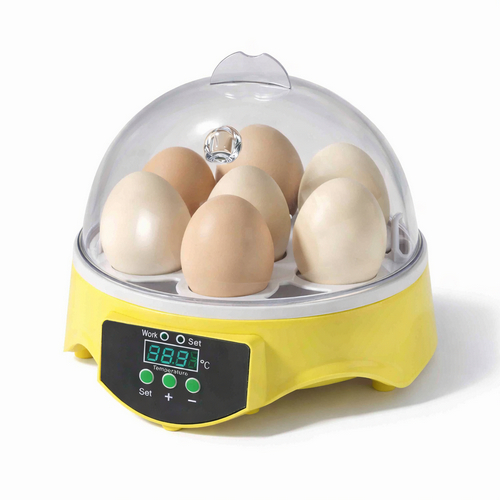
HHD 7 - Mini Egg Incubator Review
Model Purpose and Suitable Applications
The HHD 7 is a very small desktop incubator for 7 eggs. It suits one or two small batches, a home experiment with children, quail hatching, or an inexpensive trial rather than regular farm production. The plastic housing weighs less than a kilogram and occupies approximately the space of a large saucepan. This is its purpose: place it on a table, connect 220 V, set temperature, and observe without a bulky box occupying a large part of the room.
Design
The HHD 7 is simple: a heated base with a water channel, a transparent cover, and eggs arranged circularly on a plastic grid. A digital display shows temperature, maintained automatically. A fan is included, but automation mainly concerns temperature: humidity is not measured, and automatic turning is absent. Eggs require manual turning several times daily, while humidity must be judged from experience or an external hygrometer.
The package is limited but expected for this class: incubator, mains cable, and manual. At approximately 17.5 x 17.5 x 16 cm, it is genuinely miniature. Specified power is 20 W, giving low consumption throughout the cycle without a substantial socket load. The housing washes easily and plastic retains little odour, useful when stored in a cupboard between occasional batches.
.Principal Strength
The HHD 7's most convincing feature is its format. A small chamber warms faster, positioning at home is easy, and beginners can monitor seven eggs more easily than thirty. For a school experiment, first incubation, or a few quail, this is more convenient than a large appliance. Removing the lid exposes the eggs directly, making water top-ups and inspection quick. Its value lies in a compact introduction to incubation rather than any claim to professional performance.
Practical Performance
A successful HHD 7 unit works: it maintains conditions, hatches chicks, requires little familiarisation, and avoids complex controls. Several owners praise generally stable temperature and a successful first hatch for a child or beginner. For a home experiment, this is meaningful. Position it, warm for 15-30 minutes, load eggs, monitor water, and remember turning.
However, the distinction between an inexpensive mini incubator and more dependable equipment soon appears. Much relies on manual monitoring. Opening the lid for turning alters the microclimate each time. There is no built-in humidity sensor, egg candler, or audible guidance. Capacity is not always a comfortable seven eggs either: large eggs may fit tightly, and some users could not position all seven chicken eggs as freely as the listing suggested.
The Most Frustrating Issue
The main HHD 7 complaint occurs too frequently to dismiss as chance: the display reading differs from actual chamber temperature. This is not cosmetic in an incubator. If the display shows 37.5-37.8 while eggs are actually at 39-40 degrees, embryos can overheat. Some owners describe precisely this: acceptable screen readings, an excessive reference thermometer reading, and subsequent batch loss.
Uneven heating is another aspect of the same problem. In the small chamber, it is particularly noticeable: the heater area is hotter, while temperature may fall nearer the fan. The HHD 7 therefore needs external verification almost from day one. Without a separate thermometer and preferably hygrometer, users have little reliable information. This is a weakness for a model frequently purchased by beginners.
.Reliability and Household Shortcomings
The second undesirable issue is individual unit life. Reports mention failure after a few hours, on the fourth day, or after one and a half to two weeks; a popping sound after adding water; fan stoppage; and sudden inability to heat above 35.9-36 degrees. During a long incubation cycle, failure after loading wastes both time and eggs. For a children's experiment, the disappointment is particularly real.
The HHD 7 also has everyday imperfections. Its housing is light and sometimes almost toy-like. Some owners do not mind, while others perceive it as a small plastic appliance without substantial construction. Fan humming is sometimes audible. The term "automatic" can also mislead: essentially only temperature maintenance is automatic. Turning, humidity monitoring, and adjustment against an external thermometer remain human responsibilities.
Suitable and Unsuitable Users
The HHD 7 is worth purchasing in one clear situation: a very compact, inexpensive incubator is needed for an initial trial, with willingness to monitor it using a separate thermometer, turn eggs manually, and accept performance below larger models. It can then provide a first hatch, home experiment, several quail chicks, or an educational demonstration of egg development.
If equipment is required that can be started and checked only occasionally afterwards, this model is unlikely to suit. No automatic turning, no standard humidity monitoring, and temperature accuracy complaints make it demanding for users wanting a predictable cycle. The HHD 7 is interesting for compactness and price, but temperamental: a good unit pleases, while a poor one quickly demonstrates that incubator savings can cost more than the purchase itself.
Related articles:
HHD 7 FAQ
Norma Lupper Incubator Review
Norma Lupper Incubator FAQ
Nesushka Domestic Incubator User Manual
BARBUS Aquarium Filter User Manual
Motor Sich 100 Milk Separator User Manual
XH-W3001 Temperature Controller User Manual